
Major composers' less famous works still enthrall
BC Christian News, · Arts
MANY of the major com-posers have produced worthy sacred works which have lapsed into relative obscurity. The following CDs feature some prime examples.
• Choir of St. John's Church, Elora: Faire is the Heaven, Naxos, 2003.
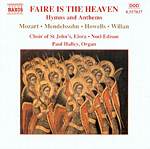 |
Canadian Healey Willan, one of the 20th century's finest Christian composers, spent some 40 years providing original works for Toronto's Church of St. Mary Magdalene. This CD includes four of those pieces, including the ambitious motet Gloria Deo per Immensa Saecula. Other notable works on the album include Herbert Howells' Te Deum; and Ave Verum Corpus, by B.C.'s Imant Raminsh. Mendelssohn also makes an appearance, with Verleih uns Frieden Gnadiglich -- based on an old hymn. The ensemble, from Elora, Ontario, are Canada's only all-professional church choir. They are led by Noel Edison, one of the country's preeminent choral directors.
• Tafelmusik Chamber Choir: Chants Sacres et Profanes, CBC Records, 2003.
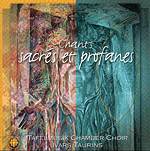 |
Another excellent Canadian choir, under the direction of Ivars Taurins, presents a collection featuring some of the finest French composers. The bulk of the CD spotlights works by 20th century great Francis Poulenc, who had a dramatic spiritual transformation after many years as a lapsed Catholic. In addition to his Exultate Deo, Salve Regina and Ave Verum Corpus, the choir performs four motets on the theme of repentance, and four Christmas motets. The sacred is also celebrated through works by Olivier Messiaen and Gabriel Fauré. The 'profane' -- i.e. secular -- side of life is represented in short works by Camille Saint-Saens and Claude Debussy, focussing on earthly beauty.
• Tallis Chamber Choir: Handel -- Coronation Anthems, Naxos, 2002.
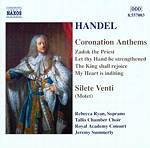 |
The material on this CD was written during the years when George Frideric Handel was best known as an eminent opera composer, well over a decade before he turned his talent to Messiah and other sacred oratorios. The four anthems, composed for the 1727 coronation of King George II, are The King Shall Rejoice, Let Thy Hand Be Strengthened, My Heart is Inditing and the often-performed Zadok the Priest. The main work here, however, is Silete Venti for Soprano and Strings, written three years before. Obviously reflecting the composer's operatic style, this substantial Latin motet invokes the love of Christ and the joys of heaven.
• The Sixteen: Iste Confessor, Coro, 2001.
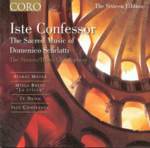 |
Known primarily as an outstanding and prolific composer of keyboard music, 17th century master Domenico Scarlatti also produced a range of sacred choral music. Inclu-ded on this collection are his Te Deum, and a short mass entitled La Stella. The highlight here is Stabat Mater, a major work of stunning polyphony. This portrayal of Mary's an-guish as she watches the crucifixion is, of course, sombre -- but not overly so. The finale is quietly exultant -- with a wonderful rush of voices entreating God to grant paradise to the believer's soul; and the piece ends with an elaborate, extended series of Amens. Impeccable sing-ing by The Sixteen, under director Harry Christophers.
• Helmuth Rilling: Mendelssohn -- Psalm 42 / Dvorak -- Te Deum, Hanssler Classic, 1998.
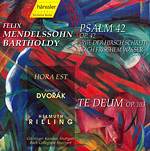 |
Two of the 19th century's giants are showcased to great effect on this CD. Felix Mendelssohn's Psalm 42 has a low key choral opening, which builds in power. There are several outstanding choruses, and the final one is stirring and joyful. Soprano soloist Sibylla Rubens turns in a splendid performance. Antonin Dvorak's Te Deum begins with dramatic drums, followed soon after by a majestic choral passage. Soprano soloist Michaela Kaune is both sweet and tranquil in the 'Sanctus' and 'Dignare Domine'; and bass Peter Mikulas excels in 'Tu Rex Gloriae.' The chorus also shines full throttle in the third movement, 'Te Deum Laudamus'; and the finale is particularly powerful. As usual, Helmuth Rilling's Gachinger Kantorei and Bach-Collegium Stuttgart are out-standing.
• The Parley of Instruments: Monteverdi -- Sacred Vocal Music, Hyperion, 2000.
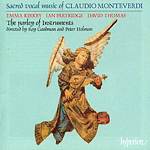 |
Claudio Monteverdi is justly renowned for his masterful 1610 Vespers. His later sacred work, however, tends to remain obscured by that high-profile work. This critically acclaimed 1981 recording -- remastered a few years ago -- draws upon the composer's 1641 collection Selva Morale e Spirituale, and some posthumous works. Confitebor Tibi Domine features an excellent solo by Emma Kirby. Bass baritone David Thomas is very assertive in the Prologue from La Maddalena; and on Ab Aeterno Ordinata Sum, he skillfully negotiates rapid note progressions. There is also fine work from tenor Ian Partridge. The Parley of Instruments, one of the veteran early music ensembles, is directed by Roy Goodman and Peter Holman.
• Choir of St. John's College, Cambridge: Stanford -- Anthems and Services, Naxos, 2003.
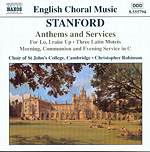 |
Charles Villiers Stanford was well known as a key figure in the development of England's choral scene in the 19th century; he was also known as a teacher of other composers, such as Vaughan Williams and Gustav Holst. However, he was also a major composer of sacred music, as his monumental Stabat Mater clearly demonstrates. This CD focuses on his shorter choral works, composed for Anglican church services. There are two settings of the Magnificat; Stanford's take on the Te Deum and Nunc Dimitis; and three motets in Latin. The most substantial work is a short mass entitled Communion Service in C; notably, the composer ends it with the 'Gloria,' instead of the traditional 'Agnus Dei.'
• Karina Gauvin: Exsultate Jubilate, CBC Records, 2001.
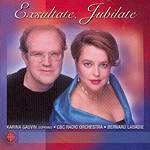 |
The title piece is one of Wolfgang Amadeus Mozart's great works: short but brilliant. The 'Allegro' and 'Alleluia' have delightfully irresistible melodies, and are both familiar as bravura encores in recitals. The com-plete piece is not performed as often; so it's nice to hear the 'Aria' movement for a change. While not as dazzling as the two big hits, it provides a solid grounding for the composition. The album also includes several gentle, melodic and lyrical pieces: Mozart's Kommet Her, ihr Frechen Sunder and Ergo Interest Quaere Superna; and Schubert's Salve Regina and Totus in Corde Langueo. Once again, Gauvin demonstrates that she is one of Canada's finest sopranos.