
Worldwide Anglicans angered by Canadian decision
BC Christian News, · Top Stories
THE ANGLICAN Church of Canada has been roundly condemned by key members of the worldwide Anglican Communion. At issue is the Canadian church's adoption of a resolution affirming 'the integrity and sanctity' of same-sex unions.
"This latest move of the Church of Canada can be neither justified nor supported," stated the Council of Anglican Provinces in Africa (CAPA) shortly after the resolution passed. CAPA further expressed "total and absolute disgust and deepest regret at the unfortunate decision."
Archbishop Gregory Venables of the Southern Cone (South America) maintained that the Canadian decision goes against scripture. "There's nothing in the Bible about the sanctity of same-sex relationships," he said.
"Canada's action merely confirms the sad reality of the fragmentation of the Anglican family."
Charlie Masters, national director of Anglican Essentials -- a coalition of orthodox Canadian Anglicans which worked behind the scenes to encourage delegates to vote from a biblically-sound perspective -- said he sympathizes with the southern primates.
"We share with them their deep rejection of this measure." But he and other leaders in the Essentials movement are urging conservative Anglicans not to leave the church at this point.
"The Essentials movement is committed to continuing as part of the worldwide Anglican Communion," he said.
For Bishop Michael Ingham of New Westminster, who gave permission for blessings a year ago, the decision is a victory. "It's not just persons in the relationship but the relationship itself" that is being affirmed, he said. But affirming is "considerably less than agreeing to bless," he added.
James Wagner, rector of Holy Cross Church in Abbotsford and a member of Essentials, said the motion impinges on both the doctrine and liturgy of the church's doctrine "because sanctity is about God's holiness; liturgy because that word [sanctity] comes up in the prayer for marriage."
Holy Cross, a recent church plant, was shut down by Ingham and is no longer part of the diocese but is associated with the Anglican Church in New Westminster (ACiNW).
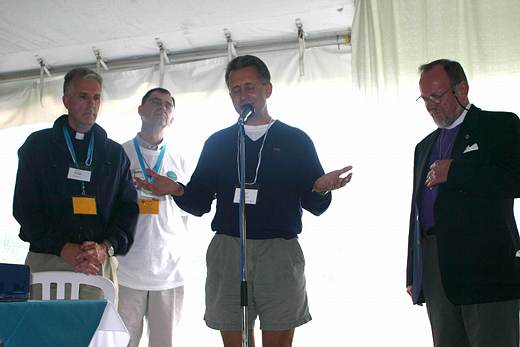
Meeting in St. Catharines, Ontario, the 300 members of General Synod -- which gathers every three years -- passed the last-minute amendment to a motion that called for another three years of study and dialogue before considering the issue of blessing same-sex unions in 2007.
Delegates voted against a proposed change to the wording of the amendment, which would have read to "affirm and love those who are in committed adult same-sex relationships."
Catherine Roberts, 17, a member of the youth delegation, said she proposed the wording because "I thought that this would show that we can love [homosexuals] because I felt that at the moment we don't really show that. I thought that the motion as it was before wasn't quite so acceptable to people."
Following the decision, nine bishops from across the country who were disappointed with the outcome stood before the synod and gave a statement, declaring that "General Synod's opinion is in error and contrary to the teaching of Scripture and the tradition of the undivided Church."
Within hours of the vote, Archbishop Drexel Gomez, Primate of the West Indies, sent a statement to the Essentials coalition, which read: "The attempt to give 'committed adult same-sex relationship' the same theological stature as marriage exacerbates the crisis in the communion and will reap devastating consequences."
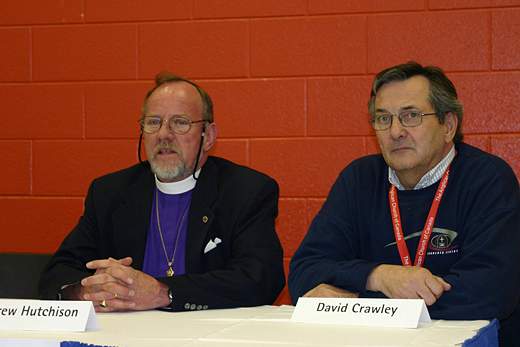
General Synod also voted in a new primate, Archbishop Andrew Hutchison of Montreal, to replace retiring Michael Peers. Hutchison, 65, is thought to be the most liberal of four candidates initially nominated by the House of Bishops.
One of the four, Bishop Victoria Matthews of Edmonton, seen by some as the most likely to be able to hold the Anglican Church of Canada together, withdrew her candidacy a week before Synod began when she was diagnosed with breast cancer.
In a press conference following his election, Hutchison said that although he personally favours blessing same-sex unions, he can't find theological or scriptural basis for marriage between homosexuals.
Asked how he expected to address the issue of unity in a church that is becoming increasingly divided over the interpretation of scripture and other matters, Hutchison said he hopes to remind Canadian Anglicans "of our history of unity in the midst of diversity."
He recalled "passionate discussions" in the past over women's place in the church, even as members of church councils, and suggested it is just a matter of time before the church accepts same-sex blessings.
As for the Anglican Church of Canada's place in the worldwide Anglican Communion, Hutchison described the communion as "an association of independent national churches" which govern their own affairs.
But two of the synod's invited guests expressed concern for the worldwide church, both Anglican and other branches.
Speaking a few days before the motions concerning same-sex unions were presented, Canon Gregory Cameron, secretary to the Lambeth Commission, warned that while the blessings in New Westminster and the consecration of Gene Robinson, a practicing gay man, as bishop of New Hampshire last fall, brought joy to many, they "caused enormous pain" in Pakistan, Uganda, Nigeria and Egypt, "where Christians, and not just Anglicans, but Baptists and Copts and others, have been publicly pilloried and physically attacked, and their homes set on fire, and people physically assaulted."
The Lambeth Commission is expected to produce a report in the fall on how to hold the Anglican Communion together.
Richard Schneider, president of the Canadian Council of Churches and an Orthodox Christian, said decisions on matters of same-sex unions have "serious consequences" in the ecumenical arena.
"The decisions you make are going to be considered doctrinal and church-defining," he said, adding that their results "will be seismic."
Despite the heavy emphasis on motions about same-sex unions, General Synod also included time on its agenda between May 28 and June 4 to hear presentations by Aboriginal Anglicans and a challenge by Stephen Lewis, the UN special envoy for HIV/AIDS in Africa, to respond to "the greatest single threat to the planet."