
I, Robot turns Asimov's original upside-down
BC Christian News, · Arts
 |
 |
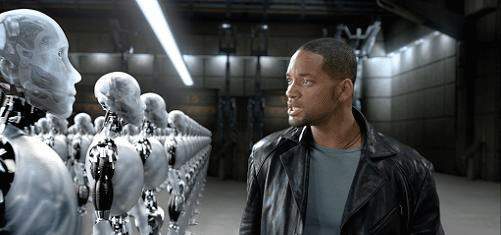
I, ROBOT not only has very little in common with the Isaac Asimov book on which it is very, very loosely based, it also takes one of that book's central messages and stands it completely on its head -- and a part of me couldn't be happier.
The movie, directed by Alex Proyas (whose Dark City was my favorite film of 1998) from a script by Jeff Vintar (Final Fantasy) and Akiva Goldsman (Batman Forever), is a run-of-the-mill special-effects-heavy Will Smith action flick that plays on our fear of robots and the tyranny of logic. In this film, the only good robots -- and no doubt the best people, too -- are the ones that learn to follow their hearts and make illogical decisions.
On the other hand, Asimov's book, a collection of short stories published in 1950, ended on a more utopian note that celebrated the triumph of reason over fear.
Asimov's machines -- being perfectly logical, practically omnipotent, and programmed to prevent the harm of humans -- come to control the world and use their position to prevent us from ever going to war again. (Such ideas were apparently in the air back then: the notion that robots could impose peace on the world was also central to the 1951 film The Day the Earth Stood Still.)
For an atheist like Asimov, such machines no doubt seemed like an improvement on the God of Judeo-Christian belief, who allows people to harm each other for reasons unknown. But I find Asimov's conclusion more chilling than promising.
What if these all-powerful robots changed their programming to permit the harming of humans? What if humans, living in a world of guaranteed comfort and no real suffering, lost the capacity for spiritual growth?
So, naturally, I could not help but smile when it became apparent that the people behind this movie also found Asimov's ideas somewhat nightmarish.
Alas, in order to express this nightmare, they have to make the machines stupid, and the people even stupider. The robots abandon all sense of subtlety, which you might think would be the more logical approach, as they try to prevent Detective Spooner (Will Smith) from exposing the conspiracy that he just knows is there; and the cops and scientists who work with Spooner have a blind faith in the robots that is more than a little naive.
To make matters worse, the action sequences are oddly lifeless. The scene in which a whole phalanx of metal men ambush Spooner's car from a couple of moving vehicles ought to be a kinetic thrill, but it's basically just a puffed-up cartoon, and it shows CGI robots leaping from CGI robot carriers onto a CGI car as it careens all over a CGI tunnel. When the sequence comes to an end and we see Spooner's car grind to a halt, we are jolted by the fact that the car suddenly has a tangible, substantial physicality that it was lacking until now. (The tunnel chase in The Bourne Supremacy is infinitely better, and feels genuinely dangerous.)
And then there is Smith's performance; his occasional sullenness suggests he is itching for another Ali-like chance to prove his acting chops even as he slums his way through another high-tech shoot-'em-up. The result is a film in which the story and the style seem to be at odds with one another. Like the robots in some of Asimov's stories, I, Robot is caught between conflicting impulses, and it ends up paralyzed.
* * *
Remember the 'Bible Collection'? It was a series of TV-movies produced between 1994 and 2002 by an Italian company in conjunction with various international partners. The series' two best-known films were Joseph -- a Turner network film starring Paul Mercurio, Ben Kingsley and Martin Landau which won an Emmy for outstanding mini-series of 1995 -- and Jesus, which starred Jeremy Sisto and Gary Oldman and aired on CBS in 2000.
It turns out the series didn't end there. Two more films were produced and shown overseas, but were not released on video in North America until this year.
Unfortunately, however, both of them are among the weaker entries in this series, partly because they dilute their biblical sources with more fictitious material than any of the other films.
Paul the Apostle, for example, spends an incredible amount of time on a completely made-up Sadducee character whose wife converts to Christianity, and who turns against Paul when Paul becomes a Christian. (And thanks to a bit of nudity on this Sadducee's wedding night, the distributor has asked Christian bookstores to destroy their copies of the film, in anticipation of a new censored version.)
Ample time is also given to Gamaliel, who represents the broad-minded, tolerant branch of the Pharisee movement.
But the life and mission of Paul himself are given very short shrift, and the film is peppered with puzzling and unnecessary historical inaccuracies. The best films based on Acts remain the 1985 mini-series A.D. (for the first half of Acts) and the 1981 TV-movie Peter and Paul, starring Anthony Hopkins (for the second half).
Then there is The Apocalypse, which stars the late Richard Harris as the apostle John. This film is interesting inasmuch as it is one of those very rare movies that tries to depict the visions of Revelation as they are written, without modernizing them or connecting them to specific events in the future.
But this film also throws in a lot of distracting nonsense regarding a Roman spy who has infiltrated a Christian church and fallen in love with one of its women. No nudity, but lots of soap opera.
The 'Bible Collection' has always been a mixed bag, but these two last films are, perhaps, more mixed than most.
* * *
Just a few more random notes.
First, while King Arthur proved to be an eminently forgettable film -- sort of a strange cross between Gladiator and director Antoine Fuqua's earlier film, Tears of the Sun -- it does include one element so odd it almost bears remembering.
In this film's otherwise very formulaic reimagining of the legend, Arthur is a Roman general and a believing Christian who stays behind in Britain when the Romans leave (and marries Guinevere in a pagan ceremony overseen by Merlin) partly because the Catholic church condemned his good friend Pelagius -- that's right, the 5th-century heretic.
Second, shooting has begun in New Zealand on the film adaptation of The Lion, the Witch and the Wardrobe. Due for release by Christmas next year, the film will star Tilda Swinton (Orlando, The Beach) as the White Witch, Dawn French (The Vicar of Dibley) as Mrs Beaver, and the excellent Jim Broadbent (Iris, Moulin Rouge) as Professor Digory Kirke.
Third, The Passion of the Christ comes out on DVD August 31, and the distributor is reportedly selling it to churches in packs of 50. Several publishers are also rushing books on the film to press.
Jesus and Mel Gibson's the Passion of the Christ: The Film, the Gospels and the Claims of History (Continuum), due August 1, seems concerned primarily with the historical issues raised by the film, and includes essays by Jesus Seminar scholars John Dominic Crossan and W. Barnes Tatum, as well as former Trinity Western University professor Craig Evans.
Then, in September, Re-Viewing the Passion: Mel Gibson's Film and Its Critics (Palgrave Macmillan) will look at the film from a broad range of disciplines, including history and media studies; the contributors include Fuller professor Robert K. Johnston and yours truly.
It's my first book -- so of course, it's bound to be a must-read.