
Local Ethiopian church has deep roots
BC Christian News, · International
 |
THE ETHIOPIAN Orthodox Coptic Church has had a presence in the Lower Mainland for the last 10 years. In history, however, the Orthodox Coptic Church in Ethiopia has existed since the 3rd century.
According to the Old Testament, Queen Sheba of Ethiopia -- known as Makeda by the Ethiopians -- heard about the glory of King Solomon, and traveled to Jerusalem to visit him. When she returned to Ethiopia, she was pregnant with King Solomon's son and gave birth to King Menelik I.
King Menelik was the first emperor of the Solomonic dynasty -- which ended in 1974 with the overthrow of the Emperor Haile Selassie.
When Menelik grew up, he traveled to Jerusalem to meet his father King Solomon. When he returned to Ethiopia, King Solomon sent the Ark of the Covenant with him. Menelik in turn sent the Ark to a monastery at Tana Kirkos, where it stayed until King Ezana brought it back to Axum in the 4th century. It is kept there to this day, in a small chapel called Tsion Mariam Church.
The replica of the Ark -- called Tabot -- is kept in all Ethiopian Orthodox Churches -- including the Orthodox Coptic Church of B.C. That is what makes it a holy place.
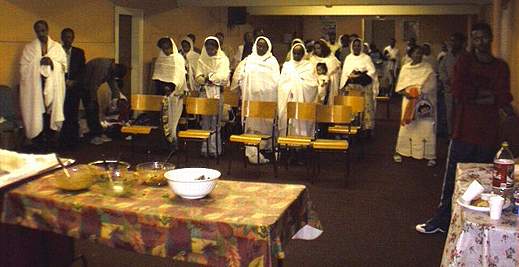
The B.C. church -- located on Kingsway in Burnaby -- has a community of 200 worshippers every Sunday. The service is performed in Amharic and Geez, a liturgical language.
The music in the church is vocal -- at times accompanied by traditional drums known as kebero. Prayers to Saint Mary and the other saints are common in an Orthodox Coptic church.
Unfortunately, the Burnaby church is being forced to move, because their building has been sold to a developer.
"It is sad situation," says the church's general secretary, Teklai Tsegai. "We were growing as a church community, and even planning to build our own church -- and now we have to suddenly vacate."
Aside from worship services, the church conducts activities such as Amharic language classes and children's sports. The church has also sponsored refugees from Russia, Afghanistan, Iraq, Ethiopia, Somalia and Rwanda.
"With the church now sold, everything is up in the air," says Tsegai. "But we do not give up. We are people of faith. We always pray so that can have a worship place of our own, and also so that we can continue with our ministry to the less fortunate and the needy."