
Olympics can test the spirit
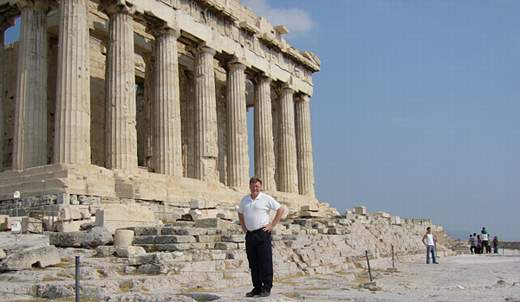
THE OLYMPICS are about strength. Physical strength. Mental strength. Emotional strength.
To many athletes, the source of that strength comes from their spiritual beliefs. That's why, though the Olympics have increasingly come to represent power, prestige and wealth, the games have maintained an official chaplaincy program -- required by the IOC charter -- called "religious services." The program implicitly recognizes a component of many individuals that can't be separated from their involvement -- whether as an athlete or one of a vast army of volunteers -- in the international spectacle.
One of the senior members of that program is David Wells, district superintendent of B.C. and the Yukon for the Pentecostal Assemblies of Canada (PAOC). At the invitation of Olympic officials, Wells is in Athens this month to make sure the chaplaincy program will be fully functional during the games.
The pastor first got involved with the Olympics in 1988 in Calgary -- where he worked as a volunteer with youth, as well as assisting local churches and international chaplains. Since that time, he has been involved in the Commonwealth Games in 1990 in Auckland, 1994 in Victoria and 2002 in Manchester. He also volunteered to help local churches at the 1992 Olympics in Barcelona.
Wells is part of a network of chaplains recognized by the Games organizers. The chaplains have, in a sense, had to prove over time that they are sensitive to the unique cultural environments of the host cities and of the Olympic village itself. If they do, they are invited back. Besides Christian chaplains there are also Jewish, Islamic, Hindu and Buddhist chaplains on site.
Privilege
"Chaplaincy is a special privilege and involvement in it means you live by the parameters set by the Olympics," explains Wells, who says there are plenty of opportunities to minister -- but outright evangelism is not one of them. Greece, where the Greek Orthodox religion is dominant and proselytizing is illegal, is a particularly sensitive environment.
"For every Olympics, there is an understanding that the chaplaincy will happen," Wells told BCCN before leaving for Athens.
"Then you get into the local context and everyone has their own understandings and biases about religious services" -- referring to 'services' as something like food services, rather than gatherings for worship.
Ironically, Wells -- a self-admitted sports junkie -- will be a stone's throw away from the world-class athletic competition, and will likely be too busy to catch even a glimpse of it. Yet, as the games proceed, the chaplains will see first hand how people at the games are affected by the events unfolding around them.
"It's quite fascinating the way things tend to vary according to what is happening in athletic circles at any given time," he says.
"The games are the backdrop, but people are still walking through things in their lives, searching," says the chaplain. Anxiety over personal issues -- whether financial, relational or health-related -- don't stop just because the Olympics dominate a person's life for a few weeks. "Sometimes the games heighten those things."
Wells recalls a Canadian event judge who needed comforting after the death of her father. "It was a tragic time for her, because he always encouraged her involvement in sports and he had encouraged her to come to the games," he recalls.
Wells was able to offer consistent encouragement to the judge, even sitting in the stands on the first day she had to be involved in a competition. The woman and the Wells family are now good friends.
"Chaplains offer an encouraging presence that's needed," says Wells. "People are looking for someone objective . . . That's the thing with chaplains in comparison to team officials, coaches; there's an objectivity that comes with the job."
The fact that Christianity is also a true global community means there are many ways it fits nicely with the Olympics. In previous Olympics, especially those held in Atlanta and Salt Lake City, Christians were involved at many levels.
In those cases, many denominations banded together under one umbrella to do everything from billeting athletes' families in their homes to hosting festivals and performances and handing out food and water.
2010
These volunteer opportunities and many others are likely to be available for the 2010 Vancouver/Whistler Olympics.
For example, as a multicultural city with a long list of vibrant ethnic churches, many Vancouver Christians could serve as translators for the hundreds of languages that are spoken at such a large scale international event, says Tom Cooper, executive director of City in Focus.
"If the past winter Olympics are any indication, there are literally hundreds and hundreds of churches and Christian organizations that represents thousands of Christians that want to help," says Cooper, pointing out that, collectively, those people possess hundreds of God-given gifts and talents that can be tapped into.
Without being presumptuous, Cooper says the community should be available to "appropriately help the Olympic committee when requested," and hopes that a formal partnership between an international umbrella group known as the Global Events Group -- a very experienced organization which has helped Christians assist in several previous Olympic games -- and the Vancouver Whistler Games Partnership, can be formalized later this year.
Kids Games
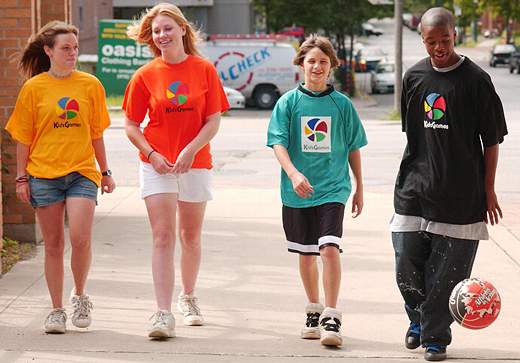
Corresponding with the Athens games, children around the world, including Toronto, will be participating in a popular phenomenon known simply as the Kids Games.
The organization reports that in 2002/2003, some 600,000 kids were involved in 75 countries. The goal is to have three million kids participating in this Olympic year.
Presently, the games coincide with either the Olympics or the World Cup of Soccer.
Though the events are big, the organization itself does not take on the model of a typical ministry. There is no paid staff (or staff raising their own funds) nor a big head office. No money goes to administration.
Instead, the group draws from a remarkably deep pool of talent worldwide that helps each local Christian community put on one of the monster events. Professional sports stars, writers, well-placed PR and business people, organizers and a host of other Christians all voluntarily network to design a high-class, tech-savvy event that combines values-based biblical messages with varying degrees of athletic competition.
The August event in Toronto, which is expected to draw 20,000 kids, held press conferences with Argos' stalwart and future CFL hall-of-famer Mike 'Pinball' Clemmons and NBA star Jerome Williams. Ottawa Senators centreman Mike Fisher agreed to be a part of the games on condition that the group begin organizing a similar event in Ottawa.
Their volunteer media coordinator is Lindsay O'Connor who does the international sports report on the city's biggest sports radio station, the FAN 590.
And though the charitable foundations for Canada's biggest banks wouldn't touch the event because it is 'faith-based,' the Toronto Blue Jays, Rawlings, Mitre, Identi-Cam, Tri-Mark (sports apparel), Kisko Freezies and National Sports all signed on as corporate sponsors. The closing ceremonies will take place at Skydome after a Jays game.
Dan Sinclair, the volunteer head of the Toronto games, compares the event to the average church's vacation Bible school. "This is beyond the reach of your normal VBS stuff. It's like a VBS on steroids."
Sinclair says this year's curriculum has been designed to dovetail with Athens by dealing with Paul's journey through Greece. One day focuses on Paul's shipwreck and the theme of "overcoming." On that day the kids will see a video of Fisher walking around in a T-shirt and shorts talking about God helping him overcome a serious injury. The idea is that the theme will permeate the day, including the athletic competition.
At the end of it all, the Toronto organizing team will hold a briefing day for others interested in hosting a Kids Games. A B.C. contingent, which will include Olympic gold medalist (alpine skiing) and North Vancouver resident Kathy Kreiner-Phillips, hopes to bring a Kids Games to Vancouver in 2006.
Kreiner-Phillips says the games will be a good way to "practice volunteering at a major event" before 2010. "It will also be a good way to practice working across denominational lines . . . We need to practice that."
Kreiner-Phillips, who has attended six Olympic games -- three as a competitor and three as a spectator -- envisions churches helping out in many practical ways as well as hosting events at their venues, such as providing a festive place for people to watch the opening and closing ceremonies in 2010.