
Generous spirit keeps Shizue going
BC Christian News, · Top Stories
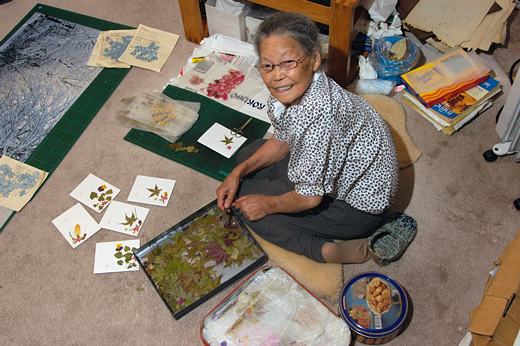
Shizue Naga, 92, truly knows how to say it with flowers.
Though slowed down a bit by a few strokes, she still continues with ikebana, the Japanese art of flower arranging and cards made with pressed flowers.
According to her daughter Misao, the greatest joy in creating her works of art is in giving them away. She has been giving her cards to newcomers at her church and people with birthdays for years; and her church building has been graced with her flower arrangements for decades.
Over the years, her pressed flower artwork has taken numerous ribbons and prizes at the PNE, and she also had a booth at Expo 86 to demonstrate her crafts.
When her husband died in 1967, she began to take classes to develop her skills. She went with a friend who translated for her at John Oliver Secondary School evening classes, and learned to quilt and make fancy pastry. She also went to the Japanese drop-in centre to learn the art of flower arranging.
She also took up jogging -- and at the age of 75, learned to swim. She still swims once a week, and up until her most recent stroke in June used to complete 10 lengths in the medium lane at the local pool.
"She is a very determined person; she received all her swimming badges," Misao says.
In addition, Shizue keeps an extensive diary. Her main outing for the year is her annual birthday trip to Harrison Hot Springs.
Shizue was born in the Wakayama province of Japan near Osaka on May 29, 1912. Though her parents had moved to Canada, she stayed behind and was reared by her grandparents. She married and moved to Canada at age 24.
The couple had a small chicken farm on Strawberry Hill in Delta. When the Second World War broke out, the farm was confiscated. Her husband was sent to a road camp in Revelstoke, but the family moved to Lethbridge to be close by, where they worked at a sugar beet farm.
The family then moved near the Hope Slide area, and stayed there until 1946 -- at which time they were given the choice to move east or go back to Japan.
"Nobody is bitter about that, because nothing was ever said. It was considered that it couldn't be helped because it was the war," Misao said.
The family returned to Japan, and shortly after, her youngest daughter died of malnutrition at eight months old. The family lived in Japan for approximately 10 years, where they eventually had a family of six daughters and one son.
It was at this time that Shizue "found something" spiritual, according to Misao. She is not sure exactly how, but it was during those years in Japan after the war. Whatever it was, she felt it really saved her after all she had been through.
It was determined that life was better in Canada, as things were difficult in Japan following the end of the war. In 1953 they began to send their children back to Canada. Eventually they moved back to Canada in 1961 where they eventually moved to the Lower Mainland.
During more difficult times, the family began to attend the Holy Cross Japanese Canadian Anglican Church, where they still attend today. They are finding great spiritual growth there with their priest, Rev. Dawn McDonald, who has "opened our family's eyes to prayers and the Bible."