
Heard was a prophet on the fringe
BC Christian News, · Arts
 |
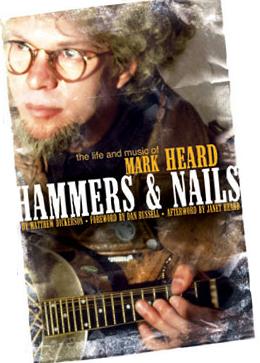
• Matthew Dickerson: Hammers & Nails -- The Life & Music of Mark Heard, Cornerstone Press, 2003.
 |
MARK HEARD was considered by some a prophet on the fringes of the Contemporary Christian Music industry. Throughout his career he was repeatedly abused by the business, and in the final years of his life (Heard died in 1992) he went to pains to avoid being labeled a 'Christian' artist.
Heard asked hard questions and refused to offer pat answers. He saw society as being lost on purpose; rather than pursuing truth, he believed we go to pains to avoid it, fearful of the cost.
He was disturbed by what he perceived as the churches' anti-artistic mind-set, where the individual is all but ignored. He felt that artists -- and their work -- should be celebrated on individual merit, rather than manipulated and employed as propagandists. Heard observed: "How sad to wish a bird would preach rather than sing." Pat Terry explained: "He really, really believed in the value and worth of the individual. He felt like, if you were made in God's image, then in-and-of-itself that was enough. That has worth and value. He always celebrated that. In the Christian community, if you really feel that and believe that to the extent that Mark did -- he really lived it -- then you get beat up."
His ideas were misunderstood by many in the church, and in some cases attacked within the community. He was treated as suspect, and expected to prove time and again that he adhered to the party line. While he abhorred much of what was propagated as church-sanctioned thought, he made it clear that it was the church, and not Christ, with whom he was disappointed.
John Fischer wrote upon Heard's death: "He heard what a lot of other people stopped hearing once they became Christians. He kept hearing the cries of people who forgot their point of origin in the mind of God. Mark never sacrificed the question for the answer, but [chose to] have them both with paradoxical realism."
Heard produced a number of acts, including Vigilantes of Love, whose Bill Malonee recounts a conversation regarding whether to perform at a Christian music festival. Mark advised him to "'Stay as far away from that as you can' . . . In Mark's mind it was all pretty clear . . . On one side of the fence, it was either music about honesty, integ-rity, credibility and passion . . . [and] on the other side, the musically trivializing and dumbing down of the Gospel of Christ (but all for a good paycheck!)"
Rather than a straightforward look at his life, Hammers & Nails collects biographical details, lyrics, ruminations from friends, and samples of Heard's writings on popular culture. You don't need to be a fan to enjoy this book; in fact, the vast majority of potential readers probably have no idea who the man was. But his story needs to be told.