
Faith thriving under the volcano
BC Christian News, · International
 |
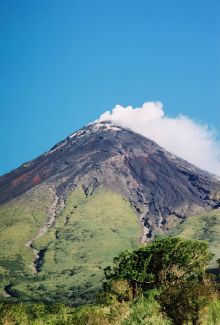
TOWERING 2,460 metres over the fields and jungles of Albay province, Mayon is the most active volcano in the Philippines. With an almost perfect cone, many consider it superior to Japan's Mount Fuji for sheer beauty and presence.
But Mayon is also an unpredictable beast. Twelve out of 47 eruptions since 1616 have been fatal. In 1993, a sudden explosion and subsequent pyroclastic flow killed 68 people in 30 minutes. Sixty thousand were forced to evacuate, including the residents of Amtic, a town nestled at the edge of the six-kilometre permanent danger zone.
During the evacuation (and others before and after), displaced townspeople were subjected to another kind of activity, one that offered hope to lives shattered by catastrophe and fear. Christians shared the gospel with them. Local pastor and IN (International Needs) church planter Nouly Caigas reflects on their experience.
"People in evacuation centres have nothing to do but sit there and worry about their homes and crops being destroyed. There's little hope. When Christians tell them that God still loves them and that there is indeed hope, people are receptive. There's more openness during eruptions."
Some residents returned to Amtic with a newfound faith; and with their assistance, Pastor Nouly restarted a former congregation planted after an earlier eruption. But new eruptions meant new evacuations and more visits to evacuation centres by Christians. Each time more evacuees became believers, prompting Nouly to remark wryly that his church was "being built on calamity! To this day, whenever there's volcanic activity . . . I start thinking, 'Lord, what are you going to do with the people this time?'"
Back in Amtic, local Christians helped neighbours rebuild after eruptions and the occasional typhoon. Returnees and local officials showed gratitude in visible ways, including free use of school facilities for a church youth camp; and a sympathetic mayor provided meals for campers.
Despite the good community relations, Joy Mandrilla, pastor of Community Christian Fellowship, admits that pastoring a church on the slopes of a volcano isn't easy - and that he gets "a little nervous sometimes." I might add "with good reason": when I visited him this summer, volcanic activity was at 'Alert Level 3' - which I understood to mean 'liable to erupt at any moment.'
 |
Pastor Joy believes, however, that God is in control and can protect him, his family and the flock of 35 to 50 attendees. "We just pray to the Lord." While Pastor Joy continues to hold services, his wife Roselle expands Sunday School facilities; and new believers continue to learn the precepts of 'The Purpose-Driven Life.'
Ministry on the slopes of Mayon is never static. In fact, 'extreme church-planting' in high-risk areas by the IN Philippines Network is driven by a passion to expand the church to neglected areas where no one else will go.
Not far from Amtic, the hamlet of Balingang lies two kilometres deeper in the permanent danger zone - and is the first community to be evacuated during eruptions. It is the next target of local IN church planters Pastor Joy and Pastor Caigas.
"The residents of Balingang are very poor; and the work, when available, is seasonal. That means money for food and clothing is scarce; and many people cannot afford to send their children to school, especially high school, because of transportation costs. As is the case in most remote areas, there is also an urgent need for medical attention."
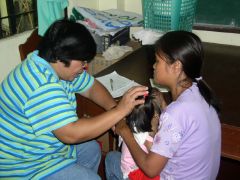
Ministry begins with a medical mission to address immediate health concerns. Then local contact families will help start a Bible study - with the goal of establishing a church in Balingang by the end of 2004.
Pastor Nestor Flores, executive director of IN Philippines, ponders the logic and logistics of ministering to people living in high-risk rural areas - where ash fall, pumice and lava flows are constant dangers. "The people will never leave, because their hearts are here in this rich volcanic soil. Although it's only backyard farming, at least they can maintain their existence here. If you relocate them, they'll be safe from the volcano - but they'll die from hunger. They are here to stay, and we will continue helping them - with a long-term vision that includes providing a livelihood, schooling for their children, libraries and a church."
Meanwhile, back in the valleys surrounding Mayon, interesting road signs appear at narrow curves and dangerous intersections: 'Caution, Accident-Prone Area.' They serve as reminders that this region seems to be one of Nature's unpredictable accidents waiting to happen.
Fortunately for those living on its shifting slopes and surrounding valleys, there are purpose-driven countrymen and women among them - determined to build their lives, churches and communities on The Rock.
John Paulki is the BC/Alberta regional director of IN Network.