
Spiritual questions lurk in Film Fest offerings
BC Christian News, · Arts
 |
CHRISTIAN film buffs looking for explicit treatments of faith may find the pickings a little slimmer than usual at the Vancouver International Film Festival this year, but there are still some films that touch on Christian themes - and of course, fundamentally religious questions are never all that far beneath the surface in most good movies.
By the time you read this, some of these films will have finished their festival runs, but a few will go on to regular theatrical releases; others might come back to the Pacific Cinematheque or on video.
One of this year's more striking films is In Your Hands, the latest film from Denmark made under the auspices of the 'Dogme 95' movement - which emphasizes hand-held cameras, no music unless it is performed on set, and other self-imposed limitations. The film is directed by Annette K. Oleson, whose family dramedy Minor Mishaps was one of my favourites at the festival two years ago; and it stars Ann Eleonora Jorgenson, who was last seen in Italian for Beginners, an offbeat comedy about a pastor who integrates himself into a new community.
In Your Hands, which takes place in a prison for women, is a much tougher sort of film. Jorgenson stars as a newly-minted minister, fresh out of seminary, who is made a chaplain to the prison and whose faith is tested by her contact with the inmates there - one of whom, Kate (Trine Dyrholm), is rumoured to have miraculous healing powers.
Don't worry, this ain't The Green Mile. Olesen makes her films the way British director Mike Leigh does, improvising the story together with the actors and allowing the characters to chart their own paths, without predetermining the ending - and the results can be both moving and a bit distressing. So if this film seems rather bleak, or if it reflects the liberal tendencies in European churches, that isn't a strike against the film. Rather, the film works because it invites us into the characters' authentic experiences, and allows us to make of them what we will.
Time of the Wolf (playing October 5), from director Michael Haneke - whose Code Unknown has become something of a favorite among Christian cinephiles - is an even more challenging film. It concerns a family, led by Isabelle Huppert, that escapes to the country following a cataclysm that has apparently hit the cities. As society has broken down, people form hesitant alliances and separate into rival nomadic tribes.
Haneke make masterful use of depth and darkness; on several occasions, he shows flames flickering delicately way off in the distance. Some of his images are also fairly graphic and hard to stomach, particularly where the death of animals is concerned. But the film raises essential questions regarding what it means to be human, both individually and socially; and in its own way, I think it points to something transcendent in the end.
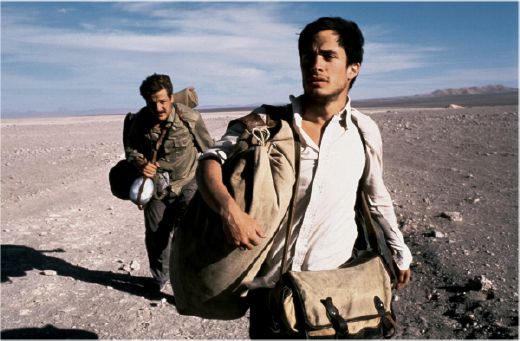
One of the more popular films this year has been The Motorcycle Diaries, directed by Walter Salles, whose earlier film, the redemptive allegory Central Station, gave an interesting glimpse of the state of religion in Brazil. The new film concerns a trip across South America taken by Ernesto 'Che' Guevara and his friend Alberto Granado, before they became key figures in the Marxist revolutions of the 1950s.
There is surprisingly little in the way of explicit politics here, which may reflect what co-star Gael Garcia Bernal has described as the disillusionment with violent revolution among his generation of Latin Americans. If anything, the political injustices Ernesto witnesses are dwarfed by what we might call 'natural' injustices: as a young medical student on his way to a Catholic leper colony, he comes across sick animals, and people crippled by age and afflicted by various diseases. Plus, Ernesto himself suffers, sometimes severely, from asthma.
One of the leprosy victims Ernesto meets tells him, "Life is pain." I could not help but think that Ernesto was brushing up against something of cosmic significance - the incredible beauty of the South American landscape when seen from afar, the many small tragedies that one sees up close - and it seems somewhat pathetic, almost a sign of resignation, that he settled for merely political struggles in his later life.
Then there are the documentaries. Relativity is all about one Toronto woman's effort to make contact with her birth parents, who turn out to be a Mennonite couple. Among other things, director Brenda Kovrig says she wishes she could be a Christian too, just to make her birth mother happy - but, well, she isn't. Although she doesn't spell it out, the question of who chooses our faith for us lingers in the air. Kovrig interviews a number of other people along the way about the nature of genetics, identity, fate, and whether our names shape us; and there is some genuine suspense as we wonder if she will put her birth family on-camera, possibly without getting their permission first.
In a more political vein, Imelda (October 5) takes a fascinating, and at times amusing, look at the former First Lady of the Philippines. Given her obsession with appearances, her financial and legal woes (which may or may not have been entirely her husband's fault), her love of singing, her nutty philosophizing, her intense religiosity, her departure from traditional faith on matters of sexuality, her appeal to drag queens, her capacity for denial, and her Reagan-era downfall, this would make a intriguing double-bill with The Eyes of Tammy Faye.
Other films I had not yet had a chance to see at press time, but which might pique the interest of Christian film buffs, include: The World According to Bush (October 4, 6), which, the program says, goes where Michael Moore feared to tread and "illustrates the part played by the administration's fundamentalist religious beliefs in policy-making"; Shake Hands with the Devil: The Journey of Romeo Dallaire (October 6), which explores the former UN commander's "deeply religious" understanding of the Rwandan genocide; Searching for the Wrong-Eyed Jesus (October 5), an alt-country documentary whose subjects include "a rockabilly mountain priest"; and Irredeemable (October 5, 7), a collection of Canadian short films on sin and attempted salvation.
For scheduling and venue information, contact: Viff.org
* * *
And this just in: Luther, the biopic about the Reformation leader starring Joseph Fiennes (Shakespeare in Love), Alfred Molina (Spider-Man 2) and the late Peter Ustinov (Death on the Nile), will finally be released in Canada October 22. A review will soon appear at CanadianChristianity.com/film.