
Christian artistry: Will that be light or dark?
BC Christian News, · Arts
As executive director of Imago, John Franklin has been both an observer and promoter of biblically-influenced works of art. Here, he examines two very different mainstays of Christian culture.
GENERALLY, I find that artists who have faith in Jesus are not very comfortable using the phrase 'Christian art.'
Someone has said that 'Christian' is a good noun but a poor adjective. What could we possibly mean when we speak of 'Christian art'? We are inclined to think of art with Christian themes, I suppose – art that is obviously Christian in its content. But does that get to the heart of the matter?
Just recently, I was challenged by someone for using the term 'Christian artist.' Now, I would have thought that was safe. A person may be an artist and a Christian at the same time – so surely there should be no offence in saying 'Christian artist.'
Well, the per-son who posed the challenge was a Christian and also an artist, but had little patience for using those two terms together. I asked for some clarification about why 'Christian artist' was unacceptable. The response was that if you use the term 'Christian artist,' everyone will expect the art to be mediocre.
Suffice it to say, there is a lot of baggage around linking the words 'art' and 'Christian.' Many call for a clear separation, while others are keen to see that they come together. In each case, it has to do with what one thinks about art and what one believes is required of a Christian who is gifted in the arts and chooses to take up the task of being an artist – whether music, drama, painting, film-making or dance.
There is a considerable spectrum of work that is thought of in Christian terms. I want to illustrate this by looking at the work of two very different artists.
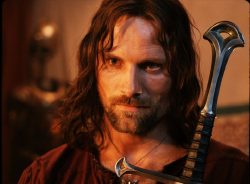 |
In mid-September I had the pleasure of hosting a lecture that looked at the work of J.R.R. Tolkien. On that same weekend, American painter Thomas Kincade was visiting Toronto. Kincade is seen by many as America's (perhaps the world's) most successful visual artist. Success here is determined by annual income.
Kincade galleries generate more than $100 million annually for this artist. I also understand that his images have been reproduced more than 10 million times. Tolkien's work has been considered the greatest literary achievement of the 20th century. His Lord of the Rings trilogy has received a great boost in profile through the recent film series
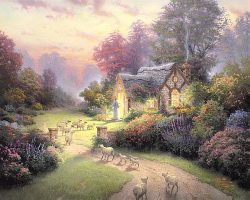
Thomas Kincade's work is commonly criticized by artists within the faith community. They feel he is compromised by depicting a world that is essentially false – and that his work is contrived, seeking only to elicit a pleasant emotion. As a trademark, he has called himself 'The Painter of Light' – a title for which Vermeer or J.M.W. Turner would be more worthy candidates.
Kincade is clear in identifying himself as a Christian and affirming his work as valuable for God's kingdom. However, his paintings have a saccharine quality about them. Everything is pleasant and idealized in his work. Greg Wolfe, in an editorial in the journal Image, addresses the issue of sentimentality in Kincade's work.
 |
He quotes Oscar Wilde, who says: "A sentimentalist is one who desires to have the luxury of an emotion without paying for it." But more significantly, Wolfe observes, "The heart of the problem is that of a misrepresentation of the world, in order to indulge certain emotional states."
The world Kincade depicts is very circumscribed. Nothing of the diversity of the real world – whether economic, racial or cultural – shows up in his paintings. Wolfe quotes Kincade as saying: "I like to portray a world without the Fall."
Wolfe then con-cludes: "To paint a world without the fall is to render Christ superfluous." What I find troubling and unbiblical about Kincade's work is its apparent refusal to see the world as it is.
In the work of J.R.R. Tolkien, one finds something very different. In his great epic The Lord of the Rings, there is a profound struggle between good and evil – a struggle more consistent with how most of us experience life in this complex world.
Tolkien knows how evil works; he is aware of its power in ordinary life. But his story is not without hope. This hope is sometimes strong and resolute, at other times weak and nearly gone – but it is sustained in the face of the great challenges of a darkened world.
There is, of course, nothing explicitly Christian in this grand story. Yet, woven into it, are values and themes which resonate with the biblical story.
There is little sentimentality in Tolkien, but a profound sense that we are called to address the harsh realities of a world in trouble. The path we take offers no promise of pleasant outcomes, but only calls us to faithfulness in carrying out the appointed task – while resisting seduction by the forces of evil.
The art of Tolkien rings truer – and more Christian – than that of Kincade. Ironically, Kincade wants to be thought of as Christian in his art, while Tolkien simply wished to tell a good story.
Tolkien's faith finds its way into the deep issues addressed in the story; while Kincade seems to want to be reassuring, telling us that all is just fine. He offers us a safe place, but leaves us ignorant of the dangers that confront us.
Art done by Christians should, at its best, help us to get at reality – and tell us the whole story, not a truncated version. The temptation to triumphalism should not distract us from the realities of a broken world in need of the transforming work of redemption.