
Promoting evangelical-Orthodox dialogue
BC Christian News, · Top Stories
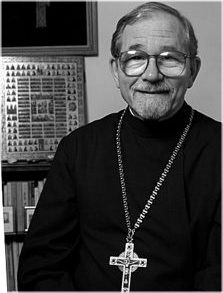 |
FR. THOMAS Hopko may have retired as Dean of St. Vladimir's Seminary in New York, but he still keeps busy. Last month, the prolific author spent nearly three weeks on the road. He visited Vancouver churches; spoke at Regent College, Trinity Western University and InterVarsity Christian Fellowship; and talked to BC Christian News.
BCCN: A lot of people who are involved in evangelical-Orthodox dialogue – such as Fr. Peter Gillquist and Frederica Mathewes-Green – seem to be converts to Orthodoxy, but you are cradle Orthodox. What draws a cradle Orthodox to that sort of discussion?
Thomas Hopko: Well, I think if a person's Orthodox, hopefully whether cradle or convert, you're still very interested in Christian unity and you're very interested in making your witness to what you believe Christianity is – which is, when all is said and done, exegesis of the Bible. And then, of course, I love to go to those settings, because I know these people do respect the scriptures and usually know it, at least formally – and they usually think that we don't! You know, they usually think, "Well, if you're Orthodox, you have traditions and you follow monks and elders and stuff, but you don't really know the scripture." So I like to show them that we do.
There has been a tendency of Orthodox to get away from their biblical roots, but none of the great saints and teachers ever accepted that . . . The Holy Fathers were doing nothing but interpreting the scriptures. All the great theological controversies were about what the Bible taught. So it's wrong to say, "Well, the Protestants have the Bible, but we have holy tradition" – that's just ridiculous. Tradition is nothing other than the Bible properly exegeted and properly applied. That's how we would understand it.
BCCN: What do you think evangelicals see in Orthodoxy that would draw them to it?
TH: Two things. I think one is, evangelicals want a church that takes the Bible seriously as the word of God, but they don't want a church where everybody can interpret it the way they want to, because I think they were frustrated over how many churches there were claiming to really follow the Bible. So they said there has to be some other criterion of exegesis than just picking up the Bible and reading it, with your Scofield commentary or something.
And then they discovered that the early church and the fathers were interpreting the Bible. Then they discovered that there were consensuses of interpretation. Then they discovered that there were whole councils that had battled over exegesis and had come to a common mind, and that there was like a history of exegesis from the time of the apostles that those in a certain church agreed upon, namely the one holy orthodox church.
So I think that they wanted the Bible – they were convinced that the Bible was basic – but they had a problem of how do you interpret it, and how do you maintain the proper interpretation. And then they found that the patristic and Orthodox tradition was doing that, at least in their conviction.
The other big thing is worship. You accept Jesus as your saviour, you believe the Bible is the word of God, but then what do you do? What church do you go to? And I think for fellows like Gillquist, that was their main problem – they said, "We all love Jesus, we all know this is the truth, but how do you worship? Where do you go? What church are you in?" Then they came to the conclusion, if scripture is true, there's got to be a church around somewhere that's consonant with scripture, and then they became convinced it was the Orthodox.
BCCN: Is there anything the Orthodox would find appealing about evangelicalism?
TH: I think – I would hope – that it would go both ways. I don't know if it often does. There was a joke that maybe contains kernels of truth, where it said, "Evangelicals come to Orthodoxy, and we teach them how to be orthodox, and they teach us how to be Christians." [laughs] I don't know if you want to quote that. But in other words, their commitment to Christ, their zeal for Christ, their missionary enthusiasm, their enthusiasm for works of mercy – helping the poor, the needy, sacrificing their life to mission fields – well, Orthodoxy is definitely recharged by that, no doubt about it.