
The way to the soul is through the stomach
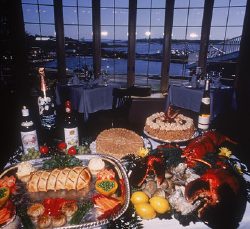 |
FOOD . . . Our language – in all languages – reflects our preoccupation with the subject. We talk about 'bringing home the bacon,' how 'a watched pot never boils' and that 'too many cooks spoil the broth.' In fact, similar idioms appear in languages from the four corners of the world. It seems the events of Babel could divide our speech but it could not separate us from our universal communion with our stomachs.
Why is that? Do we love food because it sustains us? Because it satisfies our animal-like nature? Because it is pleasurable?
As we approach the Christmas season, swarming supermarkets for the fattest turkey and creamiest chocolate, are we really no different from the instinct-driven beasts that comb the land, air and sea for their favourite morsels?
The universal union of food and celebration tells us that food is much more than sustenance: it is a gift from God, created for us for the purpose of spiritual union and human communion.
As humans, we are created with four indivisible quadrants: body, mind, soul and heart. In this fantastic tapestry, nothing can exist in only one quadrant. Food – although its most basic function is to sustain our body – is far more important for the sustenance of our mind, soul, and heart. As Jesus says, "Man cannot live on bread alone." (Luke 4:4). Food is about communion and community.
Think about it: does anyone ever say to you, "Why don't you come over and tell me your deepest thoughts and feelings?" or "How about meeting so I can try to persuade you to do something for me?" Rather, we say, "Let's have coffee sometime."
The current boom in coffee shop business has little to do with our need for a hot caffeinated beverage, and much to do with our desire to connect with one another – maybe for a heart-to-heart, maybe for an intellectual discussion or a business decision, or maybe to lift one another up to God.
Eating feasts, having a cup of coffee or a glass of wine, breaking bread – these things are rarely connected in a healthy way with solitude. This is not to say that you can't enjoy a snack in your quiet time, but it is to say that a solitary love of food is often a sign of something wrong. Eve is testament to this condition: she fell to temptation and ushered in our fallen humanity when left alone with a plump-looking apple.
The notion of hospitality, of food shared with God and man, abounds in literature. Throughout Homer's The Odyssey, feasting is equated with building relationships – both horizontally, with fellow humans, and vertically, with the gods.
Bilbo Baggins, beloved protagonist of Tolkien's The Hobbit, begins his adventures with "an unexpected party, " followed by "roast mutton." He does not receive his commission from a letter or a phone call, but as part of a lengthy, elaborate series of meals and musical interludes. Similarly, in C.S. Lewis's The Lion, the Witch and the Wardrobe, Lucy is not in Narnia long before she is given a "wonderful tea" – where her friendship begins with Mr. Tumnus. Later, the children also receive Christmas presents, symbols of spiritual gifts, together with tea and the cheer, "Merry Christmas! Long live the true King!"
Food must be shared, and it is in the sharing that God elevates a physical element to a spiritual symbol and to a God-given purpose.
Jesus emphasized this relationship throughout his ministry. His first miracle was the turning of water into wine at the wedding in Cana. The point of this was not simply to make more wine, but to reveal something spiritual – and to do so in the context of community. Many of Jesus' parables and lessons played upon the symbolism of food as spirit – sowing and reaping, the fig tree, the fruit of the Spirit. And of course, Christ's last supper is the ultimate example of the dual nature of food and of the importance of gathering together.
Yet, food is not without its quality of temptation. When Satan wants to tempt Jesus, he waits till he's fasting – then challenges him to turn stones into bread. When Edmund enters Narnia, the White Witch is quick to take advantage of boyhood's ever-present empty stomach, tempting him toward evil with the promise of more turkish delight.
We are often tempted by excess, by gluttony or by addiction to food and drink. Sometimes we are also tempted to abandon food. In all of these cases, we are led away from God – often away from other people, and toward ourselves. That is because food cannot be separated from God, the creator of all good things.
We cannot deny that sometimes, we simply like food for its flavour, its texture, its richness, its juiciness. Indeed, God created us with the sense of taste, with the ability to enjoy the physical nature of food. As you enjoy the feasts of celebration this Christmas season, may you also take pleasure in unity with God and in community with his people.