
Why we're failing Africa's girls
BC Christian News, · International
January 2005
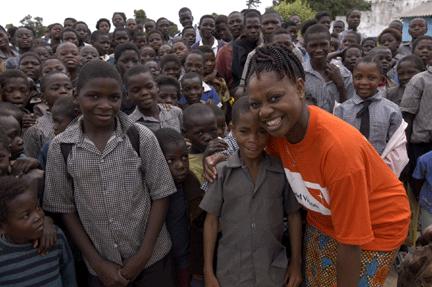 |
Princess Kasune Zulu of Zambia (pictured with African friends), spoke at South Delta Baptist Church December 4, along with popular author Tony Campolo, to highlight Africa's AIDS crisis. She released this editorial through World Vision.
AFRICA is in the death grip of HIV/AIDS and a generation of African girls is standing on the frontline of the carnage . . .
As a young African woman living with HIV, who has lost both her parents to AIDS and who is working with people impacted by the disease, the plight of the girls and their continued vulnerability is heartbreaking to me.
The latest UNAids annual report, released this week, only confirms what we know: AIDS is a female epidemic. There are 39.4 million people living with HIV across the globe and increasingly those becoming newly infected are women.
While there is evidence that women are more biologically prone to infection, there are cultural norms which are greatly increasing their risk of infection.
While there has been an education revolution in many countries about the dangers of AIDS, there is evidence that even when girls are aware of the risks, such awareness often does little to reduce their vulnerability . . .
The 'ABC' (Abstinence, Be faithful and use Condoms) strategy – which is a cornerstone of HIV/AIDS prevention efforts in many countries – does not, in isolation, protect girls and women.
It has failed because girls and women have not been allowed by men to practice the abstinence, faithful, condoms strategy.
To fight AIDS successfully and to protect girls, who are the most vulnerable to infection, the debate has to be broadened to tackle the issues of gender inequity, harmful cultural practice, bad inheritance laws, discrimination and sexual violence.
These are the threats which millions of girls face. Without tackling them, interventions based purely on promoting abstinence, faithfulness and condom use are simply irrelevant . . .
World Vision's research in Tanzania and Zambia proved that sexual exploitation of girls is a significant factor in their vulnerability to HIV/AIDS.
The research also revealed that the impact of HIV/AIDS in the community actually increases the vulnerability of women to HIV infection.
Girls who are orphaned or who are caring for parents living with AIDS are often responsible to meet their families' economic needs. In many cases girls engage in 'survival sex' to earn money or necessities such as food and school materials. UNICEF estimates there are now 12.3 million children orphaned by AIDS in sub-Saharan Africa.
Another factor multiplying the risk to girls is the rape of virgins by some HIV-positive men who believe that this will cure them of AIDS.
In cultural contexts where girls are largely monogamous but many boys are not, and where girls have little say in how and when they will practice sex, reliance on condoms as a preventative measure is not enough to reduce their vulnerability.
Until women and girls are accorded special protection in culture, law and education, ABC will not work because it isn't allowed to by the physically dominant partner in sexual relationships.
Extended schooling, for instance, has had positive results for girls and boys, contributing to delay of entry into sexual activity, the practice of safer sex and delayed marriage.
We should review our HIV/AIDS prevention strategies and ensure they include measures to expand the freedom of girls and women to negotiate their relationships and their sexual activity, and engage boys and men in discussions about their assumptions regarding their own gender roles.