
Debate over life's origins grabbing more headlines
BC Christian News, · Top Stories

"EVOLUTION is a theory, not a fact, regarding the origin of living things. This material should be approached with an open mind, studied carefully, and critically considered."
This notice appeared on a sticker placed in high school textbooks in Cobb County, Atlanta starting in 2002.
However, last month, a federal court ordered the removal of all such stickers. The case is emblematic of the increasing conflict over life's origins. Last year, the teaching of evolution was being challenged in some 40 American states.
Sure to exacerbate the conflict will be the Museum of Creation, sponsored by Answers in Genesis (AiG), set to open in Kentucky this spring.
"The evolutionary elite will be getting a wake-up call," AiG head Ken Ham told The Daily Telegraph. Among other things, the museum will feature a reconstruction of Noah's Ark which, said Ham, will be quite realistic. "You will hear the water lapping, feel the Ark rocking and perhaps even hear people outside screaming."
Grand Canyon

The museum will also feature a detailed model of the Grand Canyon, which creationists believe was carved out by the waters of the Great Flood. It has been at the centre of an ongoing controversy, thanks to a book by Tom Vail entitled Grand Canyon: A Different View (Master Books, 2003).
Vail, who has been a Canyon tour guide since 1981, was an evolutionist until he accepted Christ in 1994; since then, through his Canyon Ministries, he has led Bible-themed tours. He wrote: "The Canyon has 'God' written all over it – from the splendor and grandeur of the Canyon walls, to the intelligent design of the Creator displayed in the creatures that inhabit this magical place. Not only is the Canyon a testimony to creation, but it also presents evidence of God's judgment of the world."
For more than a year, representatives of seven scientific associations have attempted to pressure the National Park Service to remove the book from its stores nationwide.
"The Park Service leadership now caters exclusively to conservative Christian fundamentalist groups," complained Jeff Ruch, of Public Employees for Environmental Responsibility. The book is still available; however, it is now in the 'inspirational' section instead of the 'natural science' section.
Status quo
Supporters of evolution consider it essential to maintain the status quo in the education system, because they believe the theory's truth to be self-evident. Some evolutionists are committed Christians, such as UBC professor emeritus Angus Gunn, author of Evolution and Creationism in the Public Schools (McFarland & Company, 2004). Gunn has asserted: "All present forms of life on earth have a common ancestry that goes back into billions of years of biological history."
Critics, however, such as Kelowna public school teacher David Buckna, maintain that evolutionists are shutting down scientific enquiry. "Good science is always tentative and self-correcting, but this never really happens in the case of evolution," he wrote recently, adding: "Regardless of the scientific data, the idea of evolution as a valid concept is not open to debate."
Polarization between the two sides is being exacerbated by mainstream media. Recently, some reporters have equated creationists with evangelical supporters of George W. Bush.
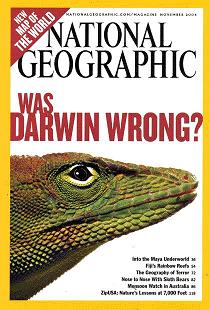 |
The increasingly high profile of the origins conflict was recently acknowledged by the National Geographic, in a November cover story entitled 'Was Darwin Wrong?' Evolutionary theory, wrote David Quammen, is "such a dangerously wonderful and far-reaching view of life that some people find it unacceptable, despite the vast body of supporting evidence."
The theory, countered AiG's Terry Mortenson, "cannot stand careful scrutiny, which is why evolutionists have to use political and academic power and legal intimidation to keep criticisms of evolution out of public schools."
'National Geographic stacks the deck' said a Christianity Today response by Thomas Woodward, author of Doubts About Darwin: A History of Intelligent Design (Baker, 2004). He wrote that Quammen gave "no hint that intelligent, well-informed dissent exists anywhere in the university world . . . I kept looking in vain for his response to the telling critiques of the Intelligent Design Movement."
Design debate
Intelligent Design (ID) has indeed altered the shape of the debate.
Popular apologist Lee Strobel promotes ID in The Case for a Creator (Zondervan, 2004). In an interview with Servant magazine, he stated: "Recently a hundred scientists with doctorates from leading institutions signed a full-page magazine ad that said: 'We are skeptical of the claims of Darwinism.' In effect, they said the emperor of evolution has no clothes. Christians who blindly accept what they were told in school about evolution . . . don't understand that the best evidence does not support the claims of Darwinism, it points toward intelligent design."
He added: "To embrace Darwinism . . . you would have to believe that nothing produces everything, non-life produces life, randomness produces fine-tuning, chaos produces information, unconsciousness produces consciousness, and non-reason produces reason. I just don't have enough faith to believe that."
Some evolutionists are combatting ID by characterizing it as 'religious.' This tendency is reflected in mainstream media. For example, speaking of creationism, broadcaster Bill Moyers recently stated: "This biblical worldview is being repackaged under a new banner. They call it 'intelligent design.'"
Many creationists, however, would vehemently dispute the claim that ID is biblical. Richard Peachey, who teaches science in the Abbotsford public school system, dealt with the topic in a recent sermon. While conceding that ID adherents have made some good points, he asserted that they "stay away from the Bible, and they mostly prefer not to specify exactly who the 'Intelligent Designer' is . . . Jesus himself is not an 'Intelligent Design Movement' sort of creationist . . . He comes across as a robust biblical creationist, taking his stand firmly on the truth of God's inscripturated word."
In a December interview with Moyers, Richard Dawkins, author of The Blind Watchmaker, dismissed ID: "Once you understand how Darwinism works, then you could easily see that that's a far better . . . far more scientific explanation than intelligent design."
Shrillness
The increasing shrillness of the origins debate since the early 1990s prompted Del Ratzsch to write The Battle of Beginnings: Why Neither Side is Winning the Creation-Evolution Debate (InterVarsity, 1996).
Ratzsch, who will speak about Intelligent Design at Regent College February 21, wrote: "Unfortunately, in such disputes the harder the lines are drawn, the less actual communication there is."
He illustrated this by quoting prominent voices on both sides of the origins debate: "The most amazing thing about this whole state of affairs is the absurdity and impossibility of the very concept of evolution!" stated creationist Henry Morris. "That a theory which is so utterly devoid of any legitimate scientific proof could have attained such a position of universal power and prestige in the name of science is surely a remarkable commentary on human nature."
Ratzsch's evolutionist representative was Dawkins, who once declared: "It is absolutely safe to say that if you meet somebody who claims not to believe in evolution, that person is ignorant, stupid or insane (or wicked, but I'd rather not consider that)."
Ratzsch wrote: "Creationists widely misunderstand both Darwin's theory and theories of his contemporary descendants. Evolutionists widely misconstrue various creationist positions, and frequently raise objections that creationists themselves recognized and responded to decades ago."
However overheated the origins debate has become, however, it has been a key factor in challenging at least one famous skeptic's thinking, according to an interview in Philosophia Christi. British philosopher Antony Flew, a self-proclaimed atheist for decades, stated: "The most impressive arguments for God's existence are those that are supported by recent scientific discoveries . . . The findings of more than 50 years of DNA research have provided materials for a new and enormously powerful argument to design."
As critics of ID would predict, this admission did not inevitably lead Flew to the God of the Bible. Calling himself a 'deist,' he stated: "I don't believe in the God of any revelatory system, although I am open to that." Nevertheless, he conceded that "the case for an Aristotelian God who has the characteristics of power and also intelligence, is now much stronger than it ever was before."