
Arwen's choice, Grima's tear: Peter Jackson's Christian vision
BC Christian News, · Arts
YEA, now that the dust of Mount Doom has long settled upon the plains of Mordor, and the Dark Lord's dire shadow has verily been banished from the big screens of Middle Earth lo these many months, we must needs contemplate anew the fall of Sauron in our home palantirs.
"This tale grew in the telling," J.R.R. Tolkien famously wrote in the foreword of The Lord of the Rings, the centrepiece of his Middle Earth saga. In New Zealand director Peter Jackson's hands, Tolkien's tale has grown beyond all expectations. This becomes clearer the more one views Jackson's marvelous extended DVD editions of his Rings trilogy.
Many have reviewed the separate installments of the theatrical film, of course; and there have been reviews of the extended DVDs – but nothing terribly in-depth, it would seem. So far, I haven't seen any detailed evaluations of the film as a complete, self-contained entity. This is one attempt to do that, with an emphasis on the film's spiritual qualities.
Christian critics
The Lord of the Rings has rightly been extolled by Christian reviewers such as Steven D. Greydanus and Sister Rose Pacatte; many have showed some real appreciation of what Jackson has accomplished. However, it seems to me that most Christian critics have only scratched the surface of this film's biblical content; they have focused on obvious elements, such as self-sacrifice, and the struggle against evil.
Several of those who have delved a little deeper have found the film spiritually wanting to some degree or other – generally concluding that, because the film makers are evidently not Christians, therefore they had only limited understanding of the book's Christian content. But if Jackson and co-scripters Frances Walsh and Philippa Boyens are indeed not Christians, it is verging on the miraculous that they caught so much of the book's Christian content – and, dare I say it, even improved upon Tolkien in some places.
Would the naysayers have preferred that only card-carrying Christians be allowed to adapt Tolkien's sacred 'textus receptus'? This massive production got precisely what it needed: supremely imaginative film-makers. If it had been left to merely 'Christian' film-makers, who among that limited faction could have pulled off the trilogy? Mel Gibson or Wim Wenders? Maybe. Andrei Tarkovsky? Well, he's dead – but the possibilities boggle the mind, nonetheless. The Left Behind guys? Fuggeddaboudit!
I don't wanna scare ya, kiddies, but imagine for a moment a Rings trilogy done as a Ted Baehr-approved production – bearing in mind Care-Baehr's Movie Guide, which very kindly alerts good little Christians about all manner of immoral, non-biblical behaviour in films (and also remembering that their review of Jackson's movie warned the born-again public to watch out for the film's "implied alcohol consumption"). If the Baehr-brains had produced a film consistent with their creed, we would've had hobbits bereft of pipeweed (!!!!); a moratorium on pubs (be not drunk with ale!); no silly songs (coarse jesting!); no garrulous dwarves (too vulgar!); no prophetic intonations from Galadriel (divination!); no haughty elves (spiritual pride!); no talking trees (substance abuse!); and no resurrection of Gandalf (implied offscreen nudity!). Oh – and no, um, sorcery. But I digress.
No-budget
Jackson's earliest films give no indication of the greatness to come. The New Zealand auteur started with a no-budget alien-invasion flick, Bad Taste (1987); progressed to Meet the Feebles (1989), an over-the-top Muppets satire; and outdid himself with the gory zombie epic, Dead Alive (1993), aka Braindead. Fortunately, he wasn't content with such limited fare.
In 1994, by now partnered artistically (and domestically) with Fran Walsh, Jackson produced Heavenly Creatures. Based on a 1950s New Zealand murder case, it was an extraordinary depiction of the fantasy world created by two teenagers, which spiralled out of control. This was followed by The Frighteners (1996) a skillful horror/comedy with state-of-the-art special effects; and Forgotten Silver (1997), a 'mockumentary' about a mythical pioneer of New Zealand's film industry.
Jackson had proven his artistic credentials, but had never had a hit. To their everlasting credit, the New Line Cinema executives took a big chance; the result, by any standards, is an unprecedented epic, dwarfing (sorry) all previous fantasy films. While I wouldn't go so far as to call Jackson a visionary, it is clear that he has taken Tolkien's phenomenal vision and truly worked wonders with it. Now that the complete extended edition is available we can fully appreciate the scope of his achievement; and thanks to the various documentary extras, we can also marvel at the sheer magnitude of this production.
No sequels
Before I proceed further, a minor point must be stressed. Some critics still insist on referring to the Rings trilogy as a three-hour hit movie (The Fellowship of the Ring) with two sequels (The Two Towers and The Return of the King). They forget that Tolkien never intended the story to be split up (that was the publisher's idea). While some reviewers have evaluated the individual theatrical films in detail, most assessments of the extended versions seem to amount to little more than laundry lists of the extra scenes; the films have generally been appreciated as separate entities, but not as parts of a whole.
This is unfortunate, considering that The Lord of the Rings is one of the most important films ever made; it deserves to be evaluated as the director intended it: as one single, self-contained tapestry. Jackson has emphasized that he considers it one continuous story, in three acts. This is how I am approaching the film in this critique; I am also writing for those who are at least familiar with the theatrical version (otherwise, beware of spoilers!)
Minor flaws
Jackson's film has its flaws. There are a few redundancies, such as the several mentions of Bilbo's book title; and some inconsistencies – as when Merry and Eowyn, who are supposed to be hiding their presence in the army from Theoden and Eomer, hang out casually with the other soldiers without covering their faces. There are also some unnecessary scenes, such as the 'drinking game' between Legolas and Gimli; and speaking of well-tossed dwarves, Gimli is used too often for comic relief. The killing contests between Leggy and Gimli are played for laughs, as are a few too many other battle scenes.
There is at least one glaring continuity error: the magic disappearing barrels in the cave when Faramir confronts Frodo and Sam. You see the barrels behind the hobbits for several shots; when Faramir enters, the barrels are nowhere to be seen. There are also a few too many 'near death experiences' – i.e. characters thinking their loved ones have been killed, only to find they have miraculously survived.
One could also accuse Jackson of false advertising. There were several notable scenes in various previews which never made it into the final film: two elf maidens running through the woods, laughing; Aragorn and Arwen frolicking, as she smiles radiantly; Arwen telling Elrond to give Aragorn "the sword of the king"; Elrond telling Arwen "You gave away your life's grace; I can no longer protect you," and then passionately embracing his dying daughter. Not nice to tease one's loyal fans; more importantly, all of these scenes could have easily been added to the finished product – and should have been.
Whither Bombadil?
Further, what of the scriptwriters' myriad changes to Tolkien's masterwork? Well, to those dedicated keepers of the Flame of the West, who have frequently bemoaned the absence of Tom Bombadil, Glorfindel, Ghan-buri-ghan, Imrahil, Radagast the Brown, the knights of Dol Amroth, the Sceptre of Arnor and the Scouring of the Shire, one can only bow the head sympathetically and say: Get a fricking life, fanboys!!!! Think you could've done a better job?
Have these people never heard of artistic license? Jackson has always stressed that this film is merely his interpretation of Tolkien's classic. Some of these grumblers evidently have little or no understanding of the structural and dramatic requirements of film, as opposed to literature; nor much grasp of the process of adaptation, and the fact that compression of material is essential in something of this magnitude. Even given the film's 11 and a half hour length, omissions were unavoidable.
There are, indeed, key differences between book and film: Frodo is rescued from the Black Riders by Arwen; Frodo and Sam are sidetracked to battle-torn Osgiliath; Aragorn is almost killed by wargs; the ghostly warriors from the Paths of the Dead join the battle at Minas Tirith; a spellbound Frodo offers the One Ring to one of the Nazgul; elves help defend Helm's Deep; Shelob attacks Frodo in the third act, not the second; Faramir tries to take the Ring from Frodo; and there is a significant twist to Frodo's final confrontation with Gollum. And your friendly neighbourhood 'purists' could probably list many more.
Some changes are improvements, however. For example, Tolkien has Merry and Pippin surprise Frodo by insisting on accompanying him when he leaves the Shire; Jackson instead has Leggy and Gimli surprise Aragorn as he leaves to embark on the Paths of the Dead – thus showing Aragorn's friends as being willing to brave supernatural terror. In act one of the book, wargs threaten the Fellowship briefly at night, as the comrades travel toward Moria; the lead beast attacks, and is quickly dispatched by Legolas; the ineffectual creatures soon back down, never to be seen again. Jackson makes much better use of the creatures, moving the wargs to the middle act, when they attack the citizens of Edoras as they journey to the refuge at Helm's Deep; the director stages a full-blown battle. There is now much more at stake: rather than just menacing the hardy fellowship, the wargs threaten to massacre women and children.
One can quibble about some of the film-makers' other changes and additions to the plot. But the extensive commentaries and documentaries accompanying the DVDs clarify their reasons – which are generally good ones. For example, Tolkien's Faramir is never tempted to take the One Ring – which is hardly the stuff of suspenseful drama. The motives of the film's Faramir add to the dramatic tension; and eventually, he overcomes the temptation, decisively rejecting the Ring.
Sunrise
Truly, all the whinging 'purists' bogged down in the dead marshes of their dashed expectations can't spoil my enjoyment of what Jackson and his team have done. Such critics are like Bilbo's trolls, so busy "arguing the whithertos and whyfors" that they fail to see the sunrise coming. And what a magnificent sunrise this film is.
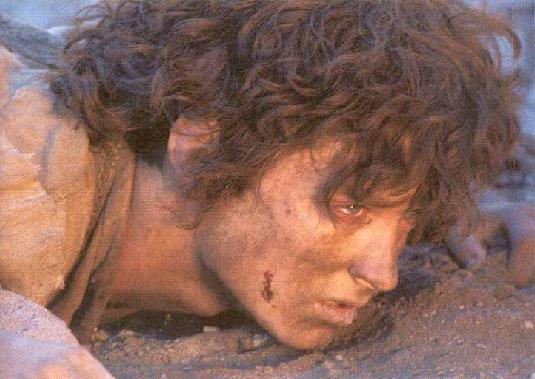
The Lord of the Rings is, far and away, the very finest film adaptation of an epic book that I've ever seen – even surpassing David Lynch's brilliant Dune. The merits of the film virtually eclipse its flaws. That may sound like hyperbole, but I believe it's warranted in this case.
The acting is uniformly superb, and some performances especially stand out: Elijah Wood's amazing range as Frodo – convincingly traversing from innocent Shireling, through obsessed Ringbearer, to failed hero; Sean Astin's pugnacity, anguish and stalwart loyalty as Samwise; Viggo Mortensen's uncertainty, inherent nobility and reckless courage as Aragorn; Andy Serkis' quirkiness and sheer intensity as Smeagol/Gollum; Liv Tyler's strength and sensitivity as Arwen; and Ian McKellen's bumbling, grumpiness and majesty as Gandalf.
The writers capture the feel of Tolkien's language, and make excellent use of many of his lines; frequently, the author's words are given to different characters, but they generally work in their new contexts. Indeed, some of the film's finest moments are expressed in words.
Aragorn rallies his troops by admitting his vulnerability: "I see in your eyes the same fear that would take the heart of me." Gandalf defies the Balrog, proclaiming: "Dark fire shall not avail you . . . Go back to the shadow! You . . . shall . . . not . . . pass!" As the final decision to confront Sauron is taken, Gimli pipes up with: "Certainty of death . . . small chance of success . . . What are we waitin' for?" As she prepares to deal the death blow to the Witch King, Eowyn cries with triumphant scorn: "I am no man!"
What is perhaps the film's most touching scene is made moreso by Elrond's mournful, loving and yet cruel words to Arwen, when he tells of what awaits her after Aragorn dies: "But you, my daughter, will linger on – in darkness and in doubt, as nightfall in winter that comes without a star. Here you will dwell, bound to your grief under the fading trees, until all the world is changed, and the long years of your life are utterly spent."
Howard Shore's grandly operatic music, with its extensive choral passages and elvish lyrics, is by turns stirring, evocative, poignant and magical. Highlights include the lighting of the mountain beacons, the flooding of Isengard, and Shelob's lair. The most musically effective sequence is the End of All Things: the chorus rages as Frodo battles Gollum above the volcano; as Gollum comes into possession of the One Ring, there is an interlude of quiet, sombre female vocalizing; the chorus returns in full force as Frodo again attacks his nemesis.
Viggo Mortensen and Billy Boyd (Pippin) contribute touching, unexpected solos; boy sopranos Edward Ross and Ben Del Maestro also shine. But Shore's trump card is his use of compelling female soloists, woven into the fabric of the soundtrack: Elizabeth Fraser, Isabel Bayrakdarian, Liv Tyler, Sheila Chandra and Renee Fleming. The credits of each of the three acts also feature superb songs by Enya ('May it Be'); Emiliana Torrini ('Gollum's Song'); and Annie Lennox (the haunting 'Into the West'). The one glaring omission from this exalted roster is Canada's Celtic music stalwart, Loreena McKennitt. Was she not asked? Considering that Shore is Canadian, he is without excuse. Nevertheless, I can't wait for a DVD of his new Lord of the Rings symphony.
Far more comprehensive
It should be emphasized that, despite what some critics have suggested, the theatrical version of The Lord of the Rings has not been rendered obsolete or superfluous by the complete version; if you want a faster-paced edition of the story, with all the essentials, it works just fine. But there's no denying that the extended edition is far more comprehensive.
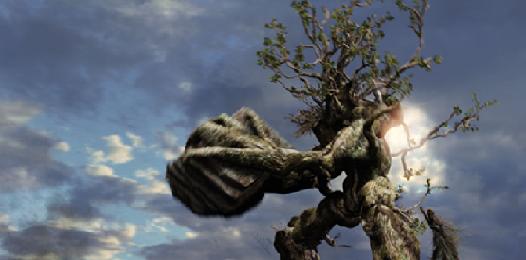
In addition to offering more in-depth portraits of key characters such as Frodo, Sam, Saruman, Galadriel, Gandalf, Treebeard, Denethor, Grima, Pippin, Merry, Faramir and Eowyn, the extended edition clarifies several points: the effect of the One Ring on Frodo's character; the nature of the darkness sent by Sauron to facilitate his attack on Minas Tirith; what happens to Eowyn during the battle of Helm's Deep; the capabilities of the palantirs, or 'seeing stones'; the long decay of the kingdom of Gondor; the significance of Frodo's mithril shirt; the meaning of the White Tree of Gondor; the magical properties of elvish lembas bread; the consequences of the destruction of Fangorn forest; and Smeagol's insidious influence over Frodo.
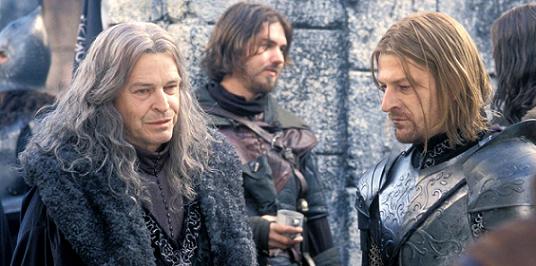
Some of the more notable scenes missing from the theatrical version include: Bilbo's account of hobbit life; an ethereal procession of elves, singing as they walk through the woods; Galadriel's gifts to the Fellowship; Eomer grieving over Eowyn's fallen body; Treebeard reciting poetry about Entwives; Merry and Pippin drinking the ent-draught; Faramir courting Eowyn in the Houses of Healing; Saruman's arrogant last stand; a flashback to Boromir's victory at Osgiliath, highlighting Denethor's conflict with Faramir; enraged trees destroying fleeing Orcs; and Eowyn's apocalyptic dream.
Some particularly significant extended edition scenes include Aragorn using the palantir to announce himself to Sauron; Gandalf uttering the 'black speech' at the Council of Elrond, turning the air dark; Eowyn singing a lament as Theodred is buried; and the grotesque Mouth of Sauron attempting to convince the Fellowship that Frodo was tortured to death. In one nice touch, Treebeard uses the words of Tom Bombadil (spoken to Old Man Willow in the book) to admonish renegade trees who are smothering Merry and Pippin.
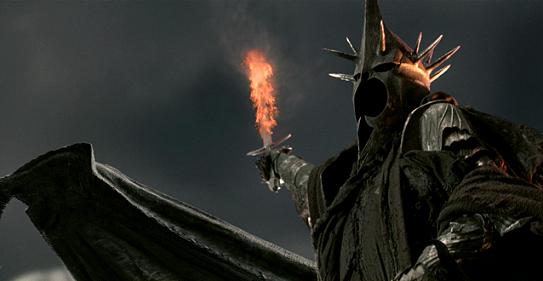
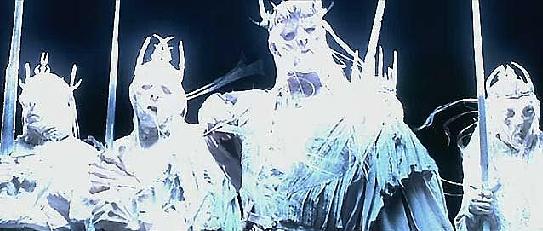
Of all the new scenes, the most powerful are Gandalf's confrontation with the Witch King of Angmar; and the finale of the Paths of the Dead. In the former, the Witch King sits astride his Fell Beast, brandishing a flaming sword; then, shockingly, Gandalf's magical staff is shattered. In the latter, Aragorn fails to persuade the ghost warriors to follow him; the city of the dead disintegrates, and an endless avalanche of skulls rains down as Aragorn and his comrades flee – a sight rivalled only by the Ents' attack on Isengard, the downhill cavalry charge at Helm's Deep, the fall of Sauron's tower, and the eruption of Mount Doom.
Emotional impact
At the risk of annoying a different set of purists, I would suggest that Jackson's magnum opus is this generation's equivalent of Wagner's 'Ring Cycle.' Like those operas, Jackson's work successfully synthesizes myth, high drama and spectacle into something transcendent.
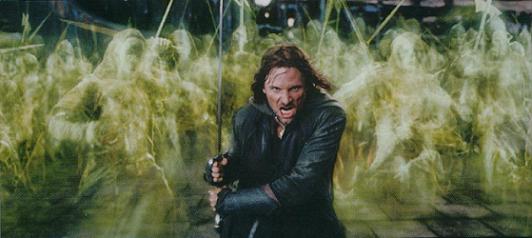
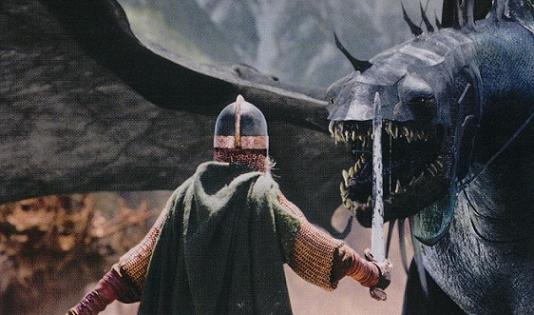
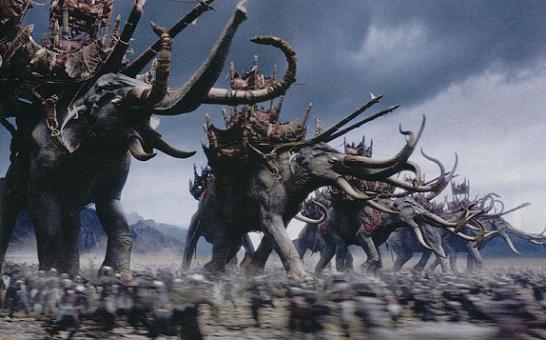
I could wax eloquent about so many indelible impressions: the dire first sight of Barad-Dur, its black ramparts dotted with tiny, evil flames; Aragorn's ferocious swordplay; the charge of the Oliphaunts; Eowyn's valour -and vulnerability on the battlefield; the immense, pillared city of Dwarrowdelf; the gate of Moria, visible only when the moon shines on it; the fires and sinister faces infesting the Dead Marshes; Gandalf's ride through Minas Tirith; the Ring Wraiths, with their hideous screams and horrific Fell Beasts; and the CGI glory that is Gollum.
But more than anything, the film impresses me with its intense emotional impact. Even after many repeated viewings, several scenes still electrify: Frodo, at the council of Elrond, volunteering to be the Ringbearer; Gandalf's struggle with the Balrog, and his fall into the abyss; the wounding of Frodo by the Witch King; Boromir's heroic death in battle; Frodo, blinded by the Ring, pulling his sword on Sam; Frodo ordering Sam to go home; the final battle at the Black Gate; Frodo's fateful decision at the Crack of Doom; and his fight to the death with Gollum.
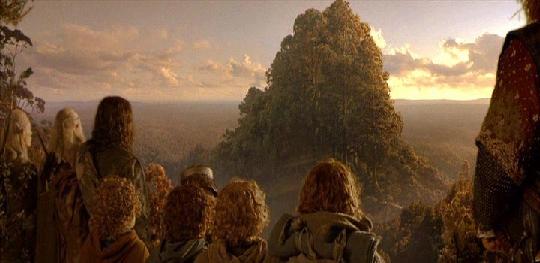
Some scenes are profoundly moving: Frodo heading off to Mordor alone; Elrond telling Arwen of the fate awaiting her if she casts aside her immortality to marry Aragorn; the unbearably sad farewell at the Grey Havens; the reunion of Arwen and Aragorn; and Sam's exhortation to the exhausted Ringbearer: "I can't carry it for you – but I can carry you!"
I am also impressed with the prolonged, elegaic finale, bringing the hobbits back to their beloved Shire. Some short-sighted critics have insisted that the film has 'too many endings.' Clearly, they are missing the whole point. All of the final scenes are there for good reasons, and bring crucial plot elements to a conclusion.
God in the details
Often in contemplating this film, small but significant details come to mind: the voice of the Ring whispers Aragorn's name, as Frodo challenges his comrade's loyalty; gigantic pieces of fallen statues, remnants of bygone kingdoms, are seen in the background several times; a burning village is seen only briefly in the distance, as Gandalf and his companions ride toward Edoras; Aragorn's newly reforged sword physically blocks the ghostly blade of the King of the Dead; Frodo's sword turns blue whenever orcs approach; a bird flies out of the eye of one of the giant Argonath sculptures; as he is crowned king, Aragorn gives a small sigh of resignation; and the White Tree of Gondor blooms in the background during the coronation scene, as its petals rain down on the new ruler.
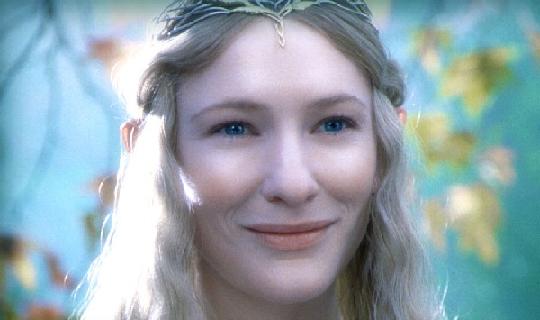
Some details leaven the solemnity of the proceedings with welcome wit. As he prepares to ride for reinforcements, Gandalf laments: "Three hundred years have I walked this earth – and now I have no time"; he then heaves a world-weary sigh, and speeds off on Shadowfax. Merry and Pippin learn that one small bite of lembas bread can sustain a grown man for a whole day; Pippin admits to eating four very large biscuits, and belches. As Theoden's guards confiscate the weapons of Gandalf and crew, the wizard beseeches: "Surely you would not part an old man from his walking stick"; minutes later, he uses his staff to break the spell binding the decrepit king.
Several small moments evoke deeper meaning. As Galadriel gazes at her own ring of power, a breeze ruffles her hair; it conjures a sense of wonder, as if nature itself is acknowledging the lure of the ring. A tattered Rohan flag tears away from its pole, flies off, and then drifts to the ground as Aragorn approaches Edoras, underscoring the gloom enveloping Theoden's kingdom. Arwen brings the wrath of the river down upon the Black Riders, in the form of fiercely charging horses composed of silver water. As Denethor leads a procession carrying his son to a funeral pyre, the image shifts to a close-up of a lone blossom, which has appeared on the dead White Tree – a symbol of hope, giving the lie to Denethor's despair.
Fallen brown leaves blow across the floor at Arwen's feet, as she surrenders her immortality. As Saruman exhorts his demonic hordes to embark on mass slaughter of humanity, a lone tear rolls down Grima's cheek – a foreshadowing of the wretched underling's later repentance. The sun shines on the decapitated head of a long-forgotten king's statue, revealing it to be topped by a garland of bright white blossoms – as Sam observes: "The king has a crown." In the final battle, a moth issues forth from Gandalf's sword, then turns into a mighty eagle.
One of the most exquisite examples of Jackson's way with the telling detail occurs in the first act, when Gandalf is imprisoned in Orthanc. There is an aerial shot of Saruman's war preparations, with appropriately loud, menacing music; the roving camera suddenly catches sight of a tiny moth-like creature; at this point, the sinister music suddenly dissolves into a tranquil and pure boy soprano, as the camera follows the moth to Gandalf, who captures it, speaks to it, and lets it go; as it flies off, the military music returns, and the camera descends into the hell of Saruman's factory. Breathtaking.
'Consciously in the revision'
Tolkien described his book as "a fundamentally religious and Catholic work," adding: "The religious element is absorbed into the story and the symbolism . . . unconsciously at first, and consciously in the revision."
In Peter Jackson in Perspective, Greg Wright of HollywoodJesus.com questions the scripters' grasp of the profoundly Christian underpinnings of the book. Certainly, they may have missed some nuances, or perhaps misinterpreted some of Tolkien's symbolism. However, it is remarkable to me that Jackson and his co-scripters are not declared Christians, and nevertheless have generally showed a clear understanding of – and respect for – all of the most crucial Christian concepts in the book.
Wright's book provides a helpful analysis of key biblical elements in Tolkien's work, but at times his perception of the film is questionable. For example, he asserts that, of all the book's characters, that of Arwen "is the most badly mangled in the films as released." Having recently re-read 'The Tale of Aragorn and Arwen' in the book's Appendix A – which directly inspired most of the film's portrait of Arwen – I find this statement perplexing.
Wright ultimately concludes that Jackson, Walsh and Boyens missed the spiritual boat. "Did they really understand what's behind The Lord of the Rings? It seemed to me that they did not." But to his credit, he notes his own "Tolkien territorialism and self-righteousness," and concludes: "I should not have been so quick to cast my own Third-age stones . . . We could have done a lot worse than Jackson (and company)." Indeed!
One can debate whether the trio brought a sufficiently Christian perspective to the material; but since most of the film is directly taken from Tolkien, it is inherently shot through with the author's faith. Obviously, just as they couldn't include every plot point and character nuance, some spiritual elements were muted or even eliminated. For example, one online commentator complained that the concept of lembas bread as symbolic of the Eucharist was missing. But surely this is nitpicking of the worst order. It was simply not possible to capture all the theological themes and implications of the book, even in the full-length version. We should be grateful that so much of the spirituality made it into the final cut.
The most notable references to Christianity found in previous Jackson/Walsh collaborations have been somewhat less than devout. In Dead Alive, a priest who knows Kung Fu kicks butt for the Lord; and in the masterful Heavenly Creatures, a grotesquely smarmy priest is beheaded in a fantasy sequence, and heaven is envisioned as a place devoid of Christians. Not exactly indicative of reverence for the faith – which makes their take on the Rings even more remarkable. They were clearly willing to resist their baser impulses, and instead demonstrated genuine respect for Tolkien's faith.
No new themes
"I'm not a Catholic," said Jackson, "so I didn't put any of that personally into the film on my behalf; but I certainly am aware that there were certain [religious] things that Tolkien was thinking of . . . We made a real decision at the beginning that we weren't going to introduce any new themes of our own into The Lord of the Rings. We were just going to make a film based upon what clearly Tolkien was passionate about."
In a conversation with Wright, Fran Walsh referred to Tolkien's "profound Christian beliefs," and said: "Those ideas in the book – we attempted as much as we could to invest them in the film. The values in them, they give you a sense of hope, that it isn't chaos, that it isn't arbitrary, that it isn't without a point."
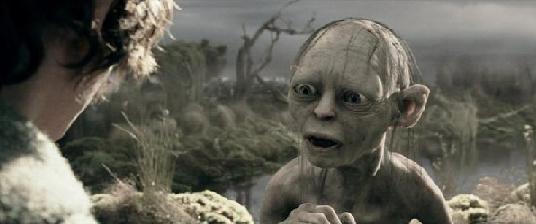
Walsh added: "There are certainly, you know, parallels that you can draw between Frodo's journey and . . . the Christ story – you can, because it's about sacrifice." She concluded: "I think at the end of the movie . . . that [Frodo] transitions to another place. Which is – that's another way of looking at faith in the story – that he doesn't die, and that Gandalf is his guide (in that he's an angelic character)."
Boyens concurred, speaking of "Tolkien's faith . . . that even those who leave us too soon or who are lost in war or who die young . . . they go to another place, they don't just fall into nothingness. They transition to somewhere else." Faith, she added, "requires us to believe in a higher power. Gandalf [in the book] says: 'The Ring came to Bilbo, and in that moment something else was at work.' Not the design of its maker – this evil power – but some other power was at work."
Christian elements
The many Christian elements clearly present in Jackson's Rings have been noted by some critics, including the power of sin, service to others, sharing, conversion, overcoming evil, pilgrimage, good will, salvation, vocation, love, compassion and redemption.
One theme would be obvious even to a biblically illiterate viewer: susceptibility to temptation, as embodied by the One Ring's effect on Gollum, Saruman, Boromir, Denethor and Faramir. This motif is presented at its most complex in the various stages of temptation Frodo goes through.
Forgiveness is especially apparent in Frodo's treatment of Gollum, and also in Theoden's kindness to the repentant Grima. The self-sacrifice, loyalty, servant nature and unconditional friendship of Samwise are a beacon throughout the film. Christ's devotion to his mother Mary is echoed when Aragorn honours his own deceased mother's statue (which is itself an obvious reference to Catholic veneration of the Virgin). And the film-makers add a surprisingly biblical twist to Theoden's release from mental and spiritual subjugation: the king is literally exorcised, freeing him from being directly possessed by Saruman. (Whether this was done because Jackson knew it was a very Catholic concept, or simply because it was a way cool cinematic device, is a matter of speculation).
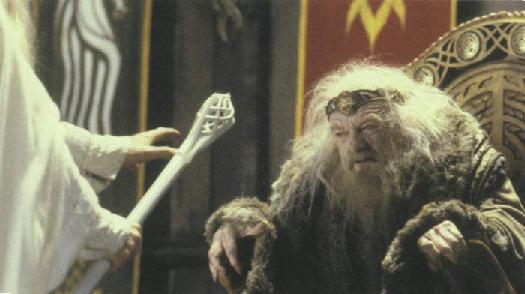
Providence rears its majestic head in several places. Gandalf tells Frodo: "Bilbo was meant to find the Ring; and you also were meant to have it. And that is an encouraging thought." As Aragorn lies grievously wounded, Arwen's spirit hovers over his body. Deep in Mordor, Sam looks up and sees a star through a break in Sauron's poisonous cloud, and says: "There is light and beauty up there, Mr. Frodo, that no shadow can touch." The White Tree finally blossoms, a none-too-subtle reference to the Tree of Life. Frodo and Sam are rescued by Gandalf and the eagles, as if by angels.
Christ figures
Just as Sauron, Saruman and the Witch King are obviously symbolic of Satan, and the Nazgul represent demons, the film also presents several clear Christ figures: Gandalf, Aragorn and Frodo.
Gandalf is explicitly called The White Rider – invoking the horseman of Revelation 19:11. As Gandalf the Grey, he falls at Khazad-dum, his arms spreading out to form a cross; he wrestles the Balrog of Morgoth (Satan) into the abyss (hell); he is later reborn as Gandalf the White, a more powerful Istari than he has ever been. In his new form, he is able to drive the fearsome Nazgul away with the white light issuing from his staff.
In the book, after the battle of Pelennor Fields, Aragorn demonstrates his gentler skills in the Houses of Healing. Tolkien writes: "The hands of the king are the hands of a healer – and so shall the rightful king be known." While Jackson doesn't overly emphasize this, he shows Eowyn being nursed by Aragorn – accompanied by a peaceful and lyrical song by Liv Tyler. Early in the film, Aragorn also uses his healing skills to help Frodo.
There is also a very touching moment near the end, when Aragorn tells the hobbits: "You bow to no one." He bows his knee to them, echoing an aspect of Christ: "He humbled himself." His humility is also demonstrated by his earlier willingness to serve another king, Theoden, even though he is a monarch waiting to ascend to his own throne.
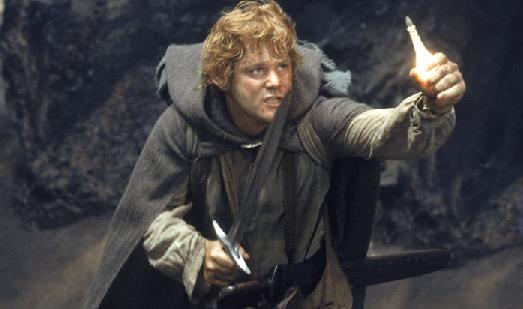
Frodo repeatedly shows mercy to Gollum, hoping to somehow help reverse the effect of the One Ring and start the pathetic creature on the road to regeneration. Frodo also embodies the punishment Christ endured when He was "wounded for our transgressions." By the time the hobbit gets to Mount Doom, he is a devastated shadow of his Shire self.
The crucial moment, where he is stricken by the poison of evil, comes in act one – when he is wounded by the Witch King on Weathertop. Jackson reminds us of this moment several times, through flashbacks and other references. Toward the end, Frodo tells Sam: "It's never really healed." The price he pays in gaining the victory over Sauron's evil echoes the price paid on the Cross.
Rebirth and eternal life
Resurrection is also very much evident throughout the film. Gandalf is literally raised from the dead. The injured Aragorn is restored by a mystical kiss from Arwen's spirit; and the future king symbolically conquers death by walking the Paths of the Dead.
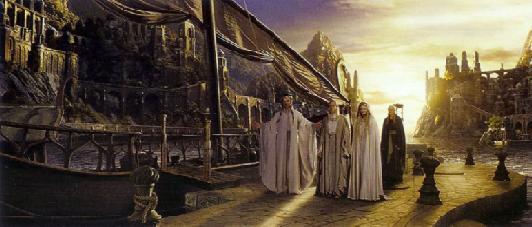
Frodo tastes death symbolically several times: getting stabbed by the morgul blade, whose poison could turn him into a wraith; capitulating to the Ring's power on several occasions; falling into a swamp filled with demonic ghosts; and being struck down by Shelob's sting. But all of these are subsumed by the Grey Havens, which is his resurrection. "We set out to save the Shire," he says, "and it has been saved – but not for me." The only way out for him is to pass from Middle Earth to the elves' paradise across the sea. Thereby, "death is swallowed up in victory."
The film makes no direct mention of the Undying Lands; but the concept of eternal life is touchingly enunciated by Gandalf, in a wonderful passage taken almost verbatim from the climax of the book (describing Frodo approaching the Undying Lands). As they sit barricaded in Minas Tirith, with enemy forces closing in, the wizard says to Pippin: "No, the journey doesn't end here. Death is just another path, one that we all must take. The grey rain-curtain of this world rolls back, and all turns to silver glass. And then you see it . . . white shores – and beyond them a far green country, under a swift sunrise."
Grace of the Valar
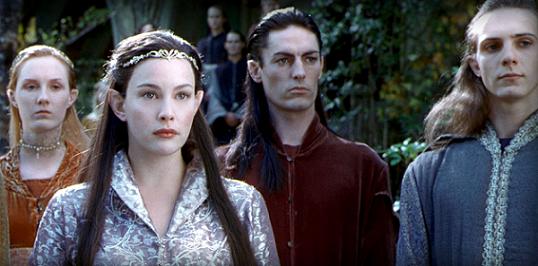
Many critics and 'purists' have complained about the increased role given to Arwen. Initially, the perception was that the film-makers were simply tacking on a gratuitous romance to appeal to 'the female demographic.' But such talk died down when it became known that most of the Arwen scenes were taken from material in Appendix A of the book.
Curiously, most Christian commentators don't seem to have picked up on the Christian elements which virtually saturate the Aragorn/Arwen subplot. In my view, this subplot was the most significant script decision taken by Jackson and company; indeed, it was a stroke of genius. By expanding Arwen's role (based faithfully on the back story outlined in Appendix A), the scripters greatly increased the Christian content; they added a strong metaphorical element which was only implied in Tolkien's actual narrative. It makes me wish Tolkien had woven the details into the narrative instead of relegating them to the appendix.
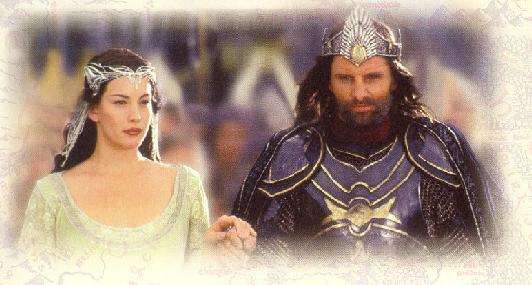
A summary of the Arwen/Aragorn story arc is in order. The first hint of the subplot occurs in act one, before Arwen appears in the film. Beside a campfire, Aragorn softly sings a song about the legendary elfmaiden Luthien, who gave her love to the human Beren – thus relinquishing her immortality. Arwen is introduced soon after, and rescues Frodo from the Black Riders; as his wound overcomes him, she prays: "What grace is given me, let it pass to him; let him be spared." In Rivendell, Arwen gives Aragorn encouragement, renews her vow to 'bind herself' to him, and bestows her Evenstar jewel upon him. He goes off on the quest, after a sombre parting.
In act two, there is a flashback to Rivendell. The lovers share a tender moment; then Elrond exhorts Aragorn to give Arwen up, thereby allowing her to leave Middle Earth and keep her immortality. Reluctantly, Aragorn breaks off the relationship; but she insists that he keep the Evenstar. Later, he is severely wounded in the warg attack. As he lies stricken, she materializes above him, conferring a blessing and a phantom kiss upon him. We hear her voice: "May the grace of the Valar protect you"; the Valar are the Ainur, the Holy Ones, the first creations of Tolkien's Creator, Iluvatar – in other words, angels.
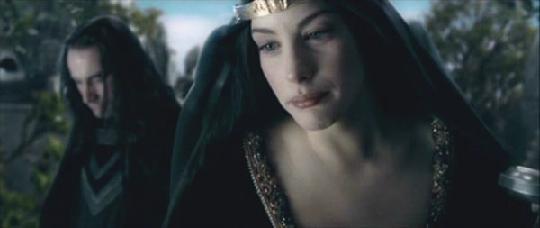
The scene switches to Rivendell. Arwen refuses to leave with the other elves, determined to be reunited with her lover. Elrond then tells her what will become of her after Aragorn meets his inevitable mortal end; he paints a devastating picture of the black-clad widow wandering desolate, alone in a barren forest. Arwen capitulates, and leaves Rivendell with the other elves.
In act three, Arwen is heading through the forest with her elvish escort. She sees a vision of an older Aragorn with a young boy, who is wearing the Evenstar jewel. She returns to Rivendell, and confronts Elrond; she chooses to stay in Middle Earth, to bring her son into the world – and exhorts her father to reforge the sword of the king, the shattered blade which cut the Ring from Sauron's hand 3,000 years before. Elrond sadly accepts her choice, and tells her: "The life of the Eldar is leaving you." Meanwhile, Aragorn has a dream of the Evenstar being shattered.
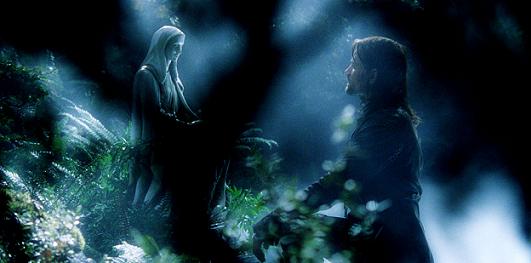
Elrond gives Aragorn the reforged sword, and the news that Arwen is dying – her fate now mysteriously tied to the fate of the One Ring. Aragorn later uses a palantir to confront Sauron – who shows him a vision of his dying lover; the Evenstar shatters, for real. Aragorn takes the king's sword, and goes to confront Sauron's army at the Black Gate; the Ring, and Sauron, are destroyed. At Aragorn's coronation, he is reunited with his lover. The reunion, while joyous, is rendered even more poignant by the bittersweet implications of Arwen's new mortal status.
Imbued with meaning
In total, Arwen is onscreen a fairly small amount of time; but it feels much more substantial. Her appearances are paced just right, and her importance to Aragorn resonates throughout the film. Their story is heavily imbued with Christian meaning, as web critic Abercius has eloquently pointed out at CatholicQandA.com.
Aragorn is willing to sacrifice Arwen's companionship to save her from a life of war and despair – loving her "as Christ loved the church, and gave Himself up for her." Yet, he never totally gives up on her, continuing to wear the Evenstar. Indeed, he is the very embodiment of Christian hope, in Tolkien's view; the author names him 'Elessar,' which means the Renewer, and 'Estel,' meaning hope.
While the film doesn't clarify these ideas, Aragorn still embodies them. At Helm's Deep, facing overwhelming odds, he tells a boy soldier: "There is always hope"; when all seems lost, he inspires Theoden to ride out and meet the enemy regardless; and his short rallying speech to the troops at the Black Gate is truly rousing.
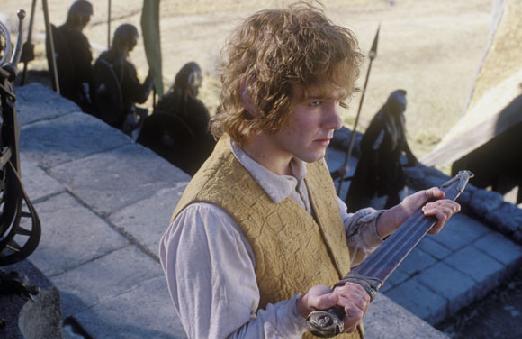
In her own way, Arwen is truly a Christ figure. She, too, humbles herself; and she also makes the supreme sacrifice. She is free to go to the Undying Lands, but chooses not to – partly motivated by the vision of the child she could only have if she stays with Aragorn. She sacrifices her immortality to bring the child into existence. While her motivation is a combination of romantic love, and love for the child, the fact is that she lays her life down to save another's life. What could be more quintessentially Christ-like?
In some respects, Arwen is the purest element in the entire film, an embodiment of nobility, grace, loyalty and love. Her story adds extraordinary emotional and spiritual power to the film. By increasing her role, Jackson and his co-scripters actually improved on Tolkien. No mean feat.
For fanatics only?
Finally, here's where we separate the elves from the dwarves. At the risk of being tagged a hopeless fanatic, I have to say that The Lord of the Rings is best appreciated when it is watched in an all-day marathon; the story has greater immediacy, momentum and accumulative emotional impact. Some key elements resonate throughout the saga.
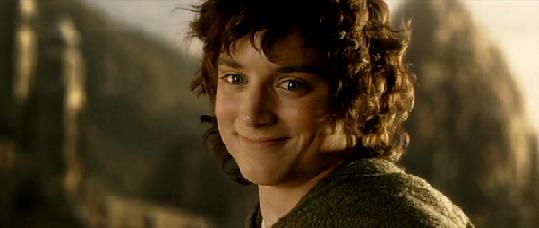
Watching the complete film in one sitting greatly enhances one's appreciation of the evolution of the relationship between Frodo and Sam; Smeagol's struggle against his alter-ego, Gollum, and his ultimate capitulation to evil; the growth of Merry and Pippin, from juvenile clowns to seasoned warriors; the dire significance of Frodo's wound; the relationships between Denethor and his sons; Aragorn's progress from uncertain exile to confident monarch; the weight of Arwen's acceptance of mortality; Theoden's evolution from slave of Saruman to courageous champion; Gandalf's progression from lovable Grey bungler to imperious White commander; Frodo's view of Smeagol, going from hatred to pity to mercy; the importance of the Shire as the hobbits' idyllic refuge from the world; Eowyn's progression from sheltered royal to shieldmaiden; and Frodo's evolution from carefree and complacent hobbit to haunted, battle-scarred outsider.
The shorter version is probably best for a day-long marathon, of course, simply because of the daunting length of the extended edition; but the latter is well worth devoting a day to (with a few breaks!), for the maximum experience. For the less venturesome, the film can also be split very nicely into two parts and viewed on consecutive days. In my opinion, it's best to end part one after Saruman sends his army of Uruk-hai off to Helm's Deep; and to begin part two with Merry and Pippin seeing Saruman's army in the distance. A Galadriel monologue soon after that scene effectively encapsulates the key points of the story thus far.
After all is said and done, there's only one thing Jackson could do to improve upon his work: release the full extended film as a big-screen special event – preferably in Imax theatres, like Matrix Revolutions. The extended editions of Fellowship and Towers were given a limited theatrical run in 2003; but the extended finale has never been shown on a big screen. I am assuming that, once the kiwi wizard gets his upcoming King Kong remake out of his system, he will consider doing a special theatrical edition of the complete Rings. Then, hopefully, he and his team will give us The Hobbit; and we can dare hope that they might even try doing The Silmarillion someday (hey, why not?). Would we really want anyone else tackling them?
In sum: it is no exaggeration to call The Lord of the Rings a masterpiece, and one of the very greatest accomplishments in the history of film. It is highly doubtful that it could ever be surpassed. The only thing that could conceivably top it would be an adaptation of the Book of Revelation, done with the same state-of-the-art technology, fidelity, craftsmanship and imagination, by someone with money willing to invest it.
Is Mel listening?
 |