
Stendal ministers at the 'epicentre' of Colombia's conflict
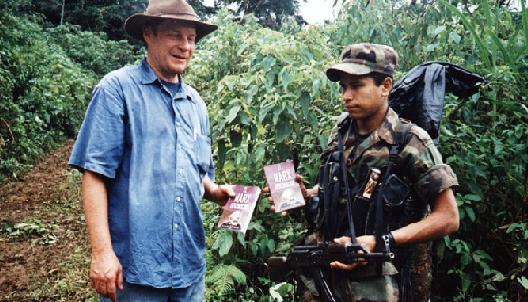
AS A MISSIONARY to Colombia, Russell Stendal was kidnapped in 1983 by communist guerrillas, and held captive for four months.
Now he runs Colombia Para Cristo (Colombia for Christ), which operates a recording studio, a publishing company and a radio station. He was a plenary speaker at Missions Fest Vancouver in late January. Just before he returned to Colombia, he spoke to BCCN.
His adopted country is deeply embroiled in what Stendal termed a "three-sided" war. The Revolutionary Armed Forces of Colombia (FARC) guerrillas, he said, "are left-wing extremists, and the paramilitaries are right-wing extremists." The third side consists of the government's armed forces. The conflict, he said, is "the longest running insurgent war of its kind in Latin American history."
His ministry runs a radio station in eastern Colombia, "at the epicentre of the violence. There are drug mafias to the east of us, the government forces to the west; and we have the paramilitaries to the north, and guerrillas to the south." The latter two factions are the most problematic, he said. "Both sides have committed a lot of atrocities."
The conflict, he continued, "shows some signs of getting worse. Both sides have been known to use extortion of drug growers as a tactic; and both sides have made money – mostly from drugs. They've begun to invest in surrounding countries – some of which are becoming favourable to the guerrillas."
Stendal's ministry attempts to counterract the strife in several ways. "Our short wave broadcasts go throughout Colombia, and into all of the surrounding countries." They also produce special editions of the Bible for each of the factions. Ministry personnel attempt to make contact whenever possible, often stopping to talk to both guerrillas and soldiers at their respective roadblocks.
"Most of the time, everything's fine," he said, adding: "But we've had trouble."
Last year, for example, he was held captive by FARC forces for a few days, along with a former guerrilla and Stendal's 18 year old daughter. Evangelism has borne fruit, however. "There've been a number of guerrillas who have come to know the Lord. But it's awful hard to say how many."
Persuading FARC members to leave the movement, he stressed, is a very delicate operation. "If we pulled them out, the guerrillas would target us." Instead, he said, "we get the word out." The gospel, he continued, then has an effect on the radicals, and they eventually find ways to leave FARC.
The paramilitaries, Stendal said, "are easier to talk to." Generally, he said, they are not anti-Christian. The guerrillas, on the other hand, are drastically influenced by "atheist/ communist doctrine. But when the gospel starts to affect their conscience, then they start being real careful with how they treat the civilian population."
Evangelistic efforts have paid off in encouraging ways. For example, he said, the ministry has made an impact on the government forces. "The commanding general of Colombia is a Christian." As a result, he said, army radio stations are now broadcasting his ministry's messages. And among both the paramilitary and guerrilla personnel, "some in high places are open to the gospel, sympathizing with the gospel."
Aside from evangelism, Stendal stressed, his ministry is "working on trying to bring people together" in the midst of Colombia's chaos.
Contact: FuerzaDePaz.com