
Newly chosen Pope Benedict has superhuman task
BC Christian News, · Editorials
 |
'HABEMUS PAPAM'. . .
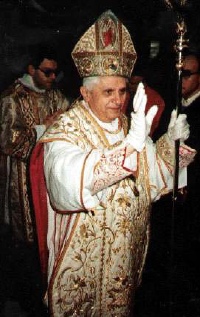
We have a new pope, Benedict XVI, formerly known as Cardinal Joseph Ratzinger of Germany. The first pope to be elected in the 21st century, he must surely be very conscious of the legacy of the 264 men who have held this office before.
Innovation
Continuity with the past, but innovation to meet the challenges of the future, are the characteristics of the papacy today. Both of these features were clearly displayed in the recently concluded election. By tradition, only cardinals of the church were entitled to vote. A recent change, however, limited the voting privilege to those under the age of 80. But, because Pope John Paul II created so many new cardinals during his long reign, there were on this occasion more eligible voters, 117 in all, than ever before.
The cardinals met to elect the new pope in a special conference, known as a Conclave. It was conducted in secret, to prevent any outside pressures being brought to bear. No one is to know the exact details of who voted for whom. The election, by tradition, was fully democratic. Each cardinal had only one vote. John Paul II also introduced the innovation that, after several days of voting, a simple majority would suffice. So too, the mediaeval tradition of signaling a successful election by puffs of white smoke through a special chimney in the Sistine Chapel was replaced by a peal of bells.
Sovereign
Paradoxically, this democratic election procedure chose the next leader of the world-wide church, who is now completely sovereign. There is no provision for a limited term of office, nor for a possible re-election. The job is for life. There are no checks or balances. The only restraints come from the accumulated weight of tradition.
It is widely acknowledged that the Vatican thinks in terms, not of today or tomorrow, but of centuries. It is virtually impossible to do anything for the first time. There has always been a precedent at some time over the past 2,000 years. Yet the pope remains an absolute ruler, as critical Protestants are quick to note.
It is not generally recognized that the pope is not only a spiritual ruler. He is also the temporal, that is secular, ruler of the Vatican state, known as the Holy See. In earlier centuries, the Holy See controlled large parts of Italy. But in 1870, the papal forces were defeated by the rising Italian nationalists, and obliged to retreat to the tiny enclave of 108 acres in the heart of Rome. Despite being completely surrounded, this is still an independent state, enjoying its own passports, police force, postage stamps and government offices. The Vatican is also the world's oldest continuous diplomatic entity. Its world-wide influence is exercised by a large staff of ambassadors, known as Nuncios.
The task of overseeing the work of this wide-ranging bureaucracy involves heavy responsibilities, and requires onerous management skills. It cannot be left to chance.
Different gifts
During the last century, a pattern emerged at successive conclaves. The cardinals were usually seeking to choose personalities having different gifts from the last pope. So, an energetic outgoing and charismatic figure was often followed by a more spiritually-concerned leader. A prophetic pope was chosen to follow someone more pastorally minded.
To be sure, the world-wide prestige of the papacy today seems to require a skilful evangelist, ready to take the church's message around the globe. But at the same time, the enormous and unending burden of office work demanded of each pope cannot be avoided.
He is, after all, in charge of all appointments, oversees all branches of the Vatican bureaucracy, makes all the major announcements on the church's doctrines, and in the end will be criticized for the church's failures.
It is clear that this task is literally superhuman. No pope can possibly have the entire range of skills required. Following the footsteps of Pope John Paul II, who reigned longer than any other pope in the last century, is itself a daunting challenge.
The immediate task of the new pope will be to seek to fulfill the expectations left behind by his predecessor, and yet to carve out his own distinctive contribution appropriate to the tasks ahead. Pope Benedict will require the prayers and support of faithful Christians around the world.
John Conway is professor emeritus of history at the University of British Columbia.