
A pilgrim's four days on the mountain of silence
 |
I AM a pilgrim. So I lean forward to embrace the icon of Christ harrowing hell through his resurrection -- 'The Anastasis.'
Christ moves toward the right, raising Adam with his right hand and holding a closed scroll in his left. Christ is flanked by two groups. On the right are the righteous, headed by the supplicant Eve. On the left are the kings and prophets of the Jews, headed by John the Baptist. Theophanis, the Cretan iconographer, has placed behind the two groups "beetling cliffs [that] converge on the central figure of Christ. The whole foreground is occupied by the rocky cavern of Hades, with its smashed doors and empty sarcophagi. In the middle of the cavern are the figures of Hades and Satan, crouching together in dread of Christ, who has vanquished death."1
This is the icon of the day in Holy Monastery Stavronikita. But as I lean forward, along with the other pilgrims in the exquisite sanctuary of the main church (katholikon), reflected in the glass cover of the icon, I see an image of Christ from the cupola of the church. There, in the centre of the dome, is Christ Pantokrator (all-powerful), representing Christ bending down Heaven and descending.2 This is my prayer: Lord, may I know you better and know your resurrection life. Maximus the Confessor pondered the implications of Christ's victory over the forces of disunity: "Christ is the center where all lines converge."3 But why am I here, of all places, in this only monastic state in the world, Mount Athos, where there are no women, no meat, no singing, not even any female dogs?
"And just what do you think a pilgrimage on Mount Athos will actually do to your personal relationship with Christ?" This probing question was asked by a good friend.
"Well, I'll be praying for four days," I replied.
"You could do that just as well at home."
"But..."
Tongue-tied at the moment, I later reflected on my real reason. The late Harvard sociologist Pitirim Sorokin claimed we can know reality in three ways: through the eye of the senses (empirical science), through the eye of the mind (rational theology and philosophy) and through the eye of contemplation. The Western church has, by and large, concentrated on the senses and reason while the Eastern Church has focused on contemplation. Kyriacos Markides, a Cypriot Orthodox drawn to his own roots though educated in the West, maintained that "Mount Athos has, in its quiet way, preserved the 'eye of contemplation.'"4 If, as is alleged, the church has two lungs -- West and East -- then I have been breathing mainly through one lung. I am intellectual and my theology is in large measure based on intellectual constructs. What I long for is a deeper direct experience of God, to breathe from both lungs.
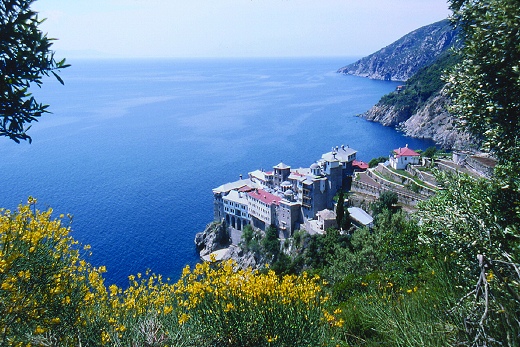
For more than ten centuries men have lived here on this slender peninsula in northern Greece, many in directed communities (coenobitic), some in independent farm houses (sketes), some in small communities attached to a monastery and under its discipline (kellias) and some in tiny hermit cells (hesychasteria) dotted like peppers over the austere and wild beauty of this mountainous terrain, which is clothed in the lower regions with pine, acacia, chestnuts and wild flowers and on the higher with the greywhite crystalline limestone peak of Mount Athos, which crowns the fifty-six kilometer peninsula. Since normal development has been prohibited for ten centuries this is a virtual paradise, a wilderness, a desert, untouched except for the majestic, cliffhanging, multi-storied monasteries, which have been pieced together over the centuries stage by stage since 835 A.D. like medieval cathedrals.
Stavronikita
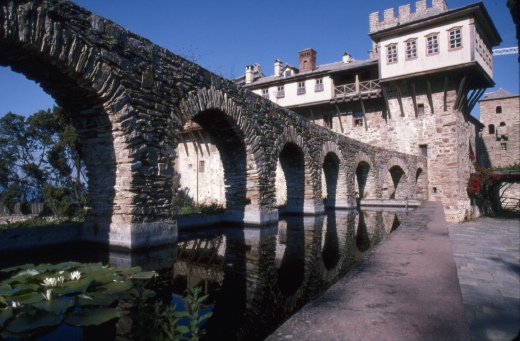 |
Stavronikita, like the other monasteries, is under constant reconstruction. Though it is the newest (tenth century) of the 20 remaining active monasteries, housing some 1,400 monks in total, it is the smallest and the only one with a view of the mountain of silence itself. I pray sitting under an arcade of grapes just outside the massive steel fortress doors at the entrance (which will be closed irrevocably at sundown), while beside me a building crane whirs away, the twenty-first century equivalent of a hundred monastic labourers bearing blocks of stone to add to the fortress tower that easily dwarfs the katholikon.
In the sanctuary, as I lean over to touch the icon of the resurrection and cross myself in the Orthodox way, I see that the main church itself is a dark room -- or so it seems at first when entering from the blazing sun outside -- encrusted with centuries of candle smoke, oil lamps and incense. The great chandelier in the middle, lined up exactly under the Pantokrator, is not electrified, but it is laden with a hundred or so candles. And as my eyes adjust to the darkness, I see that every square inch of the walls and ceiling is covered with evocative images that speak to my heart. Like the ambassadors of Vladmir, the Prince of Kiev, who journeyed to St. Sophia in Constantinople, I could exclaim, "We knew not whether we were in heaven or on earth, for surely there is no such splendour or beauty anywhere on earth."5 There is St. Nicholas, the patron saint of the monastery, in a fading icon at the entrance, and there are images of prophets, apostles, saints and John Climacus' Ladder of Perfection, with Christ at the top receiving those who ascend virtue on virtue to perfection. (There is half-truth here. There is progress in godliness but Christ also comes down Jacob's ladder to meet us just where we are). But Christ's welcome seems a sharp contrast to the welcome I received on entering.
Walking from Karyes, the administrative centre of the peninsula, reached by a two hour ferry ride (there is no overland entrance to the monastic peninsula), I walked for two hours, mainly downhill, stitching back and forth -- alone but not alone -- breathing the prayer, "Lord Jesus Christ, Son of God, have mercy on me" (and, as the Russians add), "a sinner." This Jesus prayer, the heart of Orthodox spirituality, is a practice that dates back to the remotest antiquity and is embodied in The Way of the Pilgrim (linked with the name of Hesychius)6, and it remains alive in the Orthodox way today. Theodore the Recluse proposed that by thus praying without ceasing "will be exactly like holding an object in the sun, because this is to hold yourself before the face of the Lord, who is the Sun of the spiritual world."7 Communion is the goal of prayer itself, summarized frequently in the tradition as three stages: first, asking God for what is fitting; second, an ascent of the spirit to God and finally the spirit's colloquy with God.8
Spiritual theology in the orthodox tradition is simply prayer. It is "lived dogma"9 or, as Vladimir Lossky has noted, a theology that has no sharp distinction between mysticism and theology in contrast to the Kantian turn, which pushes authentic Christian experience back "into the realm of objects of faith."10 A real theologian is someone who has reached intimate communion and perception with God. John the Evangelist is called "the theologian" (theologos) in the icons because, in the opening passages of his Gospel, he witnesses to the divinity of the Logos and thus introduces us to the mystery of the Holy Trinity. Evagrian says, "If you are a theologian, you will pray truly. And if you truly pray, you are a theologian."11
Spiritual theology holds together three things dear to the pilgrim: Spirit, God (theos) and Christ (logos), so that we might participate in the divine fellowship through prayer. John says, "our fellowship is with the Father and with his Son, Jesus Christ."12 This, then, is the mystery, essential to Orthodox spirituality and too easily missed by the flip casual spirituality of Western evangelicalism. Not surprisingly, the Eastern Church has often been compared to Mary and the Western church to Martha.
The mystery of God in the conventions of iconography is represented by a cloud-encircled mountain with a schematized jagged peak, not unlike the sharp, rocky irruptions along the shore that I saw as we made our way by boat from the last port -- Ouranopoli -- where I left my wife for her own private retreat. But now, as I am sitting under the grape arbour at Holy Stavronikita, I can see that resemblance in Mount Athos itself rising majestically 2,039 meters from the sea, with its jagged ridge and hovering clouds, tethered to the peak like kites in the lee of the wind.
Mount Athos has inspired many of the icons of the transfiguration of Jesus on another mountain, provoking the desire, sometimes spoken of as an eros dynamic love for God and a passion for the Tabor light. Paul's prayer is mine: "And we, who with unveiled faces all reflect the Lord's glory, are being transformed into his likeness with ever-increasing glory, which comes from the Lord, who is the Spirit."13 The all-powerful death-plunderer and life-giver is within, above, below, around. The Orthodox term for this metamorphosis is deification. The church fathers say that God became man so that he might make us gods.14
Tomas Spidlik summarizes the tradition usually attributed to Irenaeus in these words: "For it was for this end that the Word of God was made man, and he who was the Son of God became the Son of Man, that man [sic], having been taken into the Word, and receiving adoption, might become the son of God."15 While the Western church has stressed sanctification and holiness (and often as a human accomplishment), the Eastern Church has stressed what Peter proposes in his letter, that we "may participate in the divine nature" -- true godliness.16
I was speaking earlier about the reception here. The doorman is a lean, aging monk with a stovepipe hat and a beard that plunges like a cataract to his waist. He was, truth to tell, occupied with a bus load of day visitors, who had whipped in for a glass of cold mountain water, a Turkish delight, a five minute visit to the katholikon to kiss several of the icons, and then they were off to "do" another monastery. There was no silence, no contemplation, no embrace of God, if one may judge another on pilgrimage, if indeed a roulette wheel monastic immersion can be called a pilgrimage at all. But that crowd of spiritual tourists did allow me, as a heretic, to come into the inner part of the katholikon and to be confronted again with the Lord. I continued to breathe, "Lord Jesus Christ, Son of God, have mercy on me, a sinner."
The doorman (whom I mistook for the guest master, the arhondaris) was a rather austere figure without a smile. He motioned for me to put down my tiny knapsack, crammed with all I needed for four days of hiking, and to produce my diamonitirion -- the precious permit that allowed me access and that took me weeks of phoning, writing, emailing, snail-mailing and faxing to obtain. He did not speak any English except the word, "Telephone?" asking thereby whether I had arranged for the overnight visit by telephone, which I had, weeks ago. But perhaps I misunderstood the ancient virtue of monastic hospitality. Barsanuphius advised, "Receive your guest; after you greet him ask, 'How are you?' Then remain seated with him in silence."17 So this is the mountain of silence, as it is called.
Even my companion in room 19 of the guest house, a man my own age, speaks only Greek "et un peu française." We are foot to foot in a small, Spartan, but clean room, obviously rebuilt a few years ago with a new slate roof that shines like mica in the late afternoon sun.
The bell rings for the liturgy. A monk walks through the courtyard banging the talanton, a long plank that sends a reverberating sound through the stone walls of the monastery calling people to prayer. We all enter, crossing ourselves, and find a seat in stations surrounding the inner part of the church -- the first and central sanctuary. An icon is brought in and placed on the stand. It is Anastasis -- the Resurrection.
Icons are not religious paintings. They are symbols to be venerated but not worshipped. The Iconodules insisted, in the controversies that revolved around icons, that the Incarnation has made representational religious art possible. The whole of creation is to be redeemed. Nicholas Zernob (1898- 1980) claimed "the icons were pledges of the coming victory of a redeemed creation over the fallen one…The icons were part of the transfigured cosmos."18 They are windows on eternity. Leonid Ouspensky says:
"Christianity is the revelation not only of the Word of God but also the Image of God…The ways of iconography, as a means of expressing what regards the Deity, are here the same as the ways of theology. The task of both is to express that which cannot be expressed by human means…There are no words, no colours or lines, which could represent the Kingdom of God…Both theology and iconography are faced with a problem which is absolutely insoluble -- to express by means belonging to the created world that which is infinitely above the creature…Therefore the methods used by iconography for pointing to the Kingdom of God can only be figurative, symbolical, like the language of the parables in the Holy Scriptures."19
I am interrupted in my meditation by an embarrassing question. "Are you Orthodox?" The youngest monk, obviously a novitiate (dhokimos) and probably the only English-speaker in the room, has sidled up to me. "I am Church of England," I answer.
"Orthodox?"
"Almost!" I attempt a conciliatory thrust.
"You must remain outside."
So I retreat to the outer sanctuary. To my surprise, some of the monks have chosen this as their place to pray. Afterwards, as this young man and I share the fading glow on a cloudless Athos -- now with deep rills of light and dark green on the lower wooded part of the mountain beneath the sheer and stubborn peak -- I discover that the novitiate's name is Demetrius, an architect from Thessalonika who, after fourteen years "in the world," came here to stay just five months ago. "What time is breakfast?" I ask, having eaten a simple supper of potatoes and zucchini with the other pilgrims in the refectory (trapezaria).
"Tonight is special -- Ascension Day. We have an eight-hour liturgy, all night. It starts at midnight, your time." (For they go by a different clock as well as a different calendar.) "The meal after is not really breakfast. We have fish at 8:30 a.m. your time, 11:30 a.m. our time."
As I hear this gracious invitation, I think privately that I will have to leave before the meal in order to walk to Karyes and take the bus to the port, Daphni, and a boat to Gregoriou monastery, for we are only allowed one night at each place. As the last amber bathes the Athos peak I thank God for a truly wonderful day. "Dusk and dawn take turns calling, 'Come and worship.'"20
The kerosene lamp burns all night in the hall outside my guest room. There is no electricity in this monastery -- only candles, oil lamps, wood-fired stoves and heaters. Early in the morning, the katholikon, to which I make my way, is very dark. There are dimly burning wicks by each of the icons at the entrance of the inner church, from which I have been banned. Black-robed monks, barely distinguishable from their standing chairs, are shuffling in and out as the all-night liturgy comes to a conclusion behind the royal doors in the iconostasis (the icons screen separating the table from the rest of the sanctuary).
The doors are open and I can see into the mystery. The church itself, as Scripture says, is a mystery, once hidden but unveiled and partly realized today, and the building itself communicates this. Abbot George describes this: "The moment we enter an Orthodox Church and witness the beautiful iconography, then and there we have an experience: we learn what God's undertaking for humanity is, and what the purpose of our life is."21 I am discovering that liturgy enables one to maintain attentiveness to God, to pray continuously, which surely is the essence of Orthodox spirituality.
Dawn is breaking on a cloudless Athos. I must be on my way, foregoing the fish meal that waits for the conclusion of the liturgy. I am moving. The monks are stationary. Perhaps they are on a journey while staying still. The morning is exquisite. Athos is bathed in a pinkish glow -- that great rock finger pointing, as it were, to God. I am not into fasting yet. I have carried a supply of nuts and dried fruit "just in case" and along the way, having missed breakfast, I stop to eat by the roadside privately and discreetly. A special fault among monks was latrophagia, eating in secret, and I am guilty already on the second day!
Actually the monks are moving now, too, but not on foot. I have yet to see a monk walking any distance except between the refectory and the sanctuary. I trudge along the dirt road, step by step, prayer by prayer, being engulfed in clouds of dust as the monks speed by in their new Datsun pick-ups. One has whizzed by me in a new Mercedes truck, another in a Land Rover, going perhaps to Karyes to buy the Husqvarna chain saw I spotted in the window of one of the shops yesterday in the administrative centre of this strange state. No women here, but the latest chain saws. Karyes, the capital, is a meeting place. It is now laden with shops, but in the days when the Saturday market was the main event, a Russian monk, Vasily Gregorovic Barsky, described the event in a way that still happens in the streets.
And this somber-hued spiritual spectacle is marvelous to behold: pious, long-bearded elders with stovepipe hats and clad in humble cassocks, some from neighbouring districts in sandals and others from far off in shoes of hemp, some girdled and laden and others unencumbered, embrace each other and kiss each other courteously, either because they have not seen each other for a long time or out of great love for God.
Some are emaciated from fasting and pale from attending vigils, others are grimy from lack of washing and have calloused hands from their prostrations and manual labour, some are fat and rubicund from easy living, some are beardless and some carry a staff, while others do not. And they are of different races, and converse in different languages: Greek, Serbian, Bulgarian, Turkish, Vlach, Albanian and other tongues. And it is truly wonderful to see, and to hear the exchange of different pieces of news and the endless talk about spiritual and secular matters.22
The bus ride from Karyes to Daphne is uneventful, except where the mountainous switchbacks bring us to the unprotected edge of a precipice with dizzying verticals. The driver is careful. Waiting for Holy Anna, the local monastery boat to the south shore, is a discouraging immersion in sounds, mostly Greek, though one French Canadian waits behind me in the line for a ticket. Beer, smokes and icons are being hawked.
Gregoriou
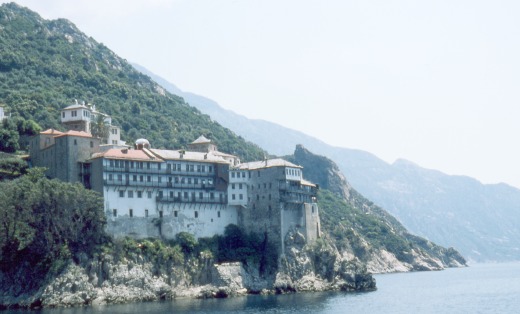 |
On the trip down the south coast, we round a craggy bluff, and I suddenly see, a thousand feet up, Simonos Petras, a multistoried monastery clinging to a cliff like a giant bird's nest. Then we travel on to Gregoriou Monastery, where I get off at the arsanas, the landing ramp and wharf of the monastery by the shore. This monastery rises from the sea rather than descending from the sky. The guesthouse is separate, and I am berthed with three Greeks who do not speak a word of English. In the reception room (arhondariki), the doorkeeper serves a Turkish delight (loukoumi), a glass of rakia (home-made Ouzo, which is to be tossed down in one gulp), a cup of Greek coffee (to be sipped slowly) and a glass of cool water.
I begin exploring this fascinating complex, especially the katholikon, which has exquisite wall paintings of Gabriel, Michael, Solomon, Ezekiel, David and an unusualicon of Paul and Barnabas. Usually the icons are of Paul and Peter holding up the church (one to the Gentiles and the other to the Jews), but this icon recognizes the strategic partnership of Paul and Barnabas. Mount Athos has preserved the largest collection of Christian art in the world, a heritage amassed over many centuries through the successive donations of Byzantine, Russian and Slav emperors. Each monastery has a treasure and the monks are proud to show their visitors the icons and paintings.
"Are you Orthodox?" a man asks.
I recall William Dalrymple's dilemma in nearby Lavra Monastery when he was tracking down the original manuscript of John Moschos's Spiritual Meadows in the monastery library. "Forgive me," the guest master asked him, "but are you Orthodox or heretic?"23
But this time, the man asking me is a long-term guest puffing one cigarette after another in the guesthouse lounge.
"Yes," I say, "I do have icons. Yes, I believe, as Peter says, that we can partake of the divine nature. Yes, I believe in the communion of saints. Yes, I believe we come to know God mainly through prayer rather than reason."
Later, at Vespers, I enter the first and second of the three sections of the church, thinking I have reserved the third part for the Orthodox, but once again the guest master asks the vexed question. I feel like saying, "Almost." Or, "I am not a heretic." But I say, "The Church of England." How can I explain non-denominational, free, unaffiliated, part-Baptist, part-Brethren, part-Anglican and part-community church? Can I say simply, "Christian?"
"Then you must move back to the narthex," he says.
After vespers we all move into the trapezaria (refectory) for a meal of beans, eggs, feta and bread, served with retsina wine and water. We eat silently, while there is reading from the pulpit, but at lightning speed. I am still wolfing down the last beans when the abbot (igoumenos) rings the bell. Seventy monks and thirty-six guests leap to their feet, and the abbot prays and leads a brief Eucharist. Unlike the meals, the refectory is beautiful. Every square inch is covered with wall paintings -- saints, biblical scenes and, over the head table, the Last Supper.
We are all ushered back into the church, this time into all three parts, except, of course, behind the iconostasis. The attending priest brings out four silver boxes, variously shaped, and thirty-five guests, myself excepted, kiss each of the boxes -- the skull of St. Gregory, a piece of the hand, the skin of a saint and, yes, a piece of the true cross of Christ. I cross myself and leave, only to be found in the monastery courtyard by the guest master, Father Damian.
Father Damian is the monk who excommunicated me to the narthex, but he offers me a CD and envelope as a "souvenir." Sitting outside in the quadrangle I open the envelope -- it is the story of Naaman and the story of Samuel and Saul.
The Jordan river of healing that springs from these two sources, the Jor and the Dan, symbolically stand for truth and obedience, and is named orthodoxy…Your faith in obedience to the truth will become the joy of your salvation. There is only one church -- the Orthodox. There hasn't been true spirituality in the West for 1000 years. The scholasticism of the West has destroyed true faith.
Later Father Damian takes me to the graveyard on the east side of the monastery at the edge of the bluff with an awesome prospect of the next two headlands. Dionysiou Monastery, my next visit, is hidden behind the last headland. One of the graves bears a cross indicating that the monk died at the age of 103. "His mind was still sharp. Monks here never suffer dementia," Damian assures me.
"Do you know Jesus?" I ask him.
"I am getting to know him," he replies.
"So am I."
"Greek," Damian continues, "is the most powerful language. It is impossible to translate into English psyche and nous. Wehave kept the tradition since the first council in Jerusalem. There is only one church and it is the Orthodox Church -- not that we can restrict the work of the Holy Spirit in other so-called churches."
I try another tack. "What have you found most helpful in growing in Christ?"
"I can't answer that question," he replies.
"Do you like being a monk?" I ask. Father Damian has told me that he is an English-born Greek who returned to England after a brief visit to Athos and then came here to spend his life.
"'Like' is not an appropriate word. It is the way for me. Do you have children?" he asks.
"Yes, three married children and eight grandchildren."
Damian responds, "I pray the Lord's blessing on them."
"Indeed," I say, "that is part of what I am doing on Mount Athos."
"What do you do?" he asks.
"I teach marketplace theology."
"What's that?"
"It is the integration of Christian faith with service and work in the world."
"It is not possible," he responds. "That's why I am a monk. It is very, very difficult to be a Christian in the world."
"But," I counter, "it is not easy being a monk. The demons are everywhere."
"Yes," continues Damian, "but it is much easier here when you have left the world."
Monasticism is a form of martyrdom, laying down one's life intentionally. In the past, and even at Athos, this has led to a variety of eccentric forms. There were grazing and browsing monks with no fixed abode, dendrites who lived in trees, statics who remained standing in open air, stylites on pillars and recluses locked in cells. Athos has developed largely through lavras, hermit colonies established around a church under the direction of a spiritual elder and monasteries under the direction of an abbot. One saying applies to all forms: "Keep to your cell, and your cell will teach you everything! Only in his cell is a monk in his element, like a fish in water."24
The monks work. Indeed, for the monk, work is spiritual. John Chrysostom elaborated the various aspects of this vocation of work: it creates a bond between people; it is a way of loving your neighbour; it helps the poor. Spidlik says, "The ideal model would be the work of monks. It is performed in an atmosphere conducive to prayer, accompanied by explicit prayers; it becomes in itself a prayer, because its motivation is charity."25 I ponder the business and professional person in the world that I serve. Perhaps the same advice holds. Do not leave and join a monastery (or become a pastor). Go deep where you are. Keep to your business and your business will teach you everything. It is your monastic cell. My cell on Athos, however, seems not so fruitful.
The Hebrew people began the day with nightfall: "the evening and the morning were the first day." The logic is persuasive. Just as Adam and Eve woke into God-consciousness on the sixth day to experience, first of all, not work but Sabbath, so we begin the day by resting, by trusting God enough to do nothing, to let God run the world while we sleep. Sleep is an act of faith. It was especially so last night, or I should say, the beginning of today. The sign inside the guest room door says not to leave money or valuables in the room lest they be stolen. Little did I guess that what would be stolen from me was my sleep.
I was placed, once again, across from the washroom with three young Greek men. The monastery doors, steel-clad and of fortress quality, are closed and locked at sundown. So it is good to turn in early, which I did at nine o'clock, but I did not anticipate the people factor. What I find so strange in this "mountain of silence" is that I am continuously running away from people to have silence. Spidlik deals with this perceptively. "A person is alone when he runs no risk of meeting another human being in his habitual living area. This is flight in the material sense. He is still alone as long as he does not converse with anyone. This is the solitude of silence. Finally, he is alone when his mind at its utmost depth has no interlocutor, when logismoi (thoughts) do not trouble his mind. This is the solitude of the heart."26 For the Hesychasts, one could not have stillness (hesychia) without material solitude. But last night I could not flee even in the material sense.
Across the hall in a smoke-filled room men laughed and guffawed until midnight. Down the hall another cluster talked noisily like crows on a summer morning. Two of my roommates came in and out, in and out, each time turning on the light (there is electricity here powered by a small hydro station and solar panels) and fidgeting with their bags. The third, already under the thick wool blanket when I entered, got up every fifteen minutes or so throughout the night, put on the hard plastic sandals kept next to each bed and steamed to the washroom across the hall, returning with a slam of the door.
"On my bed I remember you; I think of you through the watches of the night."27 I am thinking about the Incarnation: God really dwelling with us, sleeping foot to foot with the disciples, with all the irritations of thoughtless people. "Have I been with you so long…O foolish…Could you not watch with me one hour?" This reality is captured evocatively by a wall painting by the famous fourteenth-century iconographer Manuel Panselinos in the Protaton, the oldest church on the peninsula, located in Karyes. It shows the disciples graphically sleeping in the Garden of Gethsemane while Christ wages war in the Spirit.28 The Incarnation is the miracle of miracles and the greatest mystery: God in a roomful of imbeciles whom he loves and promises never to leave.
At 6:00 a.m. the huge Caterpillar bulldozer underneath our window surged into life, huffing and puffing to get started at the day's work moving a pile of gravel somewhere else.
Later, when Damian asked how I slept, I suggested that he put up a sign asking for silence between ten and six. He replied, "It wouldn't work. This is Greece."
Prince Charles was here last week at Vatopedhiou Monastery and I am sure he did not have to endure this. He arrived with thirty cases, including a satellite phone and his own food. The U.K. paper explained why: "The food is vile here."29 Perhaps that is a little too strong, but the food does sit on one's stomach late into the night until, finally and reluctantly, the digestive system capitulates. I try to imagine Charles in a room with two transient men and one beating an all-night trail to the water closet. The water closet is a strange, stand-on-the-floor device with a huge handle for flushing, which releases a noisy cataract like the throat of Foz de Iguaçu or the Niagara Falls, an almost deafening roar that can be heard in every room, or at least certainly mine.
Before breakfast Damian takes me out to the balcony overlooking the sea. We discussed several books we have both read and the mystical life. Meanwhile we watch a supply ship bringing in hardware and materials. There is no road to this isolated monastery; it can only be reached by ship and donkey trail.
"Technology!" quips Damian with a cynical touch.
The monastery was built in 1300 with monks carrying stones in packs on their back up the hill.
"In some monasteries," Damian continues, "there are original supporting timbers that are a thousand years old. And today we can only build for a hundred years -- or less. Look at these stones. The pointing is new, but behind the cement is a mortar that withstands the pounding of the sea. We know what the ingredients are but can't reproduce this waterproof cement. And the long horizontal timbers inserted in the courses of stones" -- I could see they were original and very weathered -- "are shock absorbers in this earthquake prone area.
"But the end is near. All of the monks on Athos have a sense that the time has come -- a war that will make the Second World War seem like a tea party -- an antichrist and then the Lord's second coming. It will be awesome, wonderful and glorious. But there will be no evacuation."
We say goodbye with mutual blessing. I have appreciated this soul friendship. Damian presses into my hand some postcard icons and a sermon on deification by the abbot of the monastery. It includes a prayer: "Merciful Lord, also guide the steps of heterodox Christians towards an awareness of Your Truth, so that they are not left outside Your bride chamber, deprived of the Grace of Deification. Merciful Lord, have mercy on us, and on Your creation. Amen."30 I am on my way again, this time to Dionysiou.
The journey to Dionysiou takes me over one of the most difficult vertical parts of Athos. While the total elevation is less than a thousand feet, this is scaled several times as I make my way around headlands, going up and down on rough rocks placed strategically and in an angular way to provide footsteps for the donkeys that carry in supplies and people. I make my way slowly and carefully, knowing that one badly twisted ankle could shut me down. The scenery is stark: jagged rocks protruding as one sees in the icons, a hanging waterfall a thousand feet above, wild flowers and an occasional rustling in the brush -- there are poisonous snakes on Athos. This is the desert -- not of sand, but the absence of the addictions of civilization, the seductiveness of signs and advertisements, the internet and, for the most part, cars -- creation raw and resplendent. No wonder some took to the trees and the pillars.
The first monastic foundation in Athos was established by St. Euthymius of Salonica in the ninth century. At the tender age of eighteen he took to moving around on all fours and eating grass. Sometime later he became a stylite and berated his brethren from the top of a pillar.31 I feel the absence of women especially. It is mandated by an imperial edict after, so the story goes, "the monks were in the habit of debauching the daughters of the shepherds who came to the mountain to sell milk and wool."32 It is relatively easy to be free of lustful thoughts when there is no temptation. But it is a strange world with only one sex, perhaps not what God intended at all, perhaps not even spiritually healthy. "Basil, by contrast, believed that in monasteries there was a need to converse with women for the sake of personal edification or to take care of business matters."33
Dionysiou
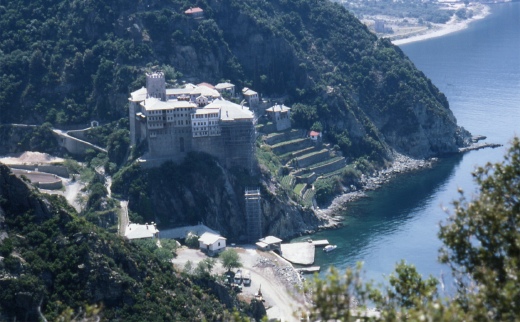 |
Nothing could have prepared me for the first sight of Holy Monastery Dionysiou. The sweat has drenched my hat, face, shirt and trousers. Rounding the last bend, I see it, gleaming in the morning sun like the Meteori monasteries perched on the top of huge rocks, a sanctuary castle built on an almost impregnable natural fortress, approached by stairs leading to a small opening capable of being fortified and locked against attack, with the inner doors clad in thick iron.
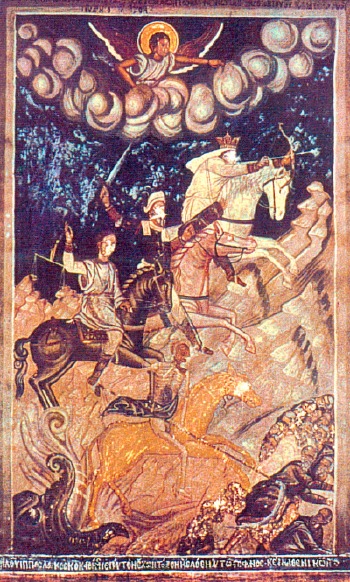
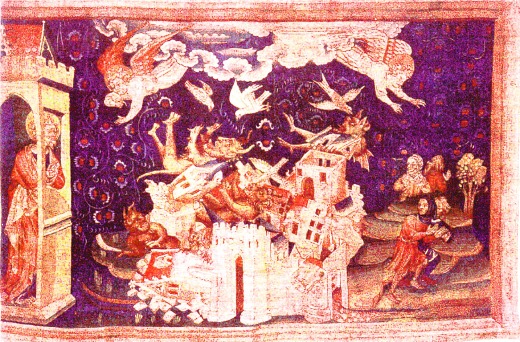
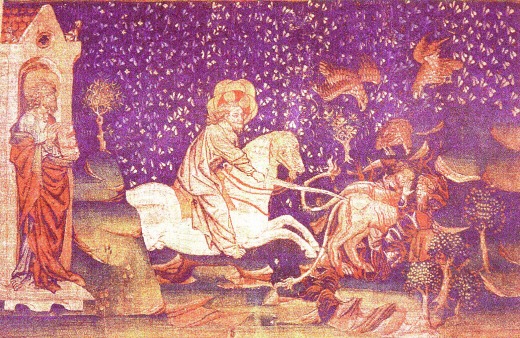
Upon arrival I discover the sixteenth century icons of the Revelation that I have seen in books. They are gloriously evocative, though sadly now in poor repair, with many of the faces defaced by the damp. I take three photographs, then am asked to desist. Scripture is everywhere here.
Spidlik notes, "St. Basil in particular affirmed an immutable principle: that every word and action must be checked against the witness of Scripture… Seraphim of Sarov, for example, read the entire New Testament once a week."34 But the fathers also distinguished two sources of faith: Scripture and "the mysteries of the church" -- or tradition, which connects dogma and devotion. It is tradition, so it is said, that is a progressive incarnation of the divine life in the concrete humanity of various cultures, accomplished by Christ through the Spirit, what amounts to a "progressive and dynamic deification."35
The welcome, however, is delightful, in spite of the photographic excommunication. The guesthouse is renovated and spotless. After signing the register and showing my diamonitirion to the doorkeeper, I am served the customary glass of cold water, Turkish delights, liquor and Greek coffee. Then to my room: a private room, a cell -- actually, the guest master's former cell. After last night's sleepless trial I am ecstatic. It is only six feet by seven feet with an archer's slit for a window, but it is private. I am alone. In silence and solitude my soul waits for God. "My soul finds rest in God alone."36
After vespers and dinner -- a simple plate of rice -- Father Ionnikos, who speaks excellent English, takes the three English speaking guests under his wing. There are three of us -- Barry from London and Pierre from Switzerland. He leads us through the church dedicated to John the Baptist, where there is a fourteenth-century icon of the Baptist rescued from a hermit on Mount Athos. Then he takes us upstairs to the main office, an immaculately embellished room with fine wood everywhere.
One of the monks, a photographer, photographed the hundreds of wall paintings in the monastery and composed a thick volume that has been published. We went through the volume page by page: the life of Christ, John the Baptist, Mary, the saints and the martyrs. Walking through the church and adjoining buildings is tantamount to reading both Testaments and the lives of the saints, the latter actually being read out loud from a text daily during meals in the refectory.
The day begins (at 9:00 p.m.) with a magnificent sleep in my monk's cell. "He gives sleep to his beloved"37 as the Lord builds the house and guards the city. Sleep is a ministry -- trusting God and renewing the soul.
Breakfast is Spartan -- two slices of hard bread and three olives, consumed without a bell demanding that we leave the refectory immediately, finished or not. The previous night my new traveling companion, Pierre from Switzerland, a medical doctor, barely got halfway through his meal. But this morning we eat without a bell on the guesthouse balcony, a cantilevered apparatus several hundred feet above the sea. The sun rises exquisitely on the other side of Agios Oros (the holy mountain), tossing slashes of light on the craggy ridges where just yesterday I hiked.
We decide to take the morning boat, Agios Anna, all the way to the end of the peninsula to see St. Paul Monastery (Agiou Pavlou) and the Skete of St. Anna. Approaching the edge of the peninsula, which rises from the sea at gravity-defying angles, the mountain emerges from the sea to over 6,000 feet without foothills or subsidiary landings. In the first thousand feet there are dozens of sketes and hermit cells, some clinging tenaciously to the edge of a cliff, inspiring the question of how the monks get there, how they get water and, more particularly, how they got the building materials there. These are, by and large, not temporary buildings but rockbuilt structures meant to last and built for solitude. St. Anthony, the founder of Eastern monasticism, has had a lasting influence on the Holy Mountain. His icon is everywhere and his life is read while monks subsist on the simplest of fare.
Ascetics, those who deny the world, or "love it not," to use John's phrase, or "mortify the flesh," to use Paul's phrase, are the models copied everywhere here. Asceticism is a training that involves perseverance, tolerating no rest and no inattention. This is the praxis of the desert. Abbot George explains, "Without ascetic endeavour, there is no spiritual life, no struggle and no progress. We obey, fast, keep vigil, labour with prostrations, and stand upright during prayer; all of this we do in order that we may be cleansed of our passions."38 The purpose is a quest for God and the growth of the soul. Spidlik explains the essential link: "the union of asceticism and mysticism is the doctrinal foundation of all forms of monasticism."39
A travel brochure says that the monks of Mount Athos live the ideal Christian life. I ponder this, knowing that only four days of deliverance from the media, the Internet, the lust of the eye, the lust of the flesh and the pride of life have been instrumental for centering on God, without distraction, wholly and directly. Significantly the dedication of Holy Monastery Dionysiou to John the Baptist is, as a concluding coda to my pilgrimage, a true beginning. On the fresco at the entrance of the monastery, John holds a scroll with the words (in Byzantine script): "Repent for the kingdom of heaven is at hand." John reminds me that repentance is not a once-for-all conversion, but a life of continuing conversion. But there is another pole of spiritual patterning in Scripture.
Ascetic practice, as Eugene Peterson says, "sweeps out the clutter of the god-pretentious self, making ample space for Father, Son, and Holy Spirit; it embraces and prepares for a kind of death that the culture knows nothing about, making room for the dance of the resurrection."40 But alongside the ascetic is the aesthetic, God's yes to match God's no. Peterson notes this theme in the story of the transfiguration:
"Peter, James and John see Jesus transfigured before them on the mountain into cloud-brightness in the company of Moses and Elijah, and hear God's blessing…Everything fitting together, the luminous interior of Jesus spilling out onto the mountain, history and religion beautifully personalized and brought into deep, resonating harmony, the declaration of love."41
The world drains the beauty out of people, as Peterson says, but so does a lot of religion. There certainly is beauty on the Holy Mountain with its wall paintings and icons -- thousands of them. It is effulgent with the glory of God just as Ezekiel foretold it: "the land was radiant with his glory."42 The Apocalypse with its luminous presentation of the lion and the lamb in heaven ruling with the mighty angels, serving, implementing, protecting, the icon of the harrowing of Hades (the Anastasis), the icon of the ascension and the Pantokrator ruling over all the principalities and powers -- all of these reveal beauty, but I perceive little joy here, especially in the liturgy, which often seems like a protracted moan. It is hard to hold together both world-denial and world-love, God's no and God's yes, the ascetic and the aesthetic, hard to hold all of this within the love that is before and above all loves, the love of God.
I have learned much by coming to the Holy Mountain -- the need for simplicity, the call to continuous repentance, moment by moment trust in God, contemplation as the normal Christian life, the mystery of God, the communion and modeling of the saints, the long and fruitful tradition of the church, intercession and the absolute centre of spiritual theology in prayer. ("Do you teach your students to pray?" asked Father Damian.) But to deepen my journey in aesthesis, I must return to my work, to my world and to my wife. As the preacher said, "Enjoy life with your wife, whom you love."43 But I will take with me what I have learned from the mountain of silence.
"Together with all the saints," Paul says, we can "grasp how wide and long and high and deep is the love of Christ"44 -- African, Eastern European, American, Orthodox, Catholic and Protestant. We, in the West, need our Orthodox brothers and sisters -- and they need us, too, though it appears that they do not see this need.
Mary needs Martha and Martha needs Mary. We need both lungs, West and East, for proper breathing.
Paul Stevens is the David J. Brown Professor of Marketplace Theology and Leadership at Regent. This article originally appeared in the December 2004 issue of CRUX.
Photo credits: Apocalypse images by Harold Neufeld / All other images by Paul Stevens.
Endnotes
1 Athanasios A. Karakatsanius, ed., Treasures of Mount Athos (Thessaloniki: Museum of Byzantium Culture, 1997), 133.
2 Archimandrite George, Abbot of the Holy Monastery of St. Gregorios, Mount Athos, "Deification: The Purpose of Life," (unpublished), 12.
3 Tomas Spidlik, The Spirituality of the Christian East: A Systematic Handbook (Kalamazoo, Mich.: Cistercian Publications, 1986), 37.
4 Kyriacos C. Markides, The Mountain of Silence: A Search for Orthodox Spirituality (New York: Doubleday, 2001), 8.
5 Timothy Ware, The Orthodox Church (Harmondsworth, UK: Penguin Books, 1983), 269.
6 Helen Bacovcin, trans., The Way of the Pilgrim and The Pilgrim Continues His Way (Garden City, NY: Image Books, 1978).
7 Spidlik, The Spirituality of the Christian East, 317.
8 Ibid., 308.
9 Ibid., 37.
10 Ibid., 72.
11 George, "Deification: The Purpose of Life," 38.
12 1 Jn 1:3.
13 2 Cor 3:18.
14 George, "Deification: The Purpose of Life," 8.
15 Spidlik, The Spirituality of the Christian East, 355.
16 2 Pt 1:4.
17 Spidlik, The Spirituality of the Christian East, 214.
18 Ware, The Orthodox Church, 42.
19 Leonid Ouspensky and Vladimir Lossky, The Meaning of Icons, trans. G.E.H. Palmer and E. Kadloubovsky (Crestwood, NY: St. Vladimir's Seminary Press, 1983).
20 Ps 65 (The Message).
21 George, "Deification: The Purpose of Life," 12.
22 Kriton Chryssochoidis, Mount Athos: The Kellia of Karyes (Thessaloniki: Hagioritiki Hestia, 2004).
23 William Dalrymple, From the Holy Mountain: A Journey in the Shadow of Byzantium (London, UK: HarperCollins, 1998), 9.
24 Spidlik, The Spirituality of the Christian East, 213.
25 Ibid., 168.
26 Ibid., 212.
27 Ps 63:6.
28 Manuel Panselinos, From the Holy Church of the Protaton (Thessaloniki: Hagioritiki, 2003), 197.
29 Geoffrey Levy, "Charles and a most unorthodox visit," Daily Mail (Thursday, 13 May 2004): 13.
30 George, "Deification: The Purpose of Life," 5.
31 Dalrymple, From the Holy Mountain, 4-5.
32 Ibid., 5.
33 Spidlik, The Spirituality of the Christian East, 223.
34 Ibid., 5.
35 Ibid., 8.
36 Ps 62:1.
37 Ps 127:2.
38 George, "Deification: The Purpose of Life," 22.
39 Spidlik, The Spirituality of the Christian East, 180.
40 Eugene Peterson, "Saint Mark: The Basic Text for Christian Spirituality," in Exploring Christian Spirituality: An Ecumenical Reader, ed. Kenneth J. Collins (Grand Rapids: Baker Books, 2000), 335.
41 Ibid., 335-6.
42 Ez 43:2.
43 Eccl 9:9.
44 Eph 3:18.