
Merton's spirit shines In the Dark Before Dawn
BC Christian News, · Arts
• Lynn R. Szabo (ed.): In the Dark Before Dawn: New Selected Poems of Thomas Merton, New Directions, 2005
I think poetry must
I think poetry must
Stay open all night
In beautiful cellars
Canto 53 (Cables to the Ace)
Thomas Merton
"PUT SIMPLY, Merton is one of our great poetic talents of the 20th century," wrote Robert McDowell in The Hudson Review, and the Canadian West Coast has done much to encourage and promote the visionary life and thinking of Thomas Merton.
A key 1978 conference at the University of British Columbia birthed two seminal books: Thomas Merton, Monk and Poet: A Critical Study (1978), by poet and UBC lecturer George Woodcock; and Thomas Merton: Pilgrim in Process ((1983), edited by Simon Fraser University humanities lecturer Donald Grayston and St. Jerome's University president Michael Higgins.
The Eighth Conference and General Meeting of the International Thomas Merton Society was held at UBC June 5 - 7, 2003. This further consolidated the role of the Canadian Pacific Rim in Merton studies.
UBC English professor Ross Labrie has been a towering Canadian figure in the world of Merton scholarship. One of his students was Lynn Szabo, professor of American literature at Trinity Western University and a Shannon Fellow in the International Thomas Merton Society. With In the Dark Before Dawn, she goes further into Merton's poetry than Woodcock, and sensitively complements the work of Labrie.

Thomas Merton (1915-1968) was known for many things, from his writings on contemplation to his anti-war activism. There is no doubt that, at the core of Merton's soul, he was a poet - and an incisive and insightful one.
The poetic impulse was in Merton from the beginning to the end of his journey, and he engaged many of the major poets of the 20th century. Merton had a unique way of heeding the most demanding questions of modern poets.
Szabo suggests, in her well crafted introduction, that Merton's literary mentors were Joyce, Eliot, Auden, Lowell, Williams, Levertov and "some of the Beats," and that he was taken and held by such Spanish and Latin American poets as Lorca, Parra, Neruda, Cuadra, Cardenal and Grinberg. Pasternak and Milosz called forth much from him, and Blake and Hopkins lived in his 'beautiful cellars.'
Merton refused to flinch from the hard questions, and he offered a challenging perspective on the substantive issues of the time.
In the Dark Before Dawn offers us a sustained taste for Merton at his most evocative. The table is spread wide, and the feast is laid out in all its fullness. Szabo has arranged Merton's poetry to reflect his varied tendencies and inclinations. The reader cannot but be held by the wide range of Merton's interests and commitments.
In the Dark Before Dawn is divided into eight sections: Geography's Landscapes; Poems from the Monastery; Poems of the Sacred; Songs of Contemplation; History's Voices: Past and Present; Engaging the World; On Being Human; and Merton and Other Languages.
Each of these sections, in an exquisite and nuanced way, draws deep from the well of Merton's life-giving poetic struggles. Merton refused to separate the sacred from the secular, the inner from the outer, contemplation from politics, eternity from time. It was in his willingness to face into the storm of the modern world, and write about it in a compelling way, that Merton can still speak to us.
This collection of poetry does two important things that previous compilations of Merton's poetry have not.
First, Szabo says, "The current selection seeks to include more poems from the latter period of Merton's writings, with considerable representation of the antipoetry collected in Cables to the Ace (1967) and The Geography of Lograire (1968))." Second, Szabo has included the controversial love poetry written to a nurse Merton met when he was ill and hospitalized. Most of these poems have been held, thus far, in private collections.
Merton had a fondness for the silent season when much was quiet, while yet yearning for life in the dark before dawn. It was from such a place that he heard and wrote. As dawn passed and day arrived, Merton then spoke from such a listening post.
In the Dark Before Dawn highlights, in the clearest and most poignant manner, the life and light Merton managed to see in the dark before the dawn.
This needful and timely text is a must read for those keen to feel the beating heart - and mind on fire - of Merton as poet, contemplative monk and political activist.
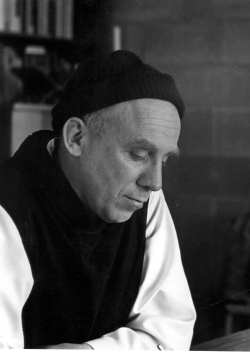
Thomas Merton: prolific author, anti-war activist and Trappist monk Right: Merton scholar Lynn Szabo