
Nursing a heart for motherless kids
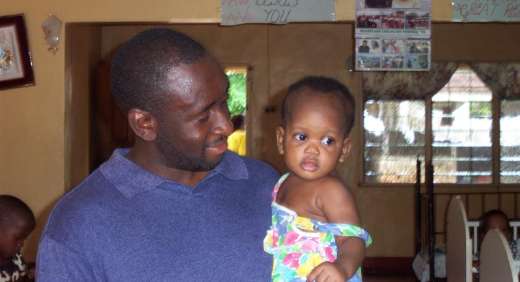
IT'S NOT every day you meet a young man who's more at ease caring for infants than fixing cars - but then not every man has grown up sharing his home, and his childhood, with over 200 babies.
Chidi Anyanwu's parents have been taking care of abandoned babies in Nigeria for the past 27 years. During that time, their small home was transformed from an average family-of-four size home, to a nursery providing care for up to two dozen infants at a time.
That probably explains why, after earning his Bachelor of Science degree, Chidi Anyanwu was determined to study nursing instead of medicine, despite obvious stereotypes and social status associated with the two fields.
"Nursing is a caring profession," explains Chidi. "It's not about diagnosing and singling out a certain ailment, it's about seeing the individual as a whole. Nursing allows me to encompass everything I've seen in African societies particularly in dealing with motherless babies.
"When you deal with babies, you're not just dealing with their needs, but you're also dealing with the extended family. It's really about community education."
With his freshly-minted nursing degree from from Trinity Western University (TWU), Chidi, 32, is eager to gain more hands-on experience; thus, for the next year, he will be working at Canadian hospitals such as Peace Arch in Surrey. He will also spend a month in Nigeria this fall.
Eventually, he plans to return to his Nigerian hometown to help run the Comprehensive Community Health Initiative - which includes Grace Hospital, a rural health facility opened by Chidi's parents in May.
Though Chidi's parents, Ambrose and Lynda Anyanwu, have successfully established three other organizations - The Eziama Motherless Babies Home, King's Kids Elementary School, and Elijah Memorial Skills Acquisition Center - starting social programs wasn't their original intention when they first moved from Vancouver to the African community of Eziama.
"Eziama is a grouping of 80,000 people in 23 villages, in a very rural part of Africa," explains Chidi. "For many years the community had been literally torn apart by war, superstition, poverty and a lack of health services and education. My parents returned there after attending Bible school in Canada, intending to plant churches."
Chidi explains that Eziama was where his dad had grown up. As the son of a chief, Ambrose was sent overseas to study, with the intention that he would come back as a prominent person who would help the community. Initially intending to become an engineer, Ambrose switched his area of study from engineering to pastoring while in Canada.
"They began the normal missionary process, but two weeks after we arrived in Eziama, a woman died giving birth, one village over," says Chidi, who was five when it happened. "In those days the custom was to leave the baby to die, because it was deemed responsible for the mother's death. And according to superstition, harm would come to anyone who cared for the baby."
After hearing about this baby, Chidi's mom went to the village, took the baby home, and cared for it. The community watched and waited, expecting doom to fall on the Anyanwu family. When nothing bad happened, word spread about this family who cared for babies.
Within six months of their arrival, Chidi's parents found themselves caring not only for their own two small children, but for 24 newborns that had been brought to their doorstep - all within their small house.
Today, 25 years later, the Eziama Motherless Babies Home provides effective care for infants in need. Home-staff care for the infants until they are 18 months old and can either be adopted or returned to their families.
Since arriving in Nigeria, the Anyanwu family has rescued over 200 babies, and succeeded in breaking the superstition that these children bring a curse.
Motherless babies weren't the only group in Eziama affected by the Anyanwu family. In 1991, an elementary school was established to provide accessible education for underprivileged children. Now enrolling more than 500 kids, the school is expanding to a high school.
They have also planted 10 churches, and opened a skills acquisition centre for poor uneducated girls - who are often the most vulnerable people in African societies.
Education, says Chidi, "is an exit [from] poverty."
Contact: Hungry For Life International: (604) 703-0223
or Angelag@hungryforlife.org