
What next for Africa?
 |
A FORCEFUL anti-poverty message - voiced by notables ranging from Pope Benedict XVI and Nelson Mandela to Bill Gates and Paul McCartney - echoed across the world's media last month, focussing attention on the planet's weakest continent and its most powerful men.
As the leaders of Britain, France, Germany, Italy, Russia, Japan, America and Canada met in Gleneagles, Scotland for the G8 Summit July 6 - 8, they were aware of the heightened expectations - at one point granting a private audience to anti-poverty rockers Bono and Bob Geldof.
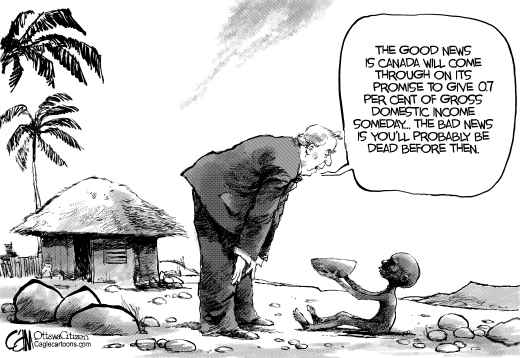
The activists urged the G8 to cancel the debts of most African countries; and to commit to the United Nations' goal of getting all developed nations to donate 0.7 percent of their gross national income (GNI) to foreign aid.
Their message was sent mainly through music, as the star-studded Live 8 concerts were held July 2 in each of the G8 countries - with a ninth in South Africa. At the London concert, event organizer Geldof declared: "Mahatma Gandhi freed a continent, Martin Luther King freed a people, Nelson Mandela freed a country. It does work. They will listen."
Such high-flown sentiments were irrelevant to some observers. "A week from now the greatest rolling rock concert in history will be just that - history," opined National Post commentator Bruce Garvey. "Poverty and corruption will still reign in Africa."
British website ChristianToday.com had a different take on the event: "With more than 26 million people worldwide sending text messages to offer support for Live 8 on Saturday, several billion tuning in on television, and more than 200,000 marching through the streets of Edinburgh, it would seem that the world has given its firm backing for the leaders to do whatever is necessary to fight the plague of poverty."
A
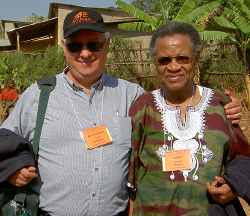 |
frican Enterprise CEO David Richardson told BCCN that the Live 8 concerts had sparked an "excellent awareness of the need to face and to tackle poverty - the root of most of Africa's problems . . . Holding G8 to their own previous promises and commitments was good, too. However they were perhaps too prescriptive about the 'how and where' of the financial aid. Rock groups are not in the best position to determine this."
Christian message
The Live 8 message was bolstered by prominent expressions of Christian faith. U.S. and British church leaders issued a joint statement June 29 at Lambeth Palace in England, declaring: "We believe God judges nations by what they do to the poorest. This means all of us in the prosperous world - governments, churches, the media and populations - stand under judgment, to the degree that we fail to respond to such a situation with costly compassion and generosity."
The same day, the World Evangelical Alliance's B.C.-based international director, Geoff Tunnicliffe, stated: "Measures to fund anti-poverty budgets, cancel debt or set trade rules right, are only half measures or less . . . . Even if the full measure is within the world's ability to provide, it is still not up to the standard of Christ and the scriptures. Only the church, whom God has charged with the mandate to care for the poor, can help to complete the healing process."
The G8 leaders agreed to double their current levels of aid by 2010; however, there were no new commitments to the 0.07 percent target.
"Overshadowed by the London bombings, the Gleneagles G8 Summit achieved little to advance the goal of 'making poverty history,'" responded the church-based Canadian coalition, KAIROS. "Too little was done to write off illegitimate debts or remove the harsh conditions attached to debt relief or to reform the international trading system. As a result, more wealth will continue to be transferred from the impoverished to the affluent than will return in the form of aid."
The G8's commitment, said Richardson, is "a great start if they deliver - but no more than a start. Last year, the U.S.A. gave $69 billion in total to foreign aid. However, they spent $500 billion on the Iraq war - so you can see where the real gap is."
Canada, he stressed, "is no different. When Stephen Lewis is asking Paul Martin for .7 of one percent of Canada's GDP to be given to AIDS in Africa by 2020, you begin to see how far we still have to go in becoming the 'generous' nation we claim to be - and certainly could be, given the display of public compassion and generosity following the tsunami."
While groups such as Micah Challenge Canada continue with political lobbying efforts, some Christians have taken it upon themselves to conduct their own creative campaigns.
Magnificat
Award-winning Canadian musician Steve Bell recently sent out an eloquent email exhorting Christians to become more involved. Referring to the Virgin Mary's famous Magnificat speech in Luke 1:46-55, he asserted:
"I find it rather compelling that the conception of Christ in the womb of Mary signals the leveling of power and economic disparity . . . 'He has satisfied the hungry with good things and sent the rich away with empty hands.'" Bell is inviting people to respond at his website, steve-bell.com
Politicians acknowledge that faith-based initiatives have been effective. Britain's Chancellor of the Exchequer Gordon Brown, who spoke at a Christian Aid event in Edinburgh July 2, told the BBC: "I think you've seen that ministers around the world have been affected by the strength of public opinion, churches, faith groups - and it does have an impact."
Christianity has been a key factor in one country which has surpassed the 0.7 percent goal, giving 0.95 percent of its GNI to foreign aid. Speaking July 4 on CBC's The Current, Norway's Minister of Development Hilde Johnson said "77 to 80 percent" of her countrymen support anti-poverty efforts. Asked why, she cited "Christian values, the responsibility for your neighbour [and] a strong missionary tradition."
Canada lagging
It's a different story in Canada, according to an Ipsos-Reid polls commissioned just before Live 8.
"Six in 10 Canadians say they believe the concerts . . . can help the world's poorest continent escape its plight," reported CanWest, adding: "But once informed that the government is being asked to make a five-fold increase in annual foreign aid contributions . . . 59 percent of those polled said the money would be better spent on health care and domestic social programs."
Edmonton MP David Kilgour finds these figures troubling. As Secretary of State for Africa from 1997 to 2002, he visited 35 African nations. Canadians, he told BCCN, "are a major part of the problem . . . We're not pulling our weight in development assistance." He would like to see Canada honour Prime Minister Lester Pearson's 1968 commitment to the UN's 0.7 target.
The corruption of many African governments has been stressed by several critics, who have expressed skepticism about the effectiveness of Western altruism.
Megalomaniacs
"The list of African leaders who have abused their power for personal gain is long, dominated by kleptomaniacs and megalomaniacs" wrote Peter Goodspeed in the Post, citing Uganda's Idi Amin and Zaire's Mobutu Sese Seko.
 |
A similar concern was expressed at Live 8 by outspoken Christian musician Bruce Cockburn, who asserted: "Those corrupt leaders have been historically propped up in the position they're in by the same countries, the G8 countries, that we're addressing today."
"No doubt there's all kinds of corruption in Africa," responded Kilgour. "But there's also plenty in Canada. Some African governments are really trying to deal with the corruption problem - but very few people know this." He cited Tunisia, Botswana, Ghana, Benin, Mali and Mozambique, adding: "Senegal is good, relatively speaking; and South Africa is improving."
Megalomaniacs
"The list of African leaders who have abused their power for personal gain is long, dominated by kleptomaniacs and megalomaniacs" wrote Peter Goodspeed in the Post, citing Uganda's Idi Amin and Zaire's Mobutu Sese Seko.
A similar concern was expressed at Live 8 by outspoken Christian musician Bruce Cockburn, who asserted: "Those corrupt leaders have been historically propped up in the position they're in by the same countries, the G-8 countries, that we're addressing today."
"No doubt there's all kinds of corruption in Africa," responded Kilgour. "But there's also plenty in Canada. Some African governments are really trying to deal with the corruption problem - but very few people know this." He cited Tunisia, Botswana, Ghana, Benin, Mali and Mozambique, adding: "Senegal is good, relatively speaking; and South Africa is improving."
Western media, he said, tend to focus on the likes of Zimbabwe's Robert Mugabe. "There are some wonderful examples of success stories, which get too little attention."
Richardson emphasized that Canadian government aid to African regimes "needs to be well researched. What I believe is a much better way to go is to recognize that there are many very experienced organizations on the ground in Africa, which have proved their capability and integrity - such as World Vision, OXFAM, Red Cross, African Enterprise, Food For The Hungry and many more.
"There should be close liaison and cooperation between governments, financial foundations, UN Agencies, NGOs and indigenous agencies - which can deliver both money and services, using trained staff on the ground where the aid is needed. It is possible to bypass any group or government about whom there may be concern or doubt. Simply handing over money or equipment or supplies to African governments without appropriate research is asking for problems."
New paradigm
Another Christian proposing practical solutions is Canadian Chuck Stephens, who works in South Africa with the Lowveld Centre for Life-Long Learning - which has a branch in North Vancouver.
Stephens has written that Canada's support for various NGOs (non governmental organizations) "was a good idea - until two out of every three African university graduates was knocked out by the combined forces of the brain drain and the AIDS pandemic. A new paradigm is needed . . . It should emphasize the deployment of Canadian know-how, expertise and technology. This is not recolonization, it is common sense."
Jaco Jacobs of White Rock-based SWAM (South West Africa Mission), has described poverty as one of the chief obstacles to evangelism in Africa. While he cited various causes for the continent's destitution, he emphasized one in particular. In the Bible's prophetic books, he stated, "strong accusations are made about the unjust behaviour of powerful people who trample on others and thus cause poverty, and even take away from the poor what they still possess. The reason for poverty in this case is the sin of the oppressor."
Next steps
Asked what anti-poverty activists should do next, Kilgour said: "Go and see your MPs, and look them in the eye. Ask them: 'Why isn't Canada fulfilling the Pearson goal? When did Canada get known for not being generous, and for having a heart the size of a small turnip?'"
He and other believers, he emphasized, have a crucial role to play. "The Christian community in Canada has done a tremendous amount. Who knows what the ripple effect is?"
"It is long overdue, and essential, for the 'have nations' to share with the 'have-not' countries," said Richardson. "There is enough food and money to go around - if we have the will to share it." Christians, he said, should "pray and go, and offer their many gifts and services to those who need them desperately. Often, those who go return having been more blessed than those they have so wonderfully served."
Jacobs stressed the need for a new perspective on Africa's poor. "We may no longer speak of 'them and us.' We are all God's children, and these brothers and sisters are dying of AIDS, famine and crime."
Change, he said, "is now more necessary than ever. Silence or inaction should no longer be an option. Poverty is still unjust, and a realization that one is completely dependent on God . . . Africa desperately needs people of faith working together for change. This call to action could not be more clear in the face of the devastation poverty brings to individuals, families and communities."