
Broken Flowers is deadpan yet sensitive
BC Christian News, · Arts
 |
 |
NOW that the action movies have come and gone, it turns out the surprise hits of the summer are a G-rated documentary and an R-rated comedy, both of which concern the mating season.
March of the Penguins is a cute, if overly anthropomorphic, look at the breeding grounds of Antarctic penguins; while Wedding Crashers is a raunchy, but sweet, tale of two bachelors who bluff their way into the weddings of total strangers to pick up bridesmaids.
The latter film may have blazed a trail for other R-rated comedies like The 40-Year-Old Virgin, which stars Steve Carell (the scene-stealing broadcaster in Anchorman and Bruce Almighty). The film plays on every stereotype about virgins imaginable, and it is extremely coarse.
However, parts of it ring quite true; and I was especially pleased by the film's conclusion, which hints at a deeper, more virtuous truth. The film treats all of its characters like members of one gigantic freak show, but in the end, those who wait turn out to be the sanest people of all.
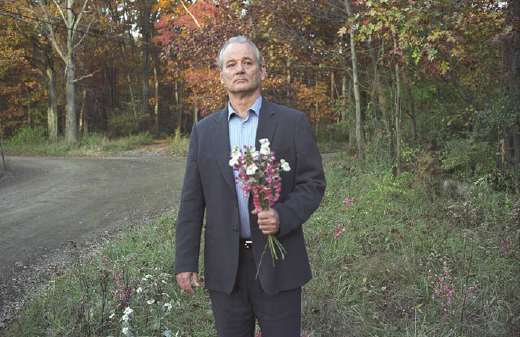
In contrast to these other films, Jim Jarmusch's Broken Flowers is a remarkably deadpan yet sensitive portrait of a bored ladies' man (played by Bill Murray) who re-evaluates his life. Don Johnston ("with a T") has just been left by the latest in a long string of lovers when an anonymous letter arrives, indicating that he just might have an adult son.
Don's neighbour encourages him to track down the women he knew during this time in his life, and the resulting trip is an interesting mix of regrets and, if not hope exactly, then at least the hope of finding hope.
As we meet these women one by one, it is difficult to believe that Don should have stayed with any one of them; as my colleague Jeffrey Overstreet has pointed out, they seem to embody the truth that glamour, wealth, and other earthly things are ultimately not that satisfying.
But what's most impressive about the film is its empathy. Jarmusch has said that he did not like Murray's character, but he went out of his way to try to feel for him; and thus, he has made a film that encourages us to see the humanity in even the most spiritually comatose of people.
• • •
Horror films are all the rage these days - and since the genre deals explicitly with questions of good, evil and the supernatural, Christians ought to be out there making them. That, at least, is the position taken by Scott Derrickson, a screenwriter who has worked on Urban Legends: Final Cut, Dracula 2000 and Hellraiser: Inferno, the last of which he directed.
Derrickson's second film as director will be The Exorcism of Emily Rose, which was shot in Vancouver late last year. The film is loosely based on the true story of Anneliese Michel, a Bavarian girl whose death during an exorcism resulted in the priest being tried in court for negligence.
Derrickson himself is a Christian, and his favourite film of all time is Akira Kurosawa's Ikiru, a heartwarming parable about a salaryman who finds new meaning in his life after he discovers he has terminal cancer. So we can probably expect more from Derrickson's film than mere shock value.
Although I have not seen it yet, I interviewed Derrickson recently, and he had many interesting things to say about art, the film industry, and his theological reasons for making scary movies. The full interview will be posted at my blog closer to the film's release September 9.
• • •
Italian directors of a certain generation inevitably turned to their Catholic roots for inspiration from time to time, and at least two - Pier Paolo Pasolini and Roberto Rossellini - made films about the life of Christ. Federico Fellini - the subject of a month-long retrospective at the Pacific Cinematheque September 1 to 26 - never went quite that far, but Christian themes do come up in a number of his films.
For example, Catholic critics such as Lloyd Baugh have argued that certain characters in La Strada (playing September 2, 3) and Nights of Cabiria (September 8, 11) could be seen as Christ figures; and La Dolce Vita (September 9), a three-hour meditation on the emptiness of celebrity culture, is famous for its use of Christ imagery in its opening and closing scenes.
The series also includes Il Bidone (September 8, 12), about three con men who pose as priests; and Toby Dammit (September 15, 19), in which Terence Stamp plays a drug- and alcohol-addicted actor who comes to Rome to play the lead in a Vatican-financed spaghetti western about Christ.
For all the appreciation Fellini's films have received from some Catholic critics, a few were also condemned by the Vatican of their day; so, as always, let the moviegoer beware. Call 604-688-FILM for showtimes.
• • •
Two very different biblical movies are coming to DVD for the first time this month.
The silent 1925 version of Ben-Hur holds up pretty well - even against its more famous remake, which starred Charlton Heston. In some ways, the original feature is the more explicitly Christian of the two. The remake has been available in DVD for some time, but not the silent film; however, both will be released, along with the usual making-of features and commentaries, in a four-disc package September 13.
Then there is The Small One, a half-hour Disney cartoon about a Judean boy who has to sell his little donkey. Guess who buys it for his pregnant wife? This 1978 short was directed by Don Bluth, a Mormon who went on to make animated features like The Secret of NIMH and The Land Before Time. It will be featured, along with the 1983 short Mickey's Christmas Carol, on Classic Holiday Stories, a DVD that comes out September 27.
Peter Chattaway's weblog is at: filmchatblog.blogspot.com