
Cross-border ride highlights Darfur's plight
BC Christian News, · International
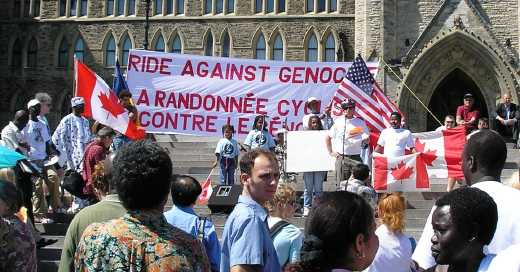
THE RIDE Against Genocide was a 960-kilometre bicycle journey to increase awareness of the strife in the Darfur region of Sudan. Many observers maintain that the people of Darfur are facing mass extermination.
The ride began when Professor John Weiss left Cornell University in Ithaca, New York on July 11. On Parliament Hill in Ottawa August 7, Weiss and other riders presented a petition to Canadian Parliamentarians.
"It was an overwhelmingly positive response," independent MP David Kilgour told BCCN. "In each of the 23 communities where the riders stopped, no one refused to sign the petition." Kilgour was host of the rally, and is well known for his Christian faith.
The petition urges the Canadian and American governments to undertake a "far stronger and more rapid use of our joint military assets, in the pursuit of security and peace in Darfur." It calls for a mandate, for any troops deployed, to allow them to protect civilians and aid workers with all means necessary. It also calls for enactment of the Darfur Peace and Accountability Act in America and Canada. This act would impose harsh sanctions against the Sudanese government, strengthen the arms embargo on Sudan, and send a U.S. presidential envoy to the region.
"One thing we uncovered in talking to people along the way was the attitude that 'Africa's always a mess' - and 'What are we going to do, anyway?'" Weiss told BCCN. "We were able to answer this, tell them what is really happening."
The European Union and NATO have agreed to help bring in 5,000 more African Union Mission troops and provide them with better equipment and training, with Canada pledging the most funds.
"We come with a special sense of urgency because, as 10,000 people a month die in the refugee camps or in hiding, Canadians are being led down a primrose path," Weiss told the crowd at the rally, adding: "[It is] a path lined not with primroses, but with the bodies of Darfuri individuals - and the severely wounded bodies of the cultures that made them distinct peoples, brightly colored tiles in the human mosaic."
Weiss told the crowd not to be fooled by the assurances of various world leaders that the genocide will end by September 30. "We are told that the matter is now [one] of humanitarian aid: deliver enough food, drill enough wells, handle the disease, pacify the bandits."
Kilgour insisted that this isn't enough. The attacks on villages may have died down, he said, but only for lack of villages left to overtake.
"Many people have fled to Chad, or are in camps - one of which had 235,000 women and children in it. But still, people are dying of starvation, and women are being raped."
If drivers of non-governmental organizations' (NGOs') vehicles cannot get through to the camps, 100,000 people a month could die.
"The Janjaweed [militia] have threatened to kill the drivers," Kilgour said. "They control everything that goes in and out of the camps."
Weiss told BCCN that he is making what he calls a "solidarity film" to take to the refugee camps in Darfur and Chad - to show the people that North Americans and Europeans know about their situation, and to show them what the countries who care about them look like. These refugees, he said, "think they are alone and that no one cares. All they know are their own problems. We try to show them what America and Canada look like - and then how people are caring about them, from different places in the world."
Several hundred people showed up to the rally, emceed by Darfur-born refugee Tradji Mustafa. Speakers included Kilgour; H.E. Cissy Helen Taliwaku, high commissioner of Uganda; Fuad Didic of the Bosnian Embassy; Rabbi Dr. Reuven Bulka; and Canadian Friends of Sudan founder Justin Laku.