
Merton encouraged the Pacific Northwest's Beat enclave
BC Christian News, · Editorials
By Ron Dart
Great things are done
when men and mountains meet.
This is not done by jostling in the street.
William Blake
IT IS 50 years since key denizens of New York's bohemian Greenwich Village met the equally fabled ecological pioneers of America's west coast. This 'summit meeting' put the urban east's Allen Ginsberg and Jack Kerouac together with the rural west's Kenneth Rexroth, Gary Snyder and Philip Whalen.
The literary, spiritual and political encounter at the historic Six Gallery reading in San Francisco October 13, 1955 helped to launch the 'counter culture' of the 1960s.
There is no doubt that the 'Beat generation' of the 1950s were in search of a deeper notion of religion. Most of them turned to the contemplative traditions as a response to most forms of Christianity then current. The language of Jesus was held high by the church; but it had been gutted, and emptied of substantive meaning and power. The Beats saw this, and set out to find pearls of greater price.
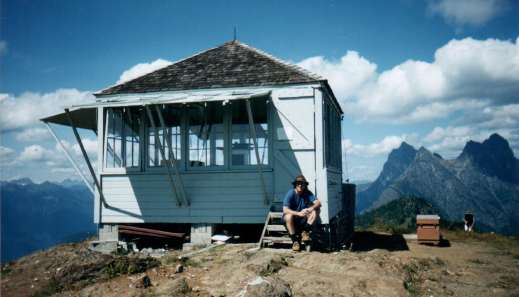
Many of them - notably Rexroth, Snyder, Whalen and Kerouac - helped build lookouts in the North Cascade mountains. This journey to the peaks was a turn to the contemplative way - in opposition to the urban hurly-burly in the valley. The distractions of the city were gone on the peaks. In such a place, all are forced to face what there is of real worth on the far side of success - and to face the deceptive nature of the chameleon ego.
Writer and monk Thomas Merton turned to the contemplative way in the 1940s - and by the 1950s, he was an honoured master on the mystical trail. Merton corresponded with Rexroth in the 1940s. Rexroth thought Merton was the best Roman Catholic poet in the U.S.; Merton's autobiography, Seven Storey Mountain, encouraged Snyder to continue his hike down the meditative path; and Kerouac dedicated two poignant poems to Merton in the 1960s. Merton's famous 'Fire Watch, July 4, 1952' article was written at the same time as Snyder's reflections from the Crater and Sourdough lookouts. Merton and the Beats were on the lookout for something profoundly transformative.
In a very real sense, the peaks of the North Cascades became the modern Pacific Rim equivalents of Orthodox hermitages and monastic desert cells. Lookouts perched on rock rims can teach much to those with eyes to see. From such heights, the stars of the night seem to touch the roof of heaven - and the lure of valley life vanishes for a fleeting season. Deeper truths emerge from within, when inner stillness becomes the new language.
I have spent most of this summer in many of the lookouts in the North Cascades. I have been at the Snyder/Whalen Sourdough lookout, and Kerouac's Desolation Peak outpost. I've spent many a fond night in other lookouts - bolted and cabled tight into rock slabs above scrub, tarn, talus slope and snow field. The sheer quietness of such high places calls forth deeper pilgrimages from within.
Merton and the Beats realized that the external landscape of nature reflected and embodied an inner landscape (or 'inscape,' as Catholic poet Gerard Manley Hopkins called it). Those who refused to visit the rock-hard peaks, transient clouds, seasonal flowers, shady forests and dark caves within would miss much. The slower the hike, the more seen on the journey.
The spiritual initiative of Merton and the Beats was, therefore, a literary and mystical hike to places most tend to ignore or deny. Most of us move at such a hasty pace that we often miss the things which are really necessary for a full life. Creeds, confessions and much else may be in place, but a deeper longing and speech reaches out for more. Merton and the Beats knew where to find the cleaner, more refreshing springs and breezes of hope and healing.
The differences between Merton and the Beats do need to be noted, though. Snyder and Whalen turned to the Eastern meditative way to find solace for their souls; and such a turn is understandable, when the West abandons its deeper contemplative way.
Rexroth, Merton and Kerouac sought to learn from Eastern meditative methods, but their grounding and roots went deeper into the Christian tradition. Their turn to the contemplative peaks raises a perennial point: it is one thing to use the historic contemplative way to oppose the frantic and shallow spiritual activism of the West; the content of the mystical journey can take an honest pilgrim in varied directions. Much hinges on the peak being climbed - and the vistas seen in such a place.
Merton and the Beats were decades ahead of their time. Our contemporary concern for the environment, contemplative theology and prophetic activism are mature fruit of those who have gone before us. May we be grateful for such mountaineers of the ancient peaks of wisdom.