
Slain Taizé founder's legacy extolled
BC Christian News, · International
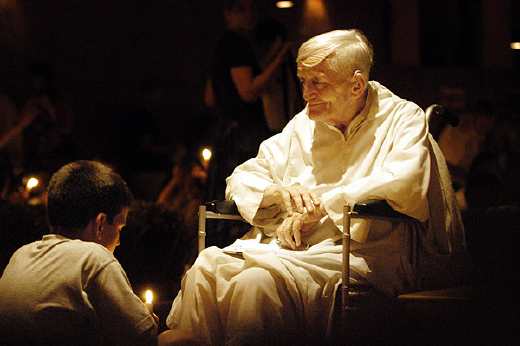
BROTHER ROGER, founder of the Taizé religious community, was murdered August 16, five minutes into a prayer service in Burgundy, France. He was 90.
A 36-year-old Romanian woman, who had been asked to leave Taizé in June after visiting for a week, returned August 14. The night of the killing, she slipped into the choir of singing monks. Considered to be psychologically fragile, she allegedly slit the throat of Brother Roger and stabbed him twice in the neck in front of the 2,500 horrified pilgrims. He died moments later.
For the next several afternoons, his body lay in the church of Taizé, open to the viewing of mourners. The funeral for Brother Roger was August 23. Brother Alois, who had been appointed eight years ago to succeed Brother Roger, began his service immediately.
It was fitting that Frère Roger, one of the great champions of dialogue among denominations, should receive eloquent eulogies from Christians of various traditions.
"This is an indescribable shock," said Archbishop of Canterbury Rowan Williams. "Brother Roger was one of the best-loved Christian leaders of our time and hundreds of thousands of people will be feeling his loss very personally."
Rev. Wilma Jakobsen of All Saints Episcopal Church in Pasadena, California described Brother Roger as "hugely important in the Protestant-Catholic church [reconciliation] in Europe after the Second World War. I think we have no idea just how far his influence extended."
"We are deeply shocked and dismayed to hear about the stabbing of Brother Roger," responded Joel Edwards, General Director of the Evangelical Alliance U.K. "He had many friends among the evangelical community who valued his devotion to God and his selfless service to others for over half a century. Many people in our membership will have spent time with the Taizé Community over the years, and will have drawn comfort and inspiration from being with fellow believers from around the world. Our thoughts and prayers are with those grieving at this time." "What a dreadful end to one of the finest men on the planet, who did more for reconciliation among Christians than anyone else I know," declared Bishop Pierre Whalon of the Convocation of American Churches in Europe.
Pope Benedict described Roger's death as "very sad and terrifying news." In a papal telegram, he characterized the beloved monk as a "man of faith passionately in love with the church," whose ministry had benefited "numerous generations of Christians".
Speaking to World Youth Day participants, the pontiff declared: "In this moment of sadness, we can only entrust to the Lord's goodness the soul of his faithful servant. We know that from sadness . . . will be reborn joy. Brother Roger is in the hands of eternal goodness and eternal love, and has arrived at eternal joy."
Secular leaders also paid tribute. German Chancellor Gerhard Schroeder extolled Roger's work with the poor, immigrants and young people; he also praised Brother Roger for aiding endangered Jews during World War II. "He was a man of peace," stated France's Interior Minister, Nicolas Sarkozy. "He had managed to establish a spiritual dialogue between the [Roman] Catholic Church and other churches. We won't forget his message." French President Jacques Chirac called Roger "one of the most remarkable servants of the values of respect and tolerance."
"Given all the current controversies surrounding so many religious leaders, Brother Roger was the last for whom any would have predicted a violent death," wrote the London Times' religion correspondent, Ruth Gledhill. An editorial in The Telegraph eloquently eulogized: "His life also successfully reconciled the tension between active engagement in the world and the monastic withdrawal that prefigures the hereafter. In a recent public letter, he observed how we must 'love life on earth, and at the same time long for a beyond, for a life that will never end.' His death, tragic as it must be for his followers, has released him into the life that will never end."
Romanian state news agency Rompres identified Brother Roger's attacker as Luminita Solcan, an unemployed Roman Catholic engineer who lived with her mother in the northeastern city of Iasi. Daily newspaper Cotidianul quoted Solcan's mother Elena saying her daughter suffered from schizophrenia. The prosecutor in nearby Macon, Jean-Louis Coste, said the suspect had bought the knife the day before the murder - and that her intentions, therefore, were clear.
In 1940, Roger Louis Schutz-Marsauche moved from Switzerland to France, having suffered for years from tuberculosis. During his long illness, he decided to create a community where simplicity, gentleness and generosity would be lived out as essential gospel realities. He described it as a place where "kindness of heart would be a matter of practical experience, and where love would be at the heart of all things".
Today, Taizé is best known for its popular, contemplative style of worship music, which has spread far beyond France to churches in many countries worldwide. The community is made up of some 100 brothers, from both Catholic and Protestant backgrounds, from more than 25 nations. By its very existence, the community symbolizes reconciliation between divided peoples.
Brother Roger wrote a variety of books, including: Peace of Heart in All Things, The Wonder of a Love, and Meditations on the Way of the Cross (co-authored by Mother Teresa). Eschewing the limelight, he was known as a humble 'servant leader' - who once stated: "My brothers and I want to be seen as people who listen, never as spiritual masters."
In one of his final books, God is Love Alone, Brother Roger described his perspective thus:
"Can I recall here that my maternal grandmother discovered intuitively a sort of key to the ecumenical vocation, and that she opened for me a way to put it into practice? Marked by the witness of her life while I was still very young, following her I found my own Christian identity - by reconciling within myself the faith of my origins with the mystery of the Catholic faith, without breaking fellowship with anyone."
Frère Roger's credo was summed up by a sign in his community's Church of Reconciliation, which says: "Let all who enter here be reconciled, brother with brother, sister with sister, nation with nation."