
Elephant Man tackles faith questions
BC Christian News, · Arts
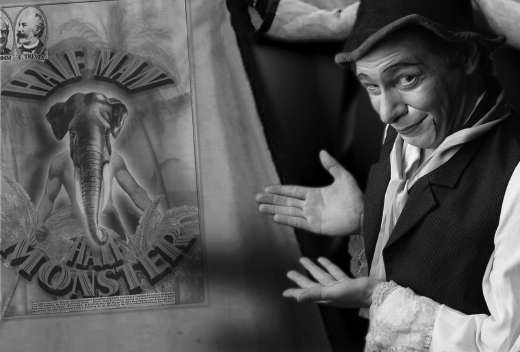 |
JOHN MERRICK was considered one of the most shockingly disfigured people in history. Bernard Pomerance's award-winning dramatization of his story is playing on a Vancouver stage this month, in the Five Bob Equity Co-op's production of The Elephant Man.
At London's carnival freak shows in the late 19th century, the public paid to gape at Merrick's grotesque features. He was openly referred to as the 'deadly fruit of original sin.' But a London doctor took pity on him, and began to study him for science.
"He derived the name [Elephant Man] from the proboscis-like projection of his nose and lips, together with the peculiar shape of his deformed forehead," wrote the British Medical Journal in April, 1890. Dr. Frederick Treves introduced Merrick to the elite of Victorian society and was startled to discover an artistic, sensible soul buried beneath the incapacitating deformity.
"As a specimen of humanity, Merrick was ignoble and repulsive; but the spirit of Merrick, if it could be seen in the form of the living, would assume the figure of an upstanding and heroic man, smooth browed and clean of limb, with eyes that flashed undaunted courage," Treves wrote in The Elephant Man and Other Reminiscences, in 1923.
In this production of the play, Vancouver's Anthony F. Ingram, a Christian who grew up in North Delta and has been involved with Pacific Theatre for several years, plays Treves. Most recently, he played in Halo, Beggars at the Waters of Immortality and The Lion, the Witch and the Wardrobe.
"Playing Treves has changed my perception when I walk down the street and see people on the fringes of society," Ingram told BCCN. "I have had to do mental and emotional double takes." Ingram, whose wife volunteers at Vancouver's Union Gospel Mission, said he always thought he was not capable of ministering to people in need the way she does. But this script made him realize most people are in the same place, emotionally and intellectually.
"These people are asking not only for hand-outs but for love," he explained. "And not just a 'God loves you,' but for someone to say, 'I love you.' It has amazed me, how profound the idea of being loved is."
In the play, Treves provides a safe haven for Merrick at the London Hospital. Merrick is exposed to literature and fine arts; he even begins a relationship with Mrs. Kendall, an actress. It is then that Treves begins to question whether he's done the right thing for Merrick, and he approaches a spiritual crisis about it.
"There's a lot of questioning of faith," said Ingram. "'How could a loving God allow this to happen to someone?' There is the question, 'What makes us human?' and 'Does being part of the established religion or culture mean conforming to what everyone does?'"
An issue Ingram faced in The Elephant Man, which he thinks should be addressed in the church during evangelization, is the fact that many Christians expect people to meet their standards of morality and appearance. "Christ spent his time with prostitutes and thieves," he pointed out.
"He didn't say, 'Once you've cleaned up your life, come and see me.' He went to them. There's a perception outside the church that, to come in, you have to be 'godly.'"
In the play, he said, "questions are left hanging so that you walk out and search yourself about it. That's what happens to Treves. In this script, he doesn't get a resolution."
Contact: 604-731-5518 or pacifictheatre.org.