
Masculinity vs. feminized faith:
BC Christian News, · Top Stories
The battle is on to attract more men into church
By Frank Stirk
 |
"WHY is it so difficult to find a nice young man to marry in the United Church? Is that too much to ask?" wrote a (presumably) single woman in the Observer five years ago.
It is very much a question worth asking - and not just because some Christian women may have difficulty finding suitable husbands.
In fact, it is a question that is likely asked in many churches, regardless of denomination, that are seeking to understand why women so frequently outnumber men in their congregations.
The troubling reality, says Leon J. Podles, author of The Church Impotent, is that despite the familiar complaints of patriarchy and male dominance in the church, Christianity "is largely a feminine affair in Western society."
As a growing body of research keeps confirming, this absence of men is having a huge negative impact on the life and health of the church in North America.
 |
"You have to have young men to attract a younger generation. You have to have younger men to bring in vitality and a desire for change and innovation," says David Murrow, author of Why Men Hate Going to Church.
"Young men are just so wonderfully aggressive and bold and are so goal-oriented. And when those men are not present in a congregation, you begin to get an inward-focused church."
In the United States, Podles calculates that churches on average are about 60 percent female and 40 percent male. In Canada, the imbalance is harder to quantify, based on current data - but it is no less real.
Polling done by Ipsos-Reid in 2003 found, for example, that Canada's evangelical community is 56 percent female and 44 percent male.
Another indicator of male detachment from church is revealed in a Statistics Canada study from 1999. It found that among children under 12 who attended a religious service at least once a week in 1994 - 95, most often it was their mothers who brought them.
The feminization of Christianity
So why are more men not in church? The subtitle of Podles' book - 'The Feminization of Christianity' - probably sums it up best.
It is a vicious cycle, he argues. The absence of men, which has been a fact of church life for centuries, gave women the freedom to shape the polity, music and language of worship, and even the ambience of the sanctuary, to their tastes.
 |
In order to minister in such a feminized environment, male clergy have tended to seem less than masculine.
Even the way that Jesus is portrayed has been distorted. What Paul Coughlin in No More Christian Nice Guy describes as "Christ's tough, courageous, protective, assertive personality, which invigorates real male sensibilities," has been submerged beneath a meek and mild, inoffensive caricature - "a Victorian Jesus."
John Eldredge, in Wild at Heart, states that many contemporary depictions of Jesus "leave me with the impression that he was the world's nicest guy."
As a result, the message men in church are receiving is that if they are to be more like Jesus, they must become, he writes, "Really Nice Guys. We don't smoke, drink or swear; that's what makes us men."
So, faced with the choice of attending a feminized church or attaining masculinity, many men choose the latter - and the cycle continues. And those who do attend, whether willingly or not, often end up passive observers.
"We judge men in the church," says Murrow, "on their ability to be verbal, sensitive, relational, nurturing, tender, good with children, good at singing. These are all things that women are going to outshine them in . . . and there's no way that the average man is going to even come close to outshining the average woman.
"She's already more Christ-like, because we have defined Christ-likeness in feminine terms."
The future of Men
Abetting the problem is the broader culture - which, according to American trendspotter Marian Salzman, author of The Future of Men, portrays men as "the inferior sex, a lesser version of the species that couldn't possibly cope unless handed directly from the care of a mother to the care of a wife."
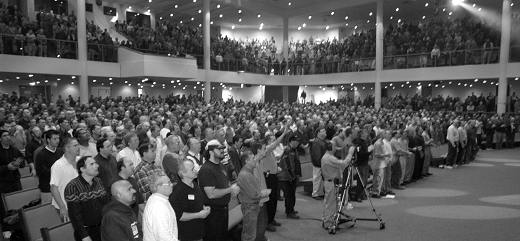
Even men's ministries like Promise Keepers, whose rallies in the U.S. and Canada drew thousands of men in the 1990s, seem to have fallen short in their goal of encouraging men to become alive in Christ and active in their local church.
Last year, Barna Research reported that while 10 percent more American men were attending church compared to a decade earlier (with their small group participation growing by 100 percent), their level of volunteerism was unchanged and 14 percent fewer men shared their faith.
Promise Keepers Canada president Ron Hannah blames these disappointing outcomes on pastors who did not join their men at a PK conference.
"If the pastor doesn't go and doesn't understand what's going on at the event," he says, "then the men come back fully charged and the pastor's saying, 'I don't have time to do one more thing' - and he puts cold water on something that was a burning fire."
At the same time, Hannah objects to Murrow's generalizations about the feminized church.

"Our church is very vibrant and growing - as are many across this country. So Why Men Hate Going to Some Churches might've been a better title," he says.
Yet Murrow also states in his book that not all churches suffer equally from gender imbalance. He points out that those with the fewest men are also the most theologically liberal, such as in their positive stance on homosexuality - which, Murrow writes, men feel "threatened by . . . in a way that women are not."
Fatherly duties override spirituality
John Stackhouse, professor of religion and philosophy at Regent College on the UBC campus, suspects another reason more men are not in church is ironically their desire to be good husbands and fathers.
"What I find in teaching young married men at Regent," he says, "is that we sometimes have to encourage them to stand against our broader secular culture, which is intensely pro-nuclear-family in some ways.
"We see that here in Vancouver, where soccer is the rival religion to church-going."
Whatever the reason so many men stay away from church, they are clearly depriving many more than just themselves of the opportunity of a saving relationship with Christ.
Dad knows best?
 |
In 1994, the Swiss government did a survey to find out if children remained faithful to their parents' religion. It discovered, as Touchstone magazine reported in 2003, "overwhelming" proof that "it is the religious practice of the father of the family that, above all, determines the future attendance at or absence from church of the children."
It found that if the father never goes to church but the mother attends regularly, only two percent of their children will become regular worshippers. But when the roles are reversed - the father attends regularly but the mother not at all - then the proportion of children becoming regular attendees jumps to 44 percent.
When both parents are regular attendees, the figure slips to 32 percent.
"It's almost better if Mom's an atheist, because the kids will always go the way Dad does," says Murrow, "and the more ferocious Dad is in his faith, the more attractive it becomes to the kids."
Reversing the trend
Less clear, however, is what churches need to do to attract and motivate more men.
Hannah believes the key certainly for Promise Keepers Canada is a greater emphasis "on Christ's basic model, which is discipleship."
"If we can teach, train and develop a core group of men that build into a bigger group of men that build into a bigger group of men," he says, "ultimately all men will begin to learn and grow in their faith - and the church will be the benefactor."
 |
For Murrow, the key is connecting each man with a 'spiritual father' or mentor.
"Men are not looking for a Bible study. Men are looking for another man who will lead him to greatness [in Christ]. That's why a great coach is so appealing to men," he says.
Beyond that, he says churches need to look more masculine. "Why can't the sanctuary look like a hunting lodge? Why can't we mount deer heads around the sanctuary?" asks Murrow, who lives in Anchorage, Alaska.
In operation since September, The Grove Church in Peoria, Illinois, may be the first in North America to design its worship along the lines that Murrow has in mind.
Mark Doebler, its pastor, or 'coach,' does not preach longer than 10 minutes. His sermons are built around themes such as NASCAR racing and home improvement. And at the end of the service, he gathers only the men for a brief huddle.
"We're definitely counter-cultural," Doebler admits. "But we do believe that in doing that, we help men, we help women, we help families, we help society.
"I've never seen a church full of men alive in their faith. And I am passionate to see that happen."