
'Mr. Christmas' does it again
BC Christian News, · Merry Christmas
• Gerry Bowler: Santa Claus: A Biography, McClelland & Stewart, 2005
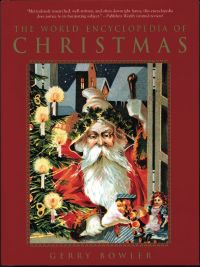
• Gerry Bowler: The World Encyclopedia of Christmas, McClelland & Stewart, 2000
 |
THREE HUNDRED thousand Vancouverites lined the streets for the 2nd annual Santa Claus parade November 20. Sponsored by Rogers and warmly welcomed, no doubt, by all local merchants, the event was lauded as an ideal kick-off for the Christmas season - and a great family event.
Gerry Bowler would understand the parade's appeal. McClelland & Stewart bill their writer as 'Mr. Christmas' - and he lives up to the grand title. His brand new biography of Santa follows up on The World Encyclopedia of Christmas - and each is crammed full of fascinating facts and insights.
With these two books, Bowler - who grew up in the Vancouver area but now teaches at the University of Manitoba - offers a culturally astute overview of the celebration which dominates each year-end, and its patron saint.
Santa Claus is a serious, though entertaining, biography, delving into Santa's origins as Saint Nicholas and following him as his ever-changing character survived attacks from pious Christians, pedantic psychiatrists, atheist ideologues and politically correct public officials.
Bowler, a Christian himself, says: "Two deities preside over the [Christmas] season. One is the baby Jesus, the divine infant, God incarnate to all Christians, adored by shepherds and angelic hosts, celebrated in carols, stained glass and midnight masses. . . . The other is Santa Claus, the dominant fictional character in our world. Neither Mickey Mouse nor Sherlock Holmes, Ronald McDonald nor Harry Potter wields a fraction of the influence Santa does."
 |
Santa's prominence has many sources - not least the commercial juggernaut built around him, and so often bemoaned. But according to Bowler, "All of Santa's prestige derives from his role as the chief gift-bringer during the celebration of Christmas."
And gift giving has ever been central to the season, whether blessed by the church or not. In 400 AD, Bishop Asterius delivered a withering sermon on the ways his flock gave holidays gifts. "Oh the absurdity of it! All stalk about open-mouthed, hoping to receive something from one another."
Will Santa's importance continue into the 21st century, weathering multiculturalism, political correctness and neo-puritanism in both the secular and religious worlds?
Yes indeed, says Bowler.
"Santa Claus lives and will live, not only because he represents fantasy in an impersonal scientific universe, but because he is the incarnation of parents' love.
"As the century progresses, Santa Claus will continue to be attacked and resisted, but as the family comes increasingly under assault, he will be evermore necessary. Parents will weigh the potential harm of telling what Plato would call a 'noble lie' against their desire to manifest love in the form of a myth."
The World Encyclopedia of Christmas is an impressive production - 257 pages, well illustrated and packed with more than 1,000 entries on every aspect of the history, colour and significance of Christmas.
The book catalogues all the predecessors, pretenders and partners of Santa throughout history.
Among the cast: Saint Nicholas (the real-life 4th century bishop from Asia Minor); Father Christmas (from an English children's book); Kris Kringle (now simply a synonym of Santa Claus, the name originated from Christkindl, the German term for the Christ Child, who was thought to bring gifts); Grandfather Frost (the Soviet version of Santa Claus, perceived as a symbol of Russian oppression in Eastern Europe); Sinterklaas (the Dutch name for Saint Nicholas, who makes his rounds with his dark-skinned Moorish servant Black Peter); and Belsnickel (a German figure who quizzed children on their behaviour during the previous year).
Bowler's books are well written, attractive and significant. All Christians could benefit by better understanding the complex mixture of pagan, Christian and secular elements which underpin our culture's Christmas/winter celebrations.
And for those of us inclined to insist that 'Jesus is the reason for the season,' they demonstrate that no immediate change is likely, whether desirable or not. We may not want to join the parade, but we would do well to appreciate where it comes from - and meditate upon what it means for our culture.