
Lobbing a kewpie-doll shaped grenade
BC Christian News, · Top Stories
"Swear words play the same role in the vernacular as religious kitsch does in popular culture: cheap clichés that are used too often and flatten meaning. They serve only to provide a vehicle for the release of emotion that has nowhere else to go."
-Betty Spackman, A Profound Weakness: Christians and Kitsch
"In everything that can be called art there is a quality of redemption."
-Raymond Chandler
 |
I'M standing in front of one of those mega-wattage suburban homes that has approximately two square inches of vinyl siding that isn't covered by a Christmas light or ornament.
"We'll get that spot next year," I imagine the owner saying.
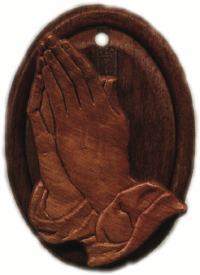
Earlier that day, I googled a satellite photo that showed the glowing house from space, but it turned out I didn't need those directions because we just had to 'follow the star' so to speak. As I look at a flickering plastic manger scene that includes a Frosty the Snowman eerily smiling over the baby Jesus, I wish Betty Spackman were here to look at the scene with her critical eye. Spackman, the author of A Profound Weakness: Christians and Kitsch (Piquant Editions, 2005) has, perhaps more than anyone alive, explored the complexities of kitsch - basically defined as mass produced 'art' with little actual artistic merit - and its role in the lives of Christians.
Kitsch uncovered
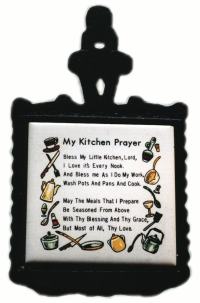 |
When I first heard about A Profound Weakness, I expected Spackman's book to be a full-blown assault on a rather obvious plague on our society. Instead, I found a substantial work that delves much deeper into why kitsch exists and the many levels on which it can be viewed.
She calls her book a "personal image journal." Judging by the 439-page coffee-table tome, the mixture of images and essays is the cathartic culmination of a lifelong personal journey through the sometimes troubling mixture of faith, consumerism and meaning that kitsch represents.
The subject of kitsch is a minefield full of people's convictions, memories and personal tastes. The traveller better tread lightly, because there's a bomb - or as Spackman describes it "a kewpie doll shaped grenade . . . both frivolous and dangerous" - ready to go off if you stomp too roughly on someone's personal territory.
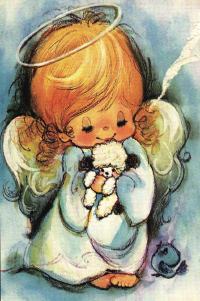
Even labelling objects as kitsch won't go over well with many Christians, including my own mother, who once made the pilgrimage to the Precious Moments chapel in Carthage, Missouri (replete with a painted ceiling fashioned after the Sistine Chapel). Forgive me, mom.
And it wouldn't be advisable to even broach the subject with the average Thomas Kinkade - self proclaimed "painter of light" (whatever that means) - disciple, either, especially if he lives in one of Kinkade's prefab communities that are modelled after his artwork.
Politically correct critiquing
 |
When we scoff at kitsch are we being elitist? Fearful? Or are we simply resisting, in the only way we know how, the surging tide of mass market, consumable, faith objects?
Though kitsch is produced in a variety of different themes, Christians are the reigning champions at coupling nearly every object imaginable (from lip gloss to amusement parks) with our beliefs. Feeding the Christian subculture's hunger to fill the book shelves, closets, cupboards and, to some extent, minds of the faithful is a multibillion dollar business.
And while a lot of that stuff is an easy mark for ridicule, Spackman's essays encourage us to go beyond our tendencies to readily embrace or readily dismiss kitsch. Though they may make one's artistic sensibilities bristle, many articles of kitsch say more about who we are and what our faith is about than we may care to admit.
"There's a paradox that things can be either cheap or meaningful," Spackman told BCCN, adding that the 'worth' of some objects has nothing to do with its intrinsic artistic value. "This book has helped me define some of the things [about kitsch] that I was wrestling with. I had to look at the material culturally, not just emotionally."
Being born into kitsch
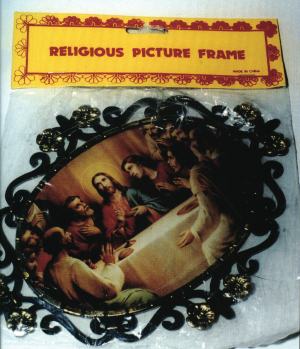 |
Those growing up in the Christian subculture must admit that some objects of kitsch can still carry deep personal significance. And most of those people will readily admit that the objects themselves carry little artistic value apart from their connection to a place and time that had meaning. For instance, as I proceeded to mock the Precious Moments chapel, my mother informed me that each painting of an angel with the trademark wide doe eyes represented an actual child that had died, a fact that stopped me mid-sentence and forced me to think beyond my own definition of art and meaning.
And when I think back to my Sunday school days, there's a soft spot in my heart for the postcard-sized glow-in-the-dark empty tomb and the 'Christianized' Archie comics given to me by my teachers. While they still elicit a quick chuckle, they are also objects that many years ago, in their own weird way, encouraged me to live out my faith in world that often ridiculed it.
"If God can speak through Balaam's ass, he can certainly communicate through even the humblest art - which rather nullifies the arguments of taste and craftsmanship when it comes to Christian outreach," states Spackman in her book, acknowledging that the type of kitsch a lot of us were outfitted with when we were kids can still mean something. "However, this doesn't mean we should be content with making mediocre art . . . we should always keep in mind that in truth it is people, not plastic night lights, Christians, not kitsch, that are called to be lights of the world." There's a clear line between the symbols of our faith and the way we actually communicate our deeply held beliefs to the world around us. We need something more than a t-shirt to speak for us.
In this vein, Spackman also refers to Francis Sheaffer's seminal works Addicted to Mediocrity and Sham Pearls for Real Swine as she explores how the Christian church has often substituted cheap clichés for real art that wrestles with the complexities of faith.
Kitsch as propaganda
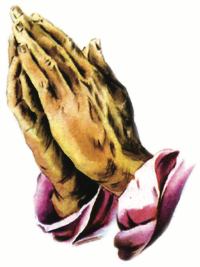 |
One of the biggest knocks against kitsch is that it numbs us to the real, gut-level experiences of faith. It gives easy answers, made-to-order convictions. In A Profound Weakness, Spackman tells the story of trying to reenact the Christmas story of the angel visiting the shepherds, with a Sunday school class. The kids were asked to think about the awesome spectacle of an angel addressing them from the sky, then try to act out how they would feel if they were "sore afraid." They dutifully stood like mannequins, frozen faces tilted to the sky just like the many similar depictions they had seen during their short lives. Spackman tried again, but this time encouraged the kids to first talk about what they do when they are really afraid, then gave them license to act out the scene according to how they would personally react.
"This time they scattered. Some hid under tables or chairs, some stood with their hands to their mouths. Some were shaking and clinging to one another and pointing . . . I don't know if the children remember that day or not. But hopefully it destroyed, for that Christmas at least, some of the damage done by all the cheap, cliched Christmas cards they had obviously taken as their models - models that gave them no sense of the awe or the humanity of the story in question," she writes.
The idea that kitsch tends to reinforce religious ideas and convictions rather than generate or challenge them is a central theme in Spackman's work. She even goes so far to say that it is an ideal tool for propaganda that has been used by governments and churches alike to both manipulate and console the masses.
When it comes to mass market appeal, however, the Christian community flogs those cliches with great success, no manipulation required. We are willing participants.
What Would Jesus Do?
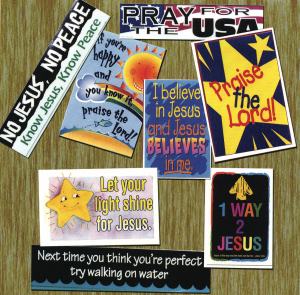 |
The WWJD phenomenon - embraced by school kids and NBA players everywhere - is one of the most salient examples of the Christian marketing machine kicking into overdrive. With 16 million bracelets and counting, the phenomenon almost guarantees the slogan its own wing if a Christian kitsch hall of fame should one ever be erected. It might even include a display detailing the U.S. lawsuit over the trademark.
The simple bracelets and spin off merchandise has also been fodder for those outside the Christian community to satirize the phrase, including the tongue-in-cheek claim that WWJD? actually stands for What Would Jesus Drive?
"One theory is that Jesus would tool around in an old Plymouth because the Bible says 'God drove Adam and Eve out of the Garden of Eden in a Fury," states one of a number of sites ridiculing the movement.
Spackman isn't a fan of the ubiquitous bracelets either, but her critique goes deeper, questioning the real message the wearers are sending.
"'What would Jesus Do?' bracelets and other objects like this strap are supposed to remind the wearer to lead a godly life," she writes. "They're also meant as an outward sign of righteousness to others, as they suggest that the wearer has a desire to be an obedient servant of God. However, from what I have observed, they're more often a kind of club membership card which signals to the initiated that the wearer is a fellow believer. In the end, things like this may start out with a genuinely constructive motive but often they end up being just one more product for sale to self-righteous Christians who want to flaunt their faith . . . WWJD? Somehow I don't think he'd wear a WWJD bracelet."
If Spackman's work accomplishes anything it will be to encourage Christians to become more visually literate in the culture around them. To think critically, in a constructive way, about the images we adopt and claim for our own. Those prone to ridicule will be encouraged to step down from the seat of judgment and examine the meaning and motives behind objects of kitsch. Those who love to showcase their faith through kitsch may be challenged to look at their motivations for doing so.
For more, including excerpts of A Profound Weakness, visit piquanteditions.us.