
'Cartoon jihad' inspires violence, censorship and hard questions
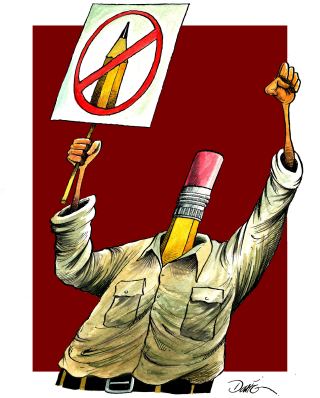 IT IS being touted as everything from an ultimate clash of civilizations to the spiritual equivalent of the 9/11 attacks.
The publishing of a handful of cartoons has sparked hyperbolic rhetoric, mass protests, boycotts, riots, flag-burnings, vandalism of embassies and at least two dozen deaths. It has also prompted censorship, fears of religious imperialism, and fierce debates over blasphemy and freedom of expression.
Thousands of Muslims have been enraged by caricatures - originally published by Danish newspaper Jyllands-Posten - which have appeared in various European newspapers. The most notorious image shows the Prophet Muhammad wearing a bomb-shaped turban; another depicts him telling suicide bombers that there are no virgins left for them in heaven.
Some extremists have seized the crisis as an opportunity to denounce the United States and Israel; others have targeted Christians - resulting in the deaths of two priests, and the burning of several churches. This has led some observers to conclude that the protests are being orchestrated to promote an Islamist agenda by fomenting a jihad, or 'holy war.'
"The cynical are again exploiting the ignorant," wrote Robert Fulford in the National Post, maintaining that "a few slapdash cartoons" had been "inflated into a violent controversy by blowhard imams and demagogic tyrants."
However, leaders such as the head of the Organization of the Islamic Conference (OIC) believe the controversy has momentous implications for international diplomacy. According to Reuters, Ekmeleddin Ihsanoglu stated: "People in the Muslim world are starting to feel this is a new September 11 against them. Muslims of Europe are taking the place of the Jews before the Second World War."
'Defamation of religion'
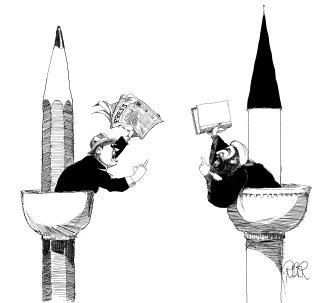 The OIC has been lobbying to get the United Nations to issue a declaration denouncing "defamation of religion"; the European Union has stated that it would support such a declaration.
In Canada, the crisis has led to the confiscation of a student newspaper which printed the offending cartoons, and the censure of a professor who made them public.
Publication of the images in the Alberta-based Western Standard (WS) prompted Mohamed Elmasry, head of the Canadian Islamic Congress, to threaten legal action. Meanwhile, Indigo/Chapters bookstores have refused to stock this particular issue of the magazine.
Writing in the National Post, Father Raymond J. deSouza responded: "You can still order a copy of The Satanic Verses [at Chapters] . . . or if your taste in blasphemous fantasy runs to the anti-Catholic instead, you might pick up The DaVinci Code, prominently displayed with related spin-offs. So the claim that Indigo does not want to offend its customers is patently implausible."
For many, the crucial issue is freedom of expression. However, writing in The Toronto Star, PEN Canada president Constance Rooke stressed the importance of "respect for the dignity and beliefs of others."
Rooke wrote: "Whatever the intentions of those responsible for the creation and publication of these cartoons may have been, it is clear that . . . good people have been badly hurt. Belief that the West is increasingly prepared to countenance disrespect of Islam has been fueled."
'Voluntary restraint'
Her organization, she stressed, "supports the right of a free press to publish these cartoons - but also believes that a wise consideration of the principle of 'voluntary restraint' would have led to better decisions."
WS editor Ezra Levant told CBC's As it Happens: "If you're saying now that the entire press must act as if we have [Islamic] sharia law . . . I would say that the press has abdicated its responsibility grievously."
In response to Levant, Rooke told BCCN: "We are not saying that Canadians are bound by sharia law or by any religious law. But it is not an abdication of the responsibility of the press to choose not to give offence."
Levant adamantly contended that many members of the press are kowtowing to fear.
"I think the violence is actually designed to scare Western journalists. [It's] saying: 'If we get this mad about some cartoons, imagine what we'll do if you try other things.'"
Levant said he and his WS colleagues had "totally underestimated the fear in the Canadian media."
"I do not believe mainstream media are 'kowtowing,'" responded Rooke. "I think they are choosing not to be offensive to large numbers of decent people in our own country and elsewhere, and choosing not to escalate tensions by taking actions they know can be exploited by Islamic extremists."
Double standard
Some in the mainstream media have given Islam markedly different treatment than other religions. This was derided as a double standard by Levant on CBC's The Current, in a heated discussion with Scott Anderson, editor-in-chief of the Ottawa Citizen.
Anderson stated: "We don't publish something just to offend somebody . . . I publish a newspaper based on community standards [which] we decide we want to respect, and we do that across all fields and all subject areas."
"Not for Christians!" scoffed Levant, adding: "You published Piss Christ!" Referring to a photograph of the notorious work by Andres Serrano, he said the image "remains the symbol of gratuitous insult to Christians. Could you be more insulting than putting a crucifix in a jar of your own urine?"
"The issue around that was: Where can art go?" Anderson replied.
"Oh, that's the issue, eh?" retorted Levant. "It wasn't offensive. I thought you just said you didn't do things that were gratuitously offensive."
Speaking on As It Happens, Levant insisted that many in mainstream media "aren't afraid of offending religions, if the religion is Christianity, or others - because they'll just get an angry letter to the editor. But when it comes to offending Islam, even in the most modest way - well, it could mean a head being hacked off." He cited the plight of Satanic Verses author Salman Rushdie, who spent years in hiding after Iran's Ayatollah Khomeini ordered his death; and the murder of Dutch film-maker Theo Van Gogh by an Islamist fanatic.
Eurabia rising?
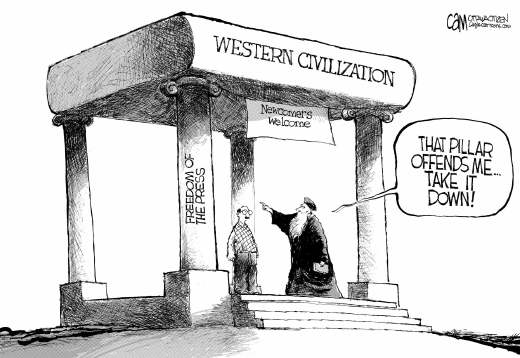 |
Some commentators consider Van Gogh - who had made a film critical of Islam - a victim of a gradual Islamic takeover of Europe. The latter thesis has been proposed for several decades by Egyptian historian Bat Ye'or, author of Eurabia: The Euro-Arab Axis.
"I think the movement of Islamic radicalism will eventually . . . win the allegiance of the Muslim masses in Europe," Ye'or opined in a 1991 French interview. "I think that we are participating in the Islamization of Europe, reflected both in daily occurrences and in our way of thinking . . . The Islamic law that forbids all criticism of the sharia and the Muslim religion has appeared here." She added that many Europeans "who infringe upon this fundamental Islamic law have . . . been the objects of intimidation and threats."
Daniel Pipes, writing in The New York Sun, recently asked: "Will the West stand up for its customs and mores, including freedom of speech, or will Muslims impose their way of life on the West? Ultimately, there is no compromise: Westerners will either retain their civilization - including the right to insult and blaspheme - or not.
"More specifically, will Westerners accede to a double standard by which Muslims are free to insult Judaism, Christianity, Hinduism and Buddhism, while Muhammad, Islam and Muslims enjoy immunity from insults? Muslims routinely publish cartoons far more offensive than the Danish ones."
Paul Marshall, a Canadian working with the U.S.-based Freedom House, addressed some of these concerns in a recent Christianity Today interview: "One of the frightening things about Europe is that the second- and third-generation immigrants are much more radical than their parents. You're not getting assimilation; you're getting the opposite . . . As time goes on in Europe, the Muslim populations are becoming more radical."
However, Marshall suggested that radical Islam's impact on North America was less of a concern. "In the United States, the sociology of the Muslim population is very, very different . . . Our Muslim population tends to be highly educated. I think more than 60 percent have degrees, and, in general, they do not live in separate neighbourhoods."
He stressed that many Muslims do not support the kind of theocratic state government endorsed by extreme Islamists. "Islam and democracy, as a practical matter, do coexist in the world." He cited Turkey, Indonesia and Mali as Muslim-dominated countries with "functioning democracies."
"It is a tragic mistake to lump all Muslims with the forces of darkness," concurred Pipes in National Review Online. "Moderate, enlightened, free-thinking Muslims do exist . . . They eventually will have a crucial role in modernizing the Muslim world."
Enemies of Islam
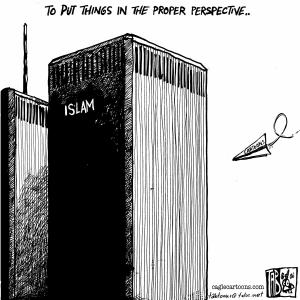 |
Currently, however, "moderate Muslims are scared," Majed El Shafie told BCCN. The head of the Toronto-based One Free World International added that sincere Islamic opponents of Muslim extremism "are worried that if they stand against this they will be considered enemies of Islam."
Muslims, he said, have been shown respect in Western countries. "We gave them equal rights, and gave their TV programs airtime here." Conversely, he contended, Christians in some Muslim countries "are not allowed to build churches." The cartoon conflict, he maintained, is "not about respecting other religions; it's about hearing other voices and other opinions."
Emphasizing the fact that he was once a Muslim, he said: "I want to ask other Muslims a question. If you don't like the USA, Europe and Canada, why are you here? Why come to the West? I say this as an immigrant. I am Egyptian, I am a brown man myself, I came here to escape persecution. I respect the law and freedom of expression."
Most Muslims currently in Europe, he said, emigrated "to escape economic and religious persecution. They should use the peaceful channels Europe gives them to say what they like and don't like."
Friends of freedom
While the shrill slogans of demonstrators and religious firebrands have received much media coverage, some Islamic leaders have nevertheless taken a firm stand against the violence.
In Lebanon, according to the Knight Ridder news service, "senior Shiite cleric Mohammed Hussein Fadlallah issued a religious order banning flag burnings and attacks on embassies." In Iran, cleric Akbar Hashemi Rafsanjani admonished his followers: "We need to put forward our calm and compassionate side, our gentleness."
The Muslim Canadian Congress has also urged moderation. Communication director Tarek Fatah noted that Muhammad "endured insults and ridicule on a daily basis. . . . At no stage during this ordeal did the Prophet lose his temper or react to these provocations. Tradition has it that he would, instead, offer a prayer of forgiveness."
University of Toronto's Anver Emon, who teaches Islamic law, made a similar point in the National Post: "Muslims the world over protest their corrupt autocratic governments where free speech is not allowed, and opposition newspapers are shut down regularly. It is hypocritical for them now to call for the closure of newspapers and issue death threats to artists."
Peacemakers
As the crisis has unfolded, few prominent Christian leaders have spoken about it. One exception is Bruce Clemenger, president of the Evangelical Fellowship of Canada, who noted that "art which denigrated Jesus has not prompted violence or the threat of violence on the part of Christians."
Nevertheless, he said, "as Christians we can understand the hurt that Muslims feel when the Prophet Muhammad is mocked."
He added: "We also understand the importance of the freedom to challenge perceived truths - as that is why Christ died." However, he emphasized, freedom of expression "does not justify the mocking or scorning of what others consider sacred . . . In a society that claims to be respectful of diversity, freedom must include self-restraint and openness to understanding what is sacred to others."
Clemenger concluded: "In what is being called a clash of civilizations, perhaps we followers of Christ can bridge the seeming solitudes and be the peacemakers Christ called blessed."
- additional reporting by Chris Wiebe