
Island Anglicans losing churches
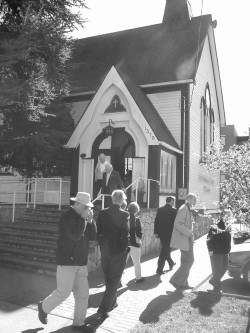
VANCOUVER ISLAND Anglicans are being asked to fold or merge 15 of 53 parishes, to cope with what a recent church document describes as a "precipitous decline" in membership.
While the leaders of some parishes slated for closure are resisting the recommendations of the diocesan report, 'Conversations on Our Shared Future,' they admit the Canadian branch of the worldwide Anglican communion needed a shakeup.
"The report's description of our problems is not unfair," said Canon Andrew Gates, pastor of St. Paul's church in Esquimalt, one of three area congregations the report calls for to be merged and their buildings sold. "We certainly needed a wake-up call."
Meanwhile, the Diocese of British Columbia is calling for more flexible approaches to ministry such as those which have helped Baptist and other evangelical Christian churches grow while Anglican parish memberships have dwindled nation-wide from 1.36 million in 1961 to 642,000 in 2001.
On Vancouver Island, the report notes, Anglicans are simply not replacing themselves: they are much older than the general population, and many of their parishes have few or no children.
In the past decade, nearly half the parishes have declined by more than 20 percent - while only 13 of 54 are growing, and 14 are stable. Thirty-three have fallen below the 120 members (and $130,000 in revenues) which the diocese considers the cutoff for financial viability; a quarter have borrowed on capital to meet operating expenses; and others have dipped into trust funds.
"We know we have to grow in membership," says Canon Gates, adding: "Our current members are mostly retired and we have to get out into the community and do mission and ministry."
St. Paul's wants till 2007 to attempt to recover. The proposed merger into a new super-parish in Saanich is problematic - not only because that municipality will not allow rezoning for churches but because, says Gates, parishes are like families and cannot easily be remade.
Diocesan Dean Logan McMenamie told BC Christian News the report was "not about closing churches," but about seeking how "God will shape the church for himself." The report calls for new models of ministry such as storefront and multi-parish churches, as well as regional ministry - in other words, working outside the traditional model of geographically narrow parishes with solo ministers.
Such flexibility is serving Canada's Baptists well. After decades of decline since the 1960s, the Baptists turned things around in the '90s. They grew by 10 percent in that decade, according to Census Canada. In British Columbia, the Baptist Union of Western Canada has grown by 25 percent, according to Jeremy Bell, its executive minister, while planting 25 new churches in the past five years for its 9,800 members.
Baptists have abandoned the parochial model for the community church - thus attracting members from a much wider geographic area, often with a larger specialized staff.
"Baptists used to be marginalized if not demonized," said Bell. "Now we are accepted because we are accepting. We don't put up barriers at the door saying you have to believe what we believe to get in."
Instead, Baptists try to follow the recommendations of Reginald Bibby, the University of Lethbridge sociologist and author, who reports that most Canadians are open to church membership, but aren't interested in doctrine so much as meeting their needs for spiritual and emotional support. "We welcome them first in and work at belief later," Bell said. "If they don't stay it's the church's fault, not theirs."
There is more to the Baptist Union's growth than method, said Paul Pearce, the Baptist Union's area minister. The beliefs it holds are 'small o' orthodox Christian, and centred on "what Christ says to us in the Bible." Many Anglicans offended by their church's confusion and permissiveness over homosexuality and same-sex marriage have moved over to Baptist churches, particularly in rural areas. In cities, said Pearce, Anglicans were likelier to shop around for a conservative parish where they could feel at home.
Parishioners of St. Paul's and other Anglican churches facing amalgamation might take heart from Victoria's Gateway Baptist, which is the recent product of a fruitful union of the elderly but declining Royal Oak church with the younger, feistier New Hope church, which had no building of its own, says Gateway's co-pastor Peter MacRaild, and no room for outreach. After a shakedown period when dissenters splintered off from both, Gateway is attracting new members through its Alpha classes. The new church is already bigger by 20 members than the initial sum of its parts at the time of union.
Significantly, the Victoria Anglican-Catholic parish of St. John the Divine has doubled to 110 members over the past decade, according to rector Father Shane Janzen. The group originated with Anglicans disenchanted with their denomination's steady doctrinal liberalization - but now attracts young people "looking for discipline, seriousness in the practice of faith and adherence to the orthodox message of Christianity."
As for the 'big o' Orthodox Church of America, its All Saints of Alaska parish in Victoria has grown from zero to 85 in a few years while the denomination, says Fr. John Hainsworth, "is the fastest growing in America." About a third of his members "came in from the cold" with no faith background. "They want clarity of teaching and a radical faith that has real traction," which Orthodoxy provides in the form of demanding seasonal fasting, prayer and liturgies rich in music and tradition.
Meanwhile, at the 'low' church end of the Anglican spectrum, the Reformed Episcopal Church, which broke with Anglicanism more than a century ago, is also growing, having added a second congregation in Courtenay to its cathedral Church of Our Lord in Victoria.