
Esperanza offers Christ-centred hope
BC Christian News, · Island Insight
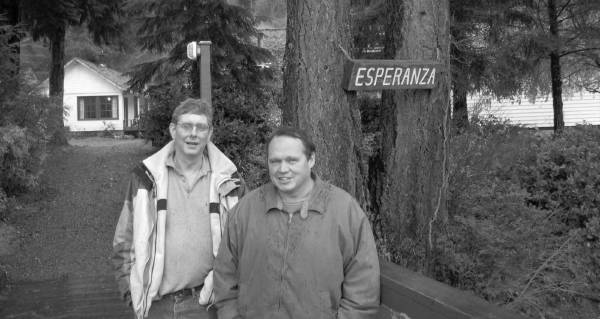
NESTLED in a mist-shrouded inlet near Tahsis on Vancouver Island's rugged west coast, the Esperanza community provides the people of a dozen coastal communities with sorely-needed spiritual and relational support.
For all its physical isolation, work crews from half a dozen churches stretching from Montana to the Lower Mainland, Victoria and Campbell River regularly descend on Esperanza to maintain and replace buildings erected decades ago by the fabled Shantymen's Christian Association, back when Esperanza was the west coast's only hospital.
The Shantymen were started a century ago to evangelize the loggers, miners and railway crews in their isolated and oft-primitive work camps (hence 'shanties'). Because the Shantymen at the time did not own property, they turned over the hospital they built in 1937 to the Nootka Mission Association. Esperanza went through several functions until 1989, when the Shantymen took over again, and it began evolving into its current form.
Dean Johnson, Esperanza's ministry centre director, moved back to Esperanza in 1994 with his wife Sharon, both being children of staff who had grown up there. "We were returning to our roots, helping people in crisis just as Esperanza always had." Not medical crises anymore but personal ones - but still "to stress the love of Christ up and down the coast."
The basic way that is done is through the family program, which is offered four times a year and lasts for six weeks. Entire families with such problems as family violence, suicide or addiction are invited to live in one of the community's homes, participate in the community's prayer and work life, and receive individual, group and family counselling
For men who find the family program only a starting point towards recovery and spiritual development, a subsequent discipleship program is offered, providing more counselling, prayer,NESTLED in a mist-shrouded inlet near Tahsis on Vancouver Island's rugged west coast, the Esperanza community provides the people of a dozen coastal communities with sorely-needed spiritual and relational support.
For all its physical isolation, work crews from half a dozen churches stretching from Montana to the Lower Mainland, Victoria and Campbell River regularly descend on Esperanza to maintain and replace buildings erected decades ago by the fabled Shantymen's Christian Association, back when Esperanza was the west coast's only hospital.
The Shantymen were started a century ago to evangelize the loggers, miners and railway crews in their isolated and oft-primitive work camps (hence 'shanties'). Because the Shantymen at the time did not own property, they turned over the hospital they built in 1937 to the Nootka Mission Association. Esperanza went through several functions until 1989, when the Shantymen took over again, and it began evolving into its current form.
Dean Johnson, Esperanza's ministry centre director, moved back to Esperanza in 1994 with his wife Sharon, both being children of staff who had grown up there. "We were returning to our roots, helping people in crisis just as Esperanza always had." Not medical crises anymore but personal ones - but still "to stress the love of Christ up and down the coast."
The basic way that is done is through the family program, which is offered four times a year and lasts for six weeks. Entire families with such problems as family violence, suicide or addiction are invited to live in one of the community's homes, participate in the community's prayer and work life, and receive individual, group and family counselling
For men who find the family program only a starting point towards recovery and spiritual development, a subsequent discipleship program is offered, providing more counselling, prayer,
skills training and work.
"They are a real blessing to us with their work," says Johnson. "Ninety percent of the families are First Nations."
He attributes the popularity of Esperanza's programs with native people to the trust built up by the operation of the hospital over four decades. During the summer, Esperanza operates camps for youth and families, including a wilderness camp isolated from Esperanza itself. About half the participants are First Nations members.
"We start every day with prayer and Bible study," says Johnson. "All our counselling is Christ-centred. Most or all are problems are the result of sin. Any form of healthy living begins with restoring our relationship with Christ."
The community itself comprises five families and several single staff. It is supported by institutional donations, program fees and individual support secured by staff members. As well, the community makes some money operating a marina and a water taxi. One anonymous American foundation has provided $50,000 US, with which Esperanza has bought materials for new kitchens and a meeting hall.
Much of the subsequent construction has been accomplished by hundreds of volunteer work crews from Campbell River's Ocean Crest Community Church, Maple Ridge Christian School, two churches in Seattle, a Christian school in Montana and Victoria's Central Baptist Church.
Gordon Hardy, an engineer who has joined three crews from the Victoria church most recently to put up drywall and insulation in a new duplex at Esperanza, sees the work as "a chance to do missionary work," and to work with his hands. The last time, his children Nathan, 16, and Elycia, 13, went along on the weekend expedition.
Nathan, who admits to feeling "stiff" after chopping firewood for 10 hours, says: "I love going up to Esperanza," for the chance it offers to "get wet and help out."
Elycia not only got wet, but dirty - in a mud fight organized by Esperanza staff. She carried wood, cleaned and painted - and promises: "I am going back."
