
Head tax redress coming
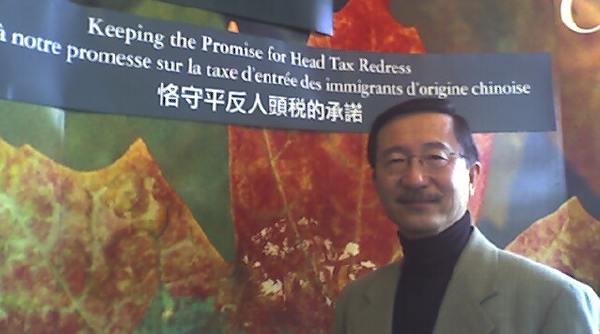
THE INJUSTICE of Canada's notorious Head Tax, which was levied against Chinese immigrants more than a century ago, may soon be resolved. The issue has been in the media spotlight recently, as activists lobbying for redress of the long-standing grievance monitor the ongoing responses of federal politicians.
Prominent among the activists is a respected Christian advocate for human rights issues. Bill Chu, Vancouver-based head of Chinese Christians in Action, and a spokesperson for the B.C. Coalition of Head Tax Payers, Spouses and Descendents, recently expressed optimism to BCCN.
Chinese-Canadians, he said, "now can look forward to the day of closure on a dark piece of Canadian history."
At an April 21 meeting in Richmond, he said, Jason Kenney - Parliamentary Secretary to the Prime Minister - listened to many members of the public.
"The whole place was packed," said Chu. It was an opportunity for people to voice their feelings directly to the government. The evening was rather emotional."
Chu added: "Essentially, this was a case of the government listening to the people." Evidently, he said, the Conservatives intend to act upon what they heard that evening.
In May, said Chu, "the party will present to Parliament the idea of a 'Parliamentary Apology.' It won't be just an off-thecuff apology, like former prime minister Martin gave some months ago."
The apology will, if approved, will be given July 1. Chu described it as "a rather unique idea." He has been in ongoing contact with Kenney, and says the latter recently sent an email in which he described the Canada Day event as "a ceremony of reconciliation." Kenney, he added, "said he was looking for ways to maximize the symbolic aspects of reconciliation." Kenney said he was "intrigued" by Chu's suggestion that the event should "involve the broader community, not just the government."
Aside from the apology, the other key issue is financial restitution. Prime Minister Stephen Harper, who has publicly expressed sympathy for the activists' concerns several times, stated April 8 that the tax was a "grave injustice."
Subsequently, however, Harper was quoted in The Globe and Mail maintaining that "the idea of compensating descendants is fraught with enormous legal and financial risk."
This did not sit well with at least one advocate of the redress campaign. Vancouverite Sid Tan told Metro Vancouver that Harper's comment was starkly inconsistent with comments by key politicians in March.
"They said everything was on the table, and they accept the concept of financial compensation for head tax payers, their spouses and descendants," Tan said. He was referring to the discussions at the Head Tax Redress consultation meeting, held in Toronto March 24.
Chu told BCCN that a decision had indeed been made regarding the financial side of the issue. Compensation, he said, will apparently be given to the 100 - 200 survivors of the Head Tax who are still alive; but, Chu said, "compensation will not likely yet be given to the descendants" of the Head Tax victims. Overall, Chu said, interactions with federal personnel were cause for optimism.
The Head Tax has its roots in B.C.'s 19th century gold rush, which prompted a wave of Chinese immigration. In the early 1880s, more than 15,000 Chinese were attracted to Canada, to do the bulk of the labour on the construction of the Canadian Pacific Railway.
Once the CPR was finished, some in power decided the immigrants had served their purpose - and instituted a draconian measure, aimed only at Chinese people. To discourage further mass immigration, the Head Tax bill was passed in 1885; with some minor exceptions, Chinese immigrants now had to pay a then-exorbitant $50 to enter the country.
This ruling was compounded in 1923, when the Chinese Immigration Act restricted immigration only to a few select Chinese applicants. One sore point for many Chinese was the fact that the legislation was passed on July 1 - Dominion Day, now known as Canada Day.
For decades, Chinese Canadians referred to it as 'Humiliation Day.' The Act was repealed in 1947.
The key issue, Chu wrote in late December, is the fact that "around 82,000 early Chinese pioneers" were subjected to financial discrimination and social humiliation. "Stripped also of their rights to vote, to own land, to a university education, to immigrate their spouses or girlfriends, etc, these early Chinese suffered great state-sponsored injustice."
At the forefront of the redress campaign is the Chinese Canadian National Council (CCNC). Citing what it terms decades of "legislated racism towards Chinese Canadians," CCNC has stated that redress "will help to redefine our Chinese Canadian community as one that is rooted in 150 years of contribution to this nation . . .
"Our government must not profit from its racism. Our surviving Head Tax payers are the true pioneers of our community. The government must not treat them as ancient history."
Regarding the amount of financial compensation the government might offer, Chu said: "The success of this redress is not about achieving a certain dollar figure. It is about achieving the elimination of discrimination against any people."
He added: "Many of us can finally be liberated from a distorted, subservient psyche - born out of a century of being refused justice by the Canadian government."
Chu concluded: "We look forward to the process of reconciliation and healing, and . . . communicating the historical lesson to all Canadians."
Bill Chu is asking churches to get involved in the planned reconciliation event. Call: 604-261-6526.
