
Balancing the influence of peers and parents
Ian Verseveldt
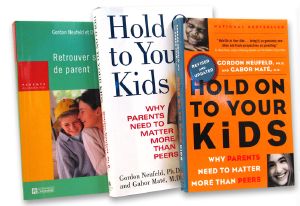
 Ian Verseveldt is assistant professor and director of the Masters in Counselling Program at the Associated Canadian Theological Schools (ACTS) of Trinity Western University. He comments on Hold On to Your Kids: Why Parents Matter by Gordon Neufeld and Gabor Mate (Knopf Canada, 2004).
Today's parents are presented with challenges that were not present a generation or two ago. Multimedia, instant messaging, online chatting and increased visual and auditory stimulation are some of the challenges parents face in attempting to have input into their children's world.
And parents are working hard to balance the economic challenges that often require both to work as well as parent their kids. Despite the plethora of parenting books today, we seem to be losing ground in connecting with our children like never before.
What is happening? How is it that we are losing our influence on our children? And in turn, what can we do to regain influence in our children's lives? Hold On to Your Kids: Why Parents Matter attempts to answer these questions.
Neufeld and Mate state that our culture is out of sync with the attachment needs of our children. The context of our North American culture has recently moved from an adult-oriented world to a peer-oriented world.
What is a peer-oriented society? Children are less likely to take their cues about living from the adults in their lives. They are more likely to orient towards other children in terms of lifestyle choices, morals, dress, language, etc.
Is peer orientation normal?
Peer orientation has become so commonplace that many believe it is a natural step in a child's becoming independent. In fact, children are often encouraged to be with peers, and their withdrawal from adult influence is believed to be normal and healthy.
Aren't parents supposed to socialize their children? Many parents might ask, aren't we supposed to socialize our children; encourage them to create strong bonds with other children?
Neufeld and Mate would say yes, but not at the expense of their relationship with significant healthy adults. They are not arguing against peer friends, as they are natural and can serve a healthy purpose.
Rather, children in adult-oriented cultures can have friends without losing the influence and guidance of a mature generation in their lives; children will not lose their bearings or have to reject parental influence.
Children have an inborn need to find their bearings by turning toward a source of authority, contact and warmth, usually with solid adult figures in their lives. Children in an adult-oriented society get their cues from adults. In the absence of these relationships, children experience an orientation void which must be filled. Peers become the natural substitute for adults in this orientation void.
Age old wisdom
 From numerous examples in the literature on attachment and brain research, Neufeld and Mate weave a convincing argument for age old wisdom: spending time and developing strong attachments with our kids creates a strong base from which they can venture out into the world.
A child's attachment hunger never goes away. The authors set out a solid argument for the role of attachment between adult and child. Attachment is not a given, it is not automatic, but must be intentionally nurtured throughout the child's life.
Neufeld and Mate have reminded us of what our grandparents knew all along: children thrive when they have close attachments and intimate relationships with loving adults in their lives. It sounds so simple, but they argue that our peer-oriented society leaves our children without moorings.
When children become more withdrawn and hang out with their peers, we assume this is a natural progression in their maturation and individuation. They become more withdrawn and sullen as they retreat into their peer world. They are separating from us.
But Neufeld and Mate remind us that our children are moving into a world where the people they take their cues from are just as immature as they. As long as our children are dependent, we need to invite them to depend on us.
Who a child is most attached to will have the greatest impact on his or her life. This does not mean that a child should not be attached to their peers. Again, they are not mutually exclusive. There should be no reason why a child cannot be attached and influenced by adults while they are attached to their peers.
What the young need is stability, presence, attention, advice, good psychic food, unpolluted stories are exactly what the sibling society won't give them. Robert Bly.
Dependence upon parents
Dependency is a natural phenomenon. Too often parents are blamed for lack of parenting skills.
Parents have good instincts to parent; it is not ineptitude but lack of power or authority to parent. Not power in the sense of coercion, but the power to create and maintain an appropriate aligned relationship with the child.
When we lack the power, we are likely to resort to force, threats or some other leverage which may further alienate the child. The secret of the power is in the dependence of the child.
The dependent child will look to the parents as the answer to their needs.
Their dependency need is natural; it is to whom they are dependent - peer or parent - that makes the difference in the child's ability to grow and mature, to be responsive and to be adaptable.
It takes three entities to make parenting work - a dependent being in need of being taken care of, an adult willing to assume responsibility and a good working attachment from the child to the adult.
A child's growth towards maturity is a paradox: it is dependence and attachment that fosters independence and genuine separation.
In other words, fulfillment of attachment needs will foster independence which leads to maturity and adaptability.
Where do we go from here?
Children may know what they want, but they cannot know what they need.
As mature adults in their lives, Neufeld and Mate encourage us to use our own intuitive parenting instincts and form solid attachments with our children - and those within our influence.
After their arguments against a peer-oriented culture, they provide seven solid disciplinary guidelines that foster, preserve and nurture attachment and maturity in his chapter aptly titled:
Discipline that does not divide
Look for further explanations to such headings as these:
1. Use connection, not separation, to bring a child into line;
2. When Problems occur, work the relationship, not the incident;
3. When things aren't working for the child, draw out the tears instead of trying to teach a lesson;
4. Solicit good intentions instead of demanding good behaviour;
5. Draw out the tempering element instead of trying to stop impulsive behaviour;
6. When dealing with an impulsive child, try scripting the desired behaviour instead of demanding maturity;
7. When unable to change the child, try changing the child's world.
Hold On to Your Kids is well worth a read for both professionals and our front-line workers - the parents.