
New Life stands behind members
BC Christian News, · Top Stories
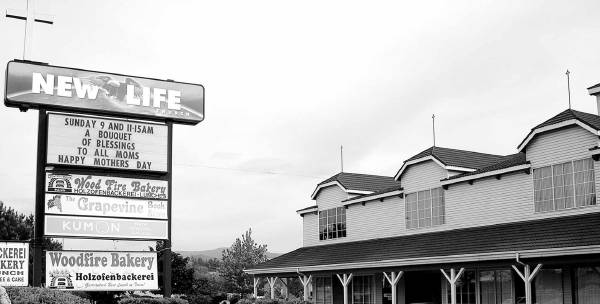
TWO WIDELY respected leaders of a high-profile B.C. church are among those implicated in a complex case involving investor fraud.
New Life Church co-founder Wesley Campbell and his colleague Ralph Bromley both provide leadership to the 1,000-member Kelowna congregation. A member of the church, John DeVries, and his son David, were also named in a B.C. Securities Commission (BCSC) 'Notice of Hearing' May 5 - as was a Dallas, Texas preacher, Ernest Reed Grafke.
Several hundred Canadians invested with John DeVries in Amber Enterprises, a company formed for the purpose of managing funds which were in turn invested with a U.S. import/export company called International Product Investment Corporation (IPIC), headed by entrepreneur Greg Setser.
IPIC collapsed in November 2003, admitting to charges of fraud. Hundreds of Canadian investors lost more than $2 million - including dozens of New Life Church members.
John DeVries, although based in the Caribbean Turks and Caicos Islands, is frequently in Canada; he has attended New Life for more than 20 years. An experienced entrepreneur, he heads a ministry called Wealth For The Nations (WFTN). According to its website, WFTN "was created in order to provide a vehicle to receive, steward and release the end-time financial release promised in scripture. As with all things in the kingdom of God, this release will require a leadership founded in scripture, tested in character and strengthened in relationship to flourish with God's blessing."
In 2001, DeVries let it be known that he was investing his own monies in Greg Setser's IPIC. According to the B.C. Securities Commission, IPIC "purportedly used investors' capital to purchase bulk lots of goods overseas for import to the United States and resale to large well-known retailers within the United States."
New Life lead pastor Kim Unrau said others wanted in on the venture, and so DeVries formed Amber Enterprises. Within two years, more than 700 Canadian investors came on board.
The attraction was three-fold.
Credibility: DeVries was respected and trusted in New Life Church. As well, IPIC was endorsed in the U.S. by famed evangelists Reinhard Bonnke and Benny Hinn. Indeed, leaders of the church - Campbell and Bromley - also lent their credibility to the venture by becoming investors with Amber.
Benefit to the poor: Investors were required to sign an agreement that 20 percent of profits from investments would be given to an overseas development organization of their choice (e.g. African orphanages). As Unrau put it, investors "were convinced they would be helping the poor. Indeed, they were given a choice as to where that support would go." At first, investors did receive reports from overseas, detailing the funds received.
Good return: Amber Enterprises was presented as a high return investment, albeit with some acceptable risk. Early investors were able to ratify this.
Despite a promising start in 2001, as time went on there were delays in receiving returns on investments from IPIC. Only after Setser and IPIC were investigated, during 2003 - 2004, was it discovered that IPIC was in fact an elaborate 'Ponzi scheme.'
Ponzi, described by Wikipedia as "a fraudulent investment operation that involves paying abnormally high returns ('profits') to investors out of the money paid in by subsequent investors, rather than from net revenues generated by any real business.
"The system is doomed to collapse because there are little or no underlying earnings from the money received by the promoter." By 2003, after nearly two years, IPIC was indeed beginning to crumble.
In September 2003, John DeVries organized a conference for 700 attendees at New Life Church. One of the plenary speakers was IPIC's Greg Setser. He showed participants a video endorsement of IPIC from Reinhard Bonnke; just two months later, IPIC collapsed.
Setser is now under criminal investigation in Dallas. After a thorough investigation in June 2004, the Receiver for the U.S. District Court of Texas stated:
"IPIC and its related [ventures] were fraud schemes. Rather than using the invested funds to support profitable business ventures, the IPIC principals paid back earlier investors, supported efforts to solicit further investments and enjoyed various adventures."
The report adds: "When the scheme was interrupted, IPIC was not found to be a self-sustaining cash flow positive business . . . IPIC was a combination of various samples and props, some quite elaborate, whose primary value unfortunately lay in their usefulness to [lend] credibility to the false representations made to prospective investors . . . Evidence of substantial import/export activity was not found."
In its May 2006 Notice of Hearing, the B.C. Securities Commission (BCSC) alleges that "John DeVries, David DeVries, Ernest Reed Grafke, Ralph Bromley and Wesley Campbell were all directly or indirectly involved in soliciting, facilitating or negotiating the Amber securities, contrary to 34(1) and 61 of the Act."
Furthermore, BCSC charges that "John DeVries and Grafke, in promoting the Partnership Agreements, made false statements to investors and potential investors" - including the claim that "Amber had conducted proper due diligence on the buyers and sellers involved in the IPIC investments."
John DeVries is currently out of the country, and unavailable for comment. However, New Life's Unrau said he believes DeVries did fully check out IPIC's operation - and, despite being an experienced entrepreneur, "he too was the victim of what the U.S. Receiver General has called 'a highly sophisticated scam.'"
Thus, he said, "the church remains fully supportive of John."
Campbell - who also considers himself a victim of the fraud - told BCCN he wanted to make it clear that "neither myself nor Ralph [Bromley] had any direct links to Amber Enterprises, and did not receive any monies or commission from them."
Vancouver lawyer Carey Veinotte, who is acting for Devries and his son, and Grafke, told The Vancouver Sun the case will give BCSC an "opportunity to make a statement or put the word out on what they call affinity fraud, which is where a fraudster gets into the middle of a group of people who have something in common - in this case, their faith or their religion - and burns through their money."
The BCSC alleges that Grafke and John DeVries, "while engaging in investor relations activities or with the intention of effecting a trade in a security or both, represented to religiously devout individuals that a investment in Amber was sanctioned by God. This put unreasonable pressure on these individuals by exploiting their beliefs and the trust shared among them within their religious community, contrary to section 50(1)(e) of the Act."
New Life addressed the scandal earlier this year, issuing a statement to members at their March 26 annual general meeting: "We believe that Ralph, Wesley & John were acting from a heart to give, to advance the kingdom and not for personal profit." In response to the Sun article and the BCSC Notice, the church issued a press release stating:
"We were extremely saddened when some of our church members lost money due to the actions of Mr. Setser in the U.S.A.; as you can imagine, those who lost money, including those named in the BCSC Notice of Hearing, were devastated and embarrassed by the developments that came to light in late 2003. We believe that our church members were acting from a heart to give and to help children in need."
Further, New Life "understands that Ralph Bromley, Wesley Campbell and John DeVries have asked their legal representatives to work with the BCSC to bring a conclusion to this matter. As a church we appreciate the work of regulatory bodies like the BCSC who exist to protect the public good, and we look forward to a resolution of these matters."
The statement concluded: "As the public can appreciate, those of our church members who suffered loss wish to put these things behind them and move on. The church continues to support all of our members and stands with them as they walk through these matters."
According to Unrau, some in the church are still "grieving" to some extent, and asking themselves the question, "Why do bad things happen to good people?" Most of them, however, "are doing quite well." He emphasized that the actual fraud now "feels like a while ago."
John and David DeVries, he pointed out, are still held in "very good standing" in the church, and are considered "men of integrity." He believes both father and son were "deceived and defrauded."
Asked to delineate how he felt New Life's experience could be helpful to other churches, Unrau noted that "all the investors were warned that this was a high return / high risk investment." Thus, he said, "the onus was on the individual investors" to use discernment. He added: "Only invest what you can afford to lose."
The BCSC will likely set a date for the hearing in early June. If the five are found responsible, the commission could levy a fine of up to $250,000, and ban individuals from activity in the securities market for life.