
Artist embraces North Shore mountains - and Christ
BC Christian News, · Arts
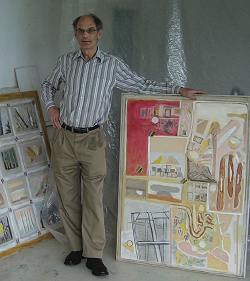 FOR PAINTER, printmaker and wall-sculptor Arnold Shives, a love of nature, a gift for art and a vibrant faith in Christ form three tightly woven strands, with each strand profoundly influencing and informing the other.
And common to all three has been a lifelong passion to hike, climb and enjoy B.C.'s North Shore mountains.
"The artist, in a way, is following the footsteps of God in the world - the great beauty of nature," he says.
"To beautifully render and represent the beauties of nature is in itself an act of homage to God. And I don't know that there's anything more gripping than wilderness."
While he turned to Roman Catholicism somewhat later in life, Shives' twin passions for art and mountaineering evolved together as a child growing up in Vancouver. Born in 1943, he says by the age of 10 he "had this inkling" to be an artist. His introduction to the back country came through his father, who was a hiker and outdoorsman.
"My father introduced me to the North Shore mountains," Shives recalls. "He himself was a member of the British Columbia Mountaineering Club. I joined when I was 16 and got quite involved in mountaineering."
After studying art history for two years at the University of British Columbia, Shives enrolled in the San Francisco Art Institute, graduating with a Bachelor of Fine Arts in 1966. He then went to Stanford University, completing a Masters of Arts in 1968.
After finishing his formal education, Shives returned to B.C. to launch his career as an artist - and apart from brief stays in other cities, has never left. A father of five, Shives and his family have lived in North Vancouver for about 25 years. Not surprisingly, their home is about as near to the North Shore mountains as urban development will allow.
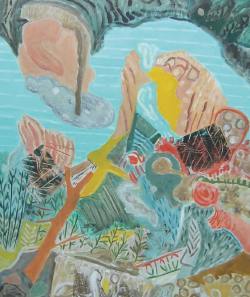 Over the years, Shives has articulated a style of painting that follows in the tradition of the Group of Seven - post-World War I painters whose works evoked an indigenous vision of Canada's natural landscape. His works are on display in galleries and in public and private collections around the world.
In 2001, Trevor Carolan, writing in Image: A Journal of the Arts, called Shives "one of the most ecologically attuned visual artists of his generation."
"Arnold is the quintessential Christian mountain painter in B.C.," says friend and fellow hiker Ron Dart, who teaches political science, philosophy and religious studies at University College of the Fraser Valley in Abbotsford. "He captures the spirit of those peaks in a living, dynamic way."
It was this "living close to the real elements of nature," as Shives calls it, that gradually drew him toward a personal acceptance of Jesus Christ. "Even in the time when I wasn't particularly religious, I still had this intuition of the existence of God because of the great beauty of nature," he says.
That intuition turned into reality in 1972, when Shives converted to the Roman Catholic faith. "Reading Chesterton, Newman, Manley Hopkins, and the lives of the mystics," Carolan wrote, "Shives found a vigour in Catholicism's sympathy toward creative expression unmatched in the Protestant-oriented paths he'd encountered."
An Anglican, Dart sees in Shives' art a reflection of his own interest in the rich Catholic heritage of mountaineering as a mystical metaphor of the human journey.
"What can mountains tell us about our own journey from lower to higher desires? What are those things that are permanent and rock-hard within? What are the fleeting desires, like clouds?" he asks. "And of course in climbing you're forced to face your fears and insecurities, those things that have to be overcome." (For more of Dart's thoughts on this subject, see page 17).
"As Christ said," Shives adds, "the path is narrow and harder and it leads us to him, but the broad path, the easy path, leads to destruction."
Last year, Dart and Shives collaborated on a book titled Thomas Merton and the Beats of the North Cascades. It commemorates the 50th anniversary of a meeting in San Francisco of urban Beat poets from Greenwich Village, including Jack Kerouac and Allen Ginsberg, and West Coast mountain Beat poets such as Gary Snyder.
From this encounter was born the counterculture movement of the 1960s.
Dart and Shives are now planning new, more ambitious collaborations. His collaborator, says Dart, is "an ignored Christian painter, writer, climber."
But while Shives himself is not satisfied with the level of recognition his art has received, he also admits, "I perhaps haven't hustled enough and I've let opportunities slip through my fingers. And stupid things I've done in my career, I can see them quite clearly now."
And yet worldly acclaim clearly remains less important to Shives than laying up treasures in heaven.
"The issue for me is doing my art with the right intention and doing it as well as I can," he says. "That is ultimately to give glory to God."
July 2006