
Dream abounds in silliness and archetypes
BC Christian News, · Summer Fun
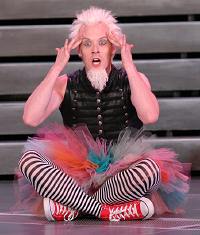
• Bard on the Beach: A Midsummer Night's Dream
HAROLD BLOOM asserts, in The Invention of the Human, that William Shakespeare in A Midsummer Night's Dream "is bawdy but not prurient."
I'm not sure where the line between the two is, but Bard on the Beach's treatment seems to milk every bit of silliness and sexuality it can from his play. It settled down after the first half, but judging from the raucous laughter of the audience, other people are not as prudish as I am.
That aside, the performance was uniformly entertaining. The actors were well fitted; no weak link intruded on my consciousness.
I particularly enjoyed Melissa Poll's rendition of Helena. For once, she was not the usual pathetic character; she enjoyed the chase.
Scott Bellis' Bottom was hilariously ridiculous. Mara Gottler's costume for Kyle Rideout's Puck was inspired: part devil, part fairy-sprite, part clown-fool, and he was certainly all of those.
The practice of adding music and dance to the productions adds a great deal to the evening's entertainment; the business of ballroom dancing which accompanied Theseus' and Hippolyta's conversation in the final act was a nice touch.
Watching Shakespearean comedy is an experience which can go beyond just an evening's entertainment. Last fall, I spent a rewarding couple of months savoring Shakespeare and the Human Mystery (Azure, 2003) by Philip Newell - a Canadian-born author and speaker living in Edinburgh.
Newell uses archetypes from the plays to challenge his readers at a fundamental/psychological level. The chapters are divided into: the King and the Queen; the Lover and the Friend; the Judge and the Warrior; the Seer and the Mage; and the Fool and the Contemplative. He says that "for Philo [Jewish philosopher] the archetypes refer to the essential characteristics of the image of God in us."
Newell says his "thesis is that instead of living from the foundations of our being, from what can be called the 'Imago,' we tend to live from the distortion of our depths." He calls us, as does Polonius in Hamlet, to be true to ourselves: "It must follow, as the night the day, Thou canst not then be false to any man."
A Midsummer Night's Dream abounds with 'Lovers and Friends.' Each has their 'cross to bear.' Hermia is denied her lover by her father, Helena is rejected by her former suitor, the King of Fairies humiliates and manipulates his Queen to get the little changeling boy. Even Bottom is deserted by his friends, who nonetheless mourn him warmly.
"The course of true love never did run smooth" says Lysander - but Hermia swears by the love "that knitteth souls," and by the end of the play, all the couples are "new in amity."
"The lover in us desires to give and receive from the centre of our being," writes Newell, "to share with another the secrets of the self and its hidden yearnings." We are most healthy when we love rightly.
Who can help feeling that all is right the the world when the erstwhile wrangling couples appear onstage in wedding garments? Shakespeare's archetypal characters, decoded by Newell, make for rich, thought-provoking reading.
If you love Shakespeare, read Shakespeare and the Human Mystery. The book should not be read at one sitting; this is a good opportunity to reflect on the state of one's soul.
A Midsummer Night's Dream runs until September 24. Contact: bardonthebeach.org.
July 2006