
Many Lebanese understand Israel's anger
BC Christian News, · International
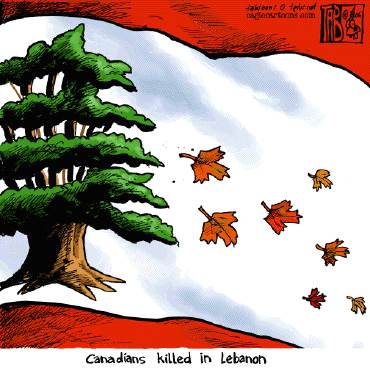 AS Lebanon remains the chief battleground in Israel's campaign to destroy one of its main opponents, Christians are taking a variety of stands on the conflict.
Israel has relentlessly targeted the Hezbollah militia, which precipitated the crisis July 12 by kidnapping two Israeli soldiers and killing eight others. After bombarding Lebanon for a week, Israel sent ground troops into the country July 19.
The majority of Lebanese Canadians are Christians, and some are quite vocal in expressing their concerns.
Elias Bejjani, a Maronite Catholic who chairs the Lebanese Canadian Coordinating Council (LCCC), said he could understand why the Israeli government would consider their actions a legitimate form of self-defence. "This is how they see it. They had no choice but to act, if you understand their situation and point of view." Further, he said, "Israel's reputation as a mighty power was threatened."
Bejjani characterized Hezbollah's provocation of Israel as a "reckless and adventurous action." He also suggested that those critical of Israel for the deaths of Lebanese civilians were not seeing the whole picture.
"I'm not sure Israel is targeting civilians. Hezbollah moves from one neighbourhood to another. According to reports we have heard from Christian villages in south Lebanon, Hezbollah come into the villages and fire their rockets; then they run away. And these villages pay the price."
Bejjani did, however, express some concerns over Israel's military campaign. "Why are they destroying the infrastructure of Lebanon?" Perhaps "to cut aid coming from Syria and Iran," he conjectured.
"Israel's reaction is massive," he continued, adding: "But what led to this reaction? Why is Hezbollah on Lebanon's borders? Why has an armed militia been allowed to patrol a neighbouring country? Why have the Lebanese people let things get to this level? It's a bizarre situation; it's not just black and white."
Much of the Lebanese Canadian community concurs with Bejjani's view, as indicated by a statement issued July 19. The press release extended "heartfelt gratitude to the Canadian government . . . for the correct, just and prompt positions they have taken with regard to Lebanon and the unfortunate military confrontations that are occurring on its soil." Further, they stated: "The actions and conduct of Hezbollah are extremely harmful to the interests of Lebanon and the Lebanese people."
The statement urged Canada to lobby for "an immediate truce in Lebanon based on UN Resolution 1559, which explicitly calls for the disarmament of all Lebanese and non-Lebanese militias, the deployment of the Lebanese army along the border with Israel, and the extension of the authority of the Lebanese government over all Lebanese territory."
The signatories to the statement included representatives of the LCCC, the Canadian Lebanese Human Rights Federation and the Canadian Lebanese Christian Heritage Club.
At press time, well over 300 people had died in Lebanon since the Israeli attack began; and 29 had died in Israel as a result of terrorist retaliation. Many observers have declared the situation in Lebanon a humanitarian crisis.
The United Nations, backed by the U.S., Britain and other countries, has attempted to engineer a diplomatic solution. They are getting help from some unusual sources. According to Reuters, Saudi Arabia has condemned the Hezbollah action. The country's official news agency, SPA, stated: "A distinction must be made between legitimate resistance and uncalculated adventures."
As the crisis has unfolded, Christians have made their views felt in several ways.
Approximately 100 protesters rallied July 12 at the Israeli consulate in Boston. Among them were various Episcopal priests, and Thomas Shaw, Bishop of Massachusetts - who called for "an immediate and peaceful halt to the hostilities . . . and for the peaceful coexistence of Israel and Palestine."
"Is there ever to be an end to violence in the land we call holy?" asked the National Council of Churches and the Church World Service. The July 14 joint statement further asked: "What has violence solved these last 60 years?" The two groups called upon various nations to build upon "the success of former peace initiatives," and urged their members to "pray for all those who have suffered and died . . . and to engage in humanitarian and advocacy actions for peace."
A statement released July 17 by the Canadian branch of The International Christian Embassy Jerusalem (ICEJ) placed the blame squarely on both Hezbollah and Hamas extremists, declaring:
"The inspiration behind their agenda is fanatical Islam, which seeks the total destruction of Israel. Now, in concert with their devious sponsors in Damascus and Tehran, they have unleashed a war against Israel. Israel now has no alternative other than to destroy the terror infrastructure and capabilities of these two groups."
ICEJ executive director Malcolm Hedding further stated: "We fully support Israel in her right to self-defence and in her measured military campaign now being waged against this terror militia. Israel's response is entirely just." He added: "We are not without sympathy for the vast majority of Lebanese citizens, who have been forced into war."
Israel, Bejjani said, "could be an enemy or a friend" to Lebanon. "Israel did not come to south Lebanon to occupy it." While he acknowledged that Israel previously had its forces in Lebanon for almost two decades, he noted: "Israel stayed there all those years, but didn't build one settlement. They helped Lebanese villagers. In the eyes of many Lebanese in south Lebanon, the Israelis were not occupying."
Asked how Israel should deal with ongoing terrorist violence against its people, he said the embattled nation "is fighting for its existence" - and that some of Israel's opponents, such as Hezbollah, are motivated by "pure religious belief." Thus, he asserted, "If I was Israel, I'd take that very seriously."
Nothing, he emphasized, "justifies loss of life. But we are in a war - and war justifies everything for those who are in it." LCCC, he stressed, is "against violence, no matter where it comes from. This conflict shouldn't just end with a truce. What is needed is an agreement which will disarm all militias."
He said he was encouraged by the fact that some Arabic nations have condemned Hezbollah's actions. "This has set a precedent. They have acted boldly. They are saying that Hezbollah is threatening the peace process."
Asked how his group views the efforts of both Christian Zionists and Christians conducting disinvestment campaigns against Israel, he responded: "They can advocate what they want as long as they use peaceful means." He added: "What we advocate has nothing to do with religious beliefs. We are a Christian community, but we don't work on 'Christian issues.' We are Lebanese. We work for democracy, independence and human rights. We want a country where Christians can be Christians."
Noting that Lebanon was split 50/50 between Christians and Muslims, BCCN asked Bejjani whether he believed the two groups could live together peacefully.
"Yeah," he replied, "if we are left alone and have no interference from outside forces - like Iran, Syria and the Palestinians."
August 2006