
World Trade Center a positive view of faith
BC Christian News, · Arts
 |
MOVIES about World War II were produced all throughout that conflict. So in some ways, it is a little strange to hear some people ask if the world is ready for one movie, let alone two, about the terrorist attacks that took place September 11, 2001 - nearly five years ago. Others might ask what took so long.
One reason for our cinematic reluctance may be that we are much more suspicious now of anything that reeks of propaganda. So the filmmakers who have finally tackled the events of that day have had to follow those events very, very closely.
That includes Oliver Stone, whose World Trade Center is now in theatres, and Paul Greengrass, whose United 93 comes to DVD this month.
In theory, at least, each filmmaker has picked one aspect of that day and researched it extensively and presented the facts more or less as they were, without inserting any sort of political commentary into the story. In theory, each movie lets the viewer draw his or her own conclusions about the broader significance of that day.
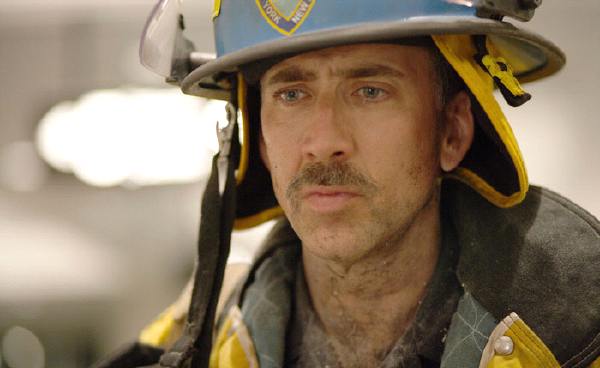
It has been especially fascinating to watch the discussion around World Trade Center, which concerns two Port Authority police officers who were trapped in the rubble of the falling towers and, amazingly, lived to tell the tale.
How people respond to the film will probably depend on how they respond to the character of David Karnes (Michael Shannon), a former marine who plays a key part in the rescue of John McLoughlin (Nicolas Cage) and Will Jimeno (Michael Peña).
Karnes quits his job in Connecticut and puts his fatigues back on after the towers are attacked - and he goes to New York because he believes God is calling him there. Later, he declares, "We're gonna need some good men out there to avenge this." A closing title card tells us that Karnes has since served two tours of duty in Iraq.
Some viewers have assumed that the film supports Karnes' politics, but I'm not so sure. The film subtly hints that current American war efforts may be driven by an apocalyptic evangelical sensibility that, for some, is just as problematic as the radical Muslim belief in jihad; before going to New York, Karnes meets with his pastor, and the scene is set by a shot of a Bible opened to the first page of Revelation.
Be that as it may, World Trade Center is still remarkably forthright about the positive role faith did play in the experience of many people that day. It's there in the crucifixes which adorn the walls of private homes and hang from rescuers' necks; it's there in the Lord's Prayer that McLoughlin shouts in a moment of peril; and it's there in a startling vision that Jimeno has when he slips into unconsciousness.
United 93 is the better of the two films produced so far; it covers more territory, tells the story with greater realism, and boldly focuses on the terrorists themselves. But World Trade Center sheds light on an important piece of the puzzle, too. Together they form a worthy memorial to those who died - and lived - on that awful day.
* * *
Krzysztof Kieslowski fans are in for a treat. Nearly every film the Polish director made before his death in 1996 will be shown this month at the Pacific Cinematheque or the Vancouver International Film Centre - shorts, features, documentaries, the works. The series will also include two films he wrote but did not direct.
Kieslowski was profoundly concerned with moral and spiritual questions, and these themes sometimes expressed themselves in distinctly Christian ways.
Blind Chance (1987) asks to what degree our political and religious affiliations are the result of random incidents. Each episode of the mini-series Dekalog (1988 - 1989) is based in some way on one of the Ten Commandments. And Three Colours: Blue (1993) makes stunning use of a musical composition based on I Corinthians 13.
The series will also include Heaven (2002), the first of a projected trilogy based on Heaven, Hell and Purgatory that Kieslowski wrote before his death. The film was directed by Tom Tykwer, whose own Run Lola Run was inspired by Blind Chance.
Call (604) 688-3456 or (604) 683-3456 for showtimes.
* * *
The Vancouver International Film Festival will take place September 28 - October 13 this year, and one of the highlights - indeed, it's a must-see - is Son of Man.
Directed by Mark Dornford-May and filmed in South Africa, the film imagines what it might be like if Jesus were a black man living in a modern African nation. The ultimate aim of the film is more political than spiritual, but it does underscore the political elements of Jesus' own ministry, especially his call to non-violence.
Also noteworthy is Into Great Silence, a documentary by Philip Gröning about the Grande Chartreuse monastery in France. Watching the film is a meditative experience in its own right; we see monks praying, kneeling, worshipping and engaged in various tasks, but we rarely ever hear them speak.
And on the rare occasion that we do hear a human voice, it is usually chanting or reading a liturgical text, or perhaps serving some other ritual sort of function.
I'll say more about the festival in next month's column, and at my blog.
September 2006