
Freedom Writers inspires kids to fight intolerance
BC Christian News, · Arts
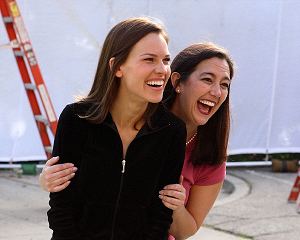
ERIN GRUWELL had no idea what she was getting into when she showed up for her first day as a teacher at Woodrow Wilson High in Long Beach, California.
The Rodney King riots had taken place only one year before, and the students assigned to her brought those racial and social divisions into Gruwell's classroom.
Several weeks into the school year, she intercepted a drawing - a racist caricature of one of her students - which was being passed around the room. She seized the opportunity to tell her students about the horrors racism had caused around the world - and about teenagers who had borne witness to those atrocities.
Inspired by the diaries of Anne Frank, Zlata Filipovic and others, Gruwell encouraged her students to write down their own experiences.
The result was The Freedom Writers Diary, which was published in 1999. It has since been turned into a film, Freedom Writers, which opens January 5 and stars Hilary Swank as Gruwell.
BC Christian News spoke to the real-life Gruwell when she passed through Vancouver in early November.
BCCN: What do you make of the film?
Erin Gruwell: I absolutely love it, which is amazing, because I was so involved in the process, and generally when they make films, they can go one way and not work with the people who are involved, or they can involve them in the process.
And from the very get-go, we were involved with the screenwriter, who became the director, and the producers, and they had an open-door policy to our lives, and access to who we were and what we really cared about, and I think the one thing that we really stressed from the beginning was we wanted to find someone who was a phenomenal writer, who could really pay homage to the Freedom Writers' stories, because that's really the basis of the book and a testament to their voices.
BCCN: In the film, when your character brings up the Holocaust, had Schindler's List already come out?
EG: I like to say the timing couldn't have been better. That incident happened in the early part of the semester, so it was like October, and it was unplanned - it was a teachable moment - and I used Schindler's List further on in February.
The irony was, I took them to my community, which is Newport Beach, which is a very affluent, very conservative community, and the response that my students got was people grabbed their purses and clutched their pearls and had these horrible racial stereotypes about my students, which ended up being another teachable moment.
Here we are going to see a film about intolerance, and we are the victims of intolerance. But I think that really united us and made us stronger.
BCCN: In the film version of The Diary of Anne Frank, there's a scene where her mother says, "Just think how people have it worse off than you," and Anne says, "What good does it do to think how bad other people have it?"
Was there any sort of reaction like that from your students?
EG: You know, I always try to make things relevant. One of my students said, "I feel like I live in an undeclared war zone." And it was so profound in his mind.
He'd lost his father to AIDS, his brother was incarcerated, and he lost about two dozen friends - following the Rodney King riots in long beach there were about 126 murders, most of which were of teenage boys. And so in his mind, this was a war zone.
I thought, if I can teach my kids not to perpetuate the cycle of violence, I have to give them examples of other kids who actually lived in real wars, who didn't perpetuate the cycle of violence but bore witness to it and chronicled what they saw - whether it was Anne Frank, or Elie Wiesel, or even a young girl from Sarajevo by the name of Zlata Filipovic, who wrote about the war in Sarajevo.
So initially, I thought: "Well, if I can teach my kids to pick up a pen and not a gun - but I have to do so by modelling that there's other kids who had it worse."
And that was initially my idea, to show them that there was strength and courage by being a witness, and by chronicling what you saw, and telling the world exactly what needs to be told about violence and discrimination.
And that's how I tried to use Anne Frank, as more of a model and more of a rallying cry.
BCCN: What role has faith played, if any, in the Freedom Writers?
EG: As a teacher, I have to be very careful, because we do have separation of church and state, and so what I did do, which I thought was really important, was expose my students to so many different types of religions in the classroom.
We had Buddhists, we had Jewish Holocaust survivors that came in, we had people from Bosnia that visited us who were Muslim, we had every denomination of the Christian faith, and I think it was really important for my students to meet incredible people who were successful and loving and great role models.
And I think that we have had divine intervention in a lot of moments. I think, going back to that moment with that note and that caricature - I think that that happened because it was supposed to happen, and things that have happened since.
January 2007