
Students report to City Hall from Canada's worst postal code
BC Christian News, · Top Stories
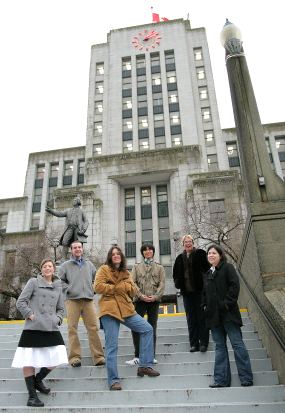
SOLUTIONS for poverty and homelessness in Canada's worst postal code might just be in the hands of a small group of Trinity Western University students.
Led by anthropology professor Claudia Launhardt, perhaps better known as co-owner of Vancouver's Ivanhoe Hotel, these students have been stepping into areas of the downtown eastside, asking hard questions to address the city's current problems of drug addiction, homelessness and public disorder.
Their approach might be the most basic, but it might also be the most powerful: talking to the actual residents, business owners and diverse non-profit organizations in the downtown eastside, and giving their suggestions a voice.
In response to Mayor Sam Sullivan's public survey request entitled 'Reducing Public Disorder: A Made in Vancouver Approach' - which asks citizens for solutions to the problems - the anthropology students brainstormed and chose several areas of focus.
These include homelessness and shelters, churches, missions, businesses, mental and physical health, nutrition, gender issues, illness and the sex trade.
Many of the poor are impacted by one or more of these factors; and if solutions are to be implemented, governing bodies need to understand the relationship which each plays in a person's life.
Launhardt, having a passion both for anthropology and for the poor, decided to fuse the two interests together - making for a unique anthropology curriculum. The result has been an innovative teaching tool.
"Part of understanding anthropology is to comprehend how to conduct field research," she says. "Sure, the students could conduct research at the university; but I wanted them to get out of the university bubble, and get into a community. These students will be graduating soon, and it's important for them to understand how societies work.
"By walking around and finding solutions, talking to the tenants, going and seeing what happens in the street, questioning why there are no garbage cans or hanging baskets in the downtown eastside, those sorts of things - by the students doing this type of research and commentary - they obtain more practical skills, and they get to see how they can potentially contribute to change."
Students Erica Finlay and Darren Wiebe are two of the 47 students researching solutions in the downtown eastside. The opportunity for education outside of the classroom has definitely made for proactive learning, Finlay notes.
"I don't want this class to be a 'what can I get out of this project' type of class; but instead, I want to help those that live down there," she says. "We don't know the solutions, so we want to learn. We also want to try to educate people on the positive things already happening in the community."
Wiebe agrees, saying: "I hope we'll be taken seriously. These are huge global issues - poverty, homelessness - and it's overwhelming; but we are meeting with people that could implement change, so it's great to be part of the process."
Sam Sullivan knows he needs solutions, and he needs them fast. With the 2010 Olympics quickly approaching, he doesn't have a great deal of time to 'fix' things - to avoid having 2010 look like 1986.
At that time, hoping to cash in on Expo 86, some entrepreneurs sold many of their single residency occupancy hotels to developers - displacing hundreds of Vancouver's poor in the process.
To some observers, the mindset behind this was a dagger to the heart of the frail downtown eastside, ripping open and spilling the lives of many of B.C.'s poor onto the street.
Not much has changed in 20 years. According to the Greater Vancouver Regional District there are approximately 2,100 homeless in Vancouver.
A drive through the downtown eastside will reveal a record number of them. They lie outside boarded up hotels, new condominium developments and soup kitchens. Meanwhile, as in 1986, developers are poised to profit from the real estate possibilities.
Launhardt has seen first hand, with the success at the Ivanhoe, how a community can change when dignity is inserted into the lives and surroundings of the poor. She hopes more of these types of solutions will be found through her students' research, and implemented by municipal officials.
"First, this as an opportunity for students to view this process, learning how the city works; and second of all, it encourages students to see that they have a voice," she says. "It's not just about writing essays and doing research - but instead teaches them how democracy works."
In early December, Launhardt and the students went to Vancouver City Hall and handed over their findings to Sam Sullivan.
January 2007