

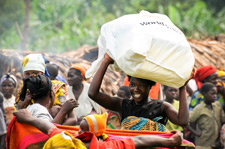
A resurgence of violence that began in August has escalated dramatically, displacing some 250,000 people in addition to the 1.2 million already uprooted since 1996.
The conflict has been the bloodiest since World War II, with the death toll now well over five million. Some 40,000 women have been raped, and thousands of children have been abducted to serve as soldiers.
World Vision (WV) has been in the area since 1993, and is distributing emergency supplies to over 100,000 people. It hopes to reach 400,000 by the end of December.
In addition to food, the help includes plastic sheets to cover the leaf shelters the refugees are building, which provide inadequate protection in the rainy season.
This immediate assistance is in addition to ongoing World Vision programs such as agricultural training and child protection programs, as well as a large-scale water and sanitation project funded by the Canadian International Development Agency.
“It is one of the worst humanitarian situations in the world,” said Anna Ridout, a member of the WV response team who spoke with BCCN from a refugee camp in Goma.
She has encountered many women and children “traumatized by what they have seen,” including a girl who had lost her entire family, and a teenage girl caring for a baby whose mother was killed.
She has also been struck by the “amazing resilience” of children, who sometimes come to the camps too traumatized to speak, and are later found laughing and playing in “child-friendly spaces” provided by WV. As hard as it is, “it’s a privilege to be here.”
Development and Peace, the international aid organization of the Roman Catholic Church in Canada, has sent $50,000 to provide emergency relief to 90,000 refugees.
Mennonite Central Committee is contributing $280,000 in aid, and is working with the Canadian Foodgrains Bank and the Pentecostal Assemblies of Canada to feed more than 20,000 displaced people.
A wide range of groups are also calling on the Canadian government to become more involved in the area. These groups include World Vision, Development and Peace, Kairos and the United Church of Canada.
| Previous article Acquitted of ‘blasphemy’ | Next article Ron Gray moves on from Christian Heritage leadership |
 |  |
| Page 6 | Page 7 |
They maintain intervention should begin with enlarging the United Nations Observation Mission in Congo, so that it can protect the civilian population. Then the government of DRC and its neighbours, as well as militia groups within the DRC, must be brought into peace negotiations.
Illegal trading of minerals from Congo’s eastern highlands must also be controlled, as it attracts many combatants to the area.
The real danger is that the conflict could escalate as it did between 1996 and 2003, bringing in most of DRC’s neighbours, including Rwanda, Burundi, Uganda, Tanzania, Zambia and Angola.
“We just need peace,” Ridout said, suggesting that meaningful development for the area cannot begin until the local people are free to go home and start farming again, and sending their children to school.
An estimated 94 percent of DRC’s population are Christians; however, there are a lot of nominal Christians, and many combine Christianity with animistic beliefs, said Jamie Munday, holistic development coordinator for MBMS International.
Given the enormously complex problems in the DRC, he said the most important thing Canadians can do is pray. – Jim Coggins
December 2008