

 I DIDN’T set out to dig up the fleur-de-lis roots of Victoria’s Union Jack image – but dig them up, I did.
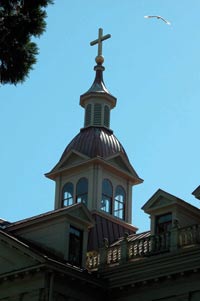
Some glitter had caught my eye: it came from a gold cross atop a building that shifted my sense of place from the Protestant Victoria of 2008 to the French Catholic Canada of the 1800s – Montreal, St. Hyacinthe or Quebec City. But I was in Victoria – wasn’t I?
The building was St. Ann’s Academy, three blocks east of the Empress Hotel, at Quadra and Humboldt. Passing locals that I quizzed knew nought, so I did some digging. I learned that St. Ann’s – celebrating its 150th anniversary this year – has roots leading right back to Wolfe’s victory over Montcalm, on the Plains of Abraham in 1759.
From 1759 until 1846, education in Quebec had been sporadic at best. In fact, in 1836, Quebec cut off funding, denying education to 30,000 children. The Sisters of Ann, a teaching and nursing order, was born out of this crisis.
Before B.C. joined Canada, in 1871, Bishop Modeste Demers trekked back to French Canada in 1857, to get help for his young diocese centred at the Hudson’s Bay Company’s trading post on the southern tip of Vancouver Island.
Demers recruited four Sisters of St. Ann, their laywoman, three priests and two monks. They sailed from Montreal for the Panama Isthmus, which was then crossed by rail; they set sail on a second boat, up the Pacific Coast, anchoring at Victoria June 5, 1858.
But Victoria was no longer a French-speaking trading post. The 20 bark-roofed shacks the bishop had left behind were lost in mass of tents, and 200 new houses. The Cariboo Gold Rush of ’57 and ’58 had lured English-speaking miners, most from California’s spent gold fields.
Sister Valois served as the first Superior of St. Ann’s Academy, a log cabin – and led her nuns through their first crisis. Although the convents forbade girls from attending dances and the theatre, three students accompanied their father Governor Douglas – a Protestant and a close friend of the bishop – to a ball aboard a man o’ war.
Governor Douglas asked Mother Superior to be lenient, but she expelled his daughters anyway. Eleven other ‘upper social class’ girls left, too.
In 1859, English-speaking Irish immigrant Sister Mary Providence McTucker replaced Sister Valois. Racism and class distinction tested Sister McTucker and Bishop Demers, when she established a select school for those who could afford to pay fees – and a free school for which minimal, if any, tuition was expected.
Black parents demanded their children be enrolled in the select school, and Bishop Demers insisted that they be admitted; but then the whites protested, and so the bishop rescinded his integration order. And, much to the blacks’ sorrow, McTucker reverted to her original plan.
In 1861, the Mother Superior began putting her students through public examinations. The press reported on them annually, adding that Victoria was lucky to have the sisters, their schools and their medical care.
Even so, the Sisters’ schools were hotly debated: “Are we to have sectarian schools?”asked the British Colonist and the Evening Examiner.
A reporter commented: “If I know the bishop well, he will carry out his objective [a convent] regardless of all opposition, as it has originated from no other foreign cause, but from a pure motive of doing an actual and real good.”
By 1871, enrollment had outgrown the academy’s three temporary sites. One of Bishop Demers’ priests, Fr. Michaud, was an architect. He designed the first section of St. Ann’s, as it stands today.
| Previous article The Cridge Centre marks 135th year with challenges and opportunities | Next article Island round-up |
 |  |
| Island Page 4 | Island Page 5 |
The same year also saw Fr. Michaud move his wooden cathedral, built in 1858, across Humboldt Street, to the rear of St. Ann’s – where a brick shell tied it to the Academy.
In 1910, Thomas Hooper designed and built the third and final section, which includes the auditorium. By 1973, a lack of nuns and sufficient funds, turn-over of lay teachers and decreasing enrollment closed St. Ann’s Academy. The sisters sold it to the provincial government in 1974.
Government agencies and charities rented space in it until 1985, when the fire marshal limited occupancy to 100, ordered the east wing abandoned and demanded upgrading be complete by 1992. Vandals had their kick at it, too. Graffiti disgraced its interior.
Academy Gardens, a private developer, won a lease allowing conversion of St. Ann’s to a licensed tourist attraction. Many protested, demanding that the gold cross be removed from the cupola: “It would be outrageous to have that cross on top of a building when 600 people are getting drunk below it.”
However the developer refused to take down the cross. “To put a development of this nature on this site,” another opponent argued, “is akin to putting an amusement park on the Plains of Abraham.”
U Vic’s chancellor William Gibson wanted St. Ann’s for his junior students; others wanted it to be an arts centre. The provincial government offered St. Ann’s to greater Victoria for $1; the city and its neighbours said “no thanks.”
Catholic artist Gregory Hartnell got press attention with tales of Emily Carr’s ghost having been seen stalking the Academy, “bewailing the historic building’s fate.”
Carr, Victoria’s most lauded artist, was born the year St. Ann’s Academy was built; she’d sketched the area; and the sisters had nursed her at St. Joseph’s hospital, just across the street.
Hartnell claimed that a white bird alit on the gold cross atop the cupola at dusk, and Emily Carr appeared, turning slowly in the cupola, looking at the panorama, her monkey Woo stroking “her face consolingly.”
Eventually, Academy Gardens’ $21 million scheme went broke. Some talked of demolishing St. Ann’s, but sanity prevailed: St. Ann’s re-opened in 1997 after a $16-million restoration. Today it is a national heritage site that includes a French-Canadian chapel, which is used for weddings and other events; an interpretive centre where visitors learn of the sisters’ work; and government office space.
December 2008