


Prairie Night was started in 1946, when the leadership at Centennial recognized that many of the people living in their community, especially in January and February, were residents at motels and hotels just west of the church, along Gorge Road.
In fact, says Judy Rankin, who has been a part of Centennial since she was a child, she and her family have usually been in a minority in the congregation: people who have spent most of their lives in Victoria.
“Between them, the transplants – those who moved to Victoria from the prairies – and the people who come here for two or three months in the winter, have traditionally made up more of the congregation than those originating here,” she says.
She said the tradition started when it became clear that many people attending the church in the winter were in Victoria for just a couple of months, to escape the prairie cold. Many were grain farmers who had time to spare, before returning to prepare for seeding.
Dian Strome, who has taken on the role of raising awareness for Prairie Night, notes that, as the congregation ages, there is a need to find ways of publicizing the links with the prairies.
Public and Christian media have both been important in keeping the awareness high. And the hotels in the vicinity provide space in their own communications systems and on their bulletin boards.
That is important, she maintains, because as a lot of the older and smaller Gorge motels closed down, the downtown hotels took over providing attractive winter rates for the winter visitors. While those hotels are a bit of a long walk to Centennial, the parking situation at the church is favourable, thanks to the availability of nearby lots ‘loaned’ to church patrons for the evening.
Prairie Night organizers like to keep track of which prairie provinces are best represented “Each year we have a ‘count’,” Strome notes. “Usually Saskatchewan has won it; but more recently, Manitoba has moved to the front.”
This year’s event included a concert. The evening was rounded off with a refreshment time, when visitors from the various provinces were able to catch up on their respective families, home churches and community organizations.
Prairie Night is not a church service, per se, although the fact that it is held in an architecturally and acoustically excellent sanctuary, which can seat over 600, helps set a comfortable tone for the event.
In 2001, the church was completely renovated and the sanctuary and pipe organ were restored to their early glory.
Strome says Roy McCormick, Centennial’s organist and choirmaster, puts the program together, with a heavy emphasis on music. The featured group alternates each year, between the Orion and Victoria Police choirs.
| Previous article Churches face opposition to growth plans | Next article Okanagan round-up |
 |  |
| Island Page 06 | Island Page 07 |
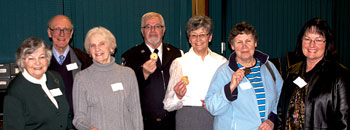
In the earlier years, there was a strong emphasis on speakers.
One of the more notable was Tommy Douglas, premier of Saskatchewan, founder of the New Democratic Party and a Baptist minister.
In more recent years, Iona Campagnolo, who was Lieutenant-Governor at the time, was remembered as an outstanding speaker.
Alanna Menu, Centennial’s minister for the past couple of years, is a transplant of sorts, from Ontario (Her own pilgrimage, available by clicking ‘bio’ at www.cucvictoria.com, is worth inspecting).
Strome says Menu is a good champion for Prairie Night, as well as for encouraging prairie winter visitors and transplants to feel “at home” at Centennial.
In that sense, she says, it is important to “put Centennial on the map.”
Rankin agrees. “Centennial is a family church. It is family to look after each other,” she says, suggesting that this seems to grow out of prairie traditions.
March 2009