

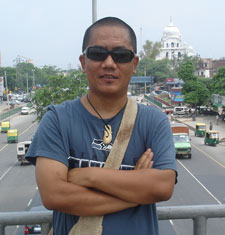
 I AM a tribal boy who has seen the hand of God move in and through me.
I was born in a little town called Churachandpur – locally known as Lamka; it is in the state of Manipur, in northeast India.
I belong to a small hill tribe called Paite. We were known to be a nomadic head hunting tribe until the gospel of Jesus Christ came through missionaries about 100 years ago. There are less than 100,000 people who speak my dialect in this world.
Not forgotten by God
I find it amazingly comforting when I reflect on how an unknown, forgotten tribe was not forgotten by God. He sent his messengers to bring us the good news.
My maternal grandfather was one of the first converts from the tribe. He suffered much taunting and persecution from his tribesmen as a result, because he was considered a traitor. “Men, cut your hair. Stop drinking. Stop worshipping spirits, and turn to Jesus” was his message.
I got my name from my grandfather. Lalpi Guite means ‘Magnificent King.’
When we were kids, our parents were very keen on teaching and leading my brother, sister and I in the path of Christian life, doing the best they knew how. And as a preacher’s daughter, my mother was extra zealous when it came to faith issues.
I remember being taught memory verses from the Bible when we were very young. And we learned to read the Bible in our own language much earlier than kids our age, which was not easy. Saying mealtime and bedtime prayers were a must.
Suffering of the faithful
As I grew older, I tried to piece together the things in my life. On the one hand, I learned from my parents and from Sunday school that God is a good and loving God.
But on the other hand, I saw much suffering, even in my grandfather’s household – despite him being a faithful and dedicated follower of a powerful, loving God.
Grandpa had been widowed three times. Some of these deaths happened while he travelled village-to-village, zealously sharing his newfound faith and hope with his tribesmen. I could not, in my young mind, resolve how a loving God would allow such a horrible thing to happen to his servant.
The area I lived in was a hotbed of the drug trade. It was part of a ‘highway’ going from south Asia’s opium-producing Golden Triangle, through the porous border with Burma and into India.
It is a known fact today that my part of the world has a very high percentage of injecting drug users – and consequently, thousands of people living with HIV.
Drugs for all
Drugs were easily available for anyone, of any age, when we were kids. I tried out hard drugs very early on in life. By age 12, I had already graduated to heroin.
I was partially motivated by curiosity, but also by a deep longing to belong. Peer pressure is strong at that age, and especially strong for a tribal boy – because life is all about being loyal to your friends, your tribe.
When I was 14, one of the boys I used to hang out with died of a drug overdose. That was the first OD that I remember hearing about. The death scared all of us for a time; but this fear did not last long, as our habits and dependence on the drugs increased.
There was much that was sacrificed along the way. Very soon, teenage deaths and drug overdoses became a very common occurrence in the neighbourhood.
By age 16, I was using a cane to support myself when walking. This was due to my lack of care for myself – and perhaps also due to side effects from all the drugs I had abused.
Over the years my family prayed and did what they could, by introducing me to spiritual leaders and other people who could help me. They also sent me to camps, in the hope that I would seek and find help.
Heroin panic
I was in one such camp at age 17. One day, I sneaked out and took a shot of heroin in the toilet. But as I pulled the syringe from my arm, I could feel my face swelling up. Instead of the expected nice calm high, it sent me on a panic spiral.
My face swelled shut, and I was rushed to the hospital. Despite the doctors’ attempts to save me, judging from my appearance it didn’t look like the medication was helping.
| Previous article Family celebration of the hope found in Easter | Next article Dalit children graduate to freedom |
 |  |
| Page 2 | Page 3 |
Looking into the mirror, I saw how ugly I looked. I felt I had a glimpse of my inner person, my helplessness and my desperate need for help from someone higher than myself.
The next day, I prayed to receive Jesus, and asked him to come and reign in my heart. Immediately, the swelling on my face subsided. There was a new birth of hope and purpose in my life. I had never felt so clean before. Cold turkey and heroin withdrawal symptoms went away, just like that.
Having set out to be a follower of Jesus, I had much to learn about him, life and myself. Christian life does not end at kicking a habit. It’s about learning to know and worship God for who he is.
There were moments of utter disgust for things I had done. But a humble gratitude would sweep in with the revelation that the love of God covers my sins. I found strength in the truth that I could come to God just as I was, and look him in the eye.
Not free of struggles
This did not mean my life was suddenly free of struggles, however.
In my mid 20s, my roommate drowned; and just five or six months later, another friend died of a drug overdose. The shock and grief, as well as having to take care of details like the post mortem and the funeral, wore me out emotionally.
For a period, it was a struggle to even pray. I condemned myself as a bad Christian for not having enough faith, for not praying.
While consumed with these emotions, one day I went off to the beach. It was there that God spoke to me, through Isaiah 42:3.
He spoke to me of how he does not disregard the small and insignificant – and how I could come to him even in my most fragile and confused state of faith.
I wrote a song called ‘Count on You,’ there on the beach. It became a personal anthem in the years to follow.
Available to Jesus
I was also reminded, over and over, that Jesus is no ‘respecter of persons” – but uses anyone who is available to him.
I moved to Vancouver in the year 2003, and now serve at Cityview Baptist Church. I also work with OpenTable, a ministry to the homeless and less fortunate in the city.
Week after week, as I testify and lead worship, I know that lives do not get changed and people do not turn to Jesus in worshipful awe, just because of my mantra.
There have been many challenging moments. I’ve had guys just drop on the floor in the middle of my sharing, because they were too intoxicated. One fellow chose to call Jesus ‘Albert’ – “because it’s more personal,” he said.
Another broke down and cried in the middle of my scripture reading, and said: “I do not believe in that because the pope does not believe in it.” Despite these kinds of challenges, we’ve seen faith commitments and baptisms over the years.
When ex-cons call you up to say “We are running about five minutes late, please do not start the prayer without us,” you cannot help but believe God is doing deep work in the lives of these folks.
While some might dismiss this congregation as a group of misfits and welfare cheque dependents, we have sponsored an African child in Burkina Faso through Compassion Canada for over a year. At Easter this year, we are hoping to sign up for our second one.
Lalpi Guite is pastor of worship and community at Cityview Church. Contact: lalpi.com.
April 2009