

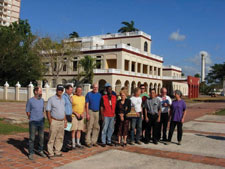
You could probably imagine some of my preconceptions, as I travelled recently to Cuba with a team of 12 adventurous crusaders from the Victoria First Church of the Nazarene.
When entering a communist country with the intent of advancing the gospel of Jesus Christ, one could expect engaging in at least a certain degree of high stakes drama, a sprinkling of evangelical espionage, and perhaps even a dollop of sanctified skulduggery.
But before we could say “Move over, Brother Andrew!” we found an incredibly wide-open door to Christian ministry and service in Camaguey.
Splitting the distance between the far reaches of Havana and Guantanamo, the city of Camaguey – the capital of the central Cuban province of the same name – was the location for our two week Work & Witness mission.
In the autumn of 2008, this area was hit by three hurricanes and a major flood. Our objective in Camaguey was to assist in the construction of a church building for the Saratoga Church of the Nazarene.
Rather than going the regular tourist route, our church contacts in Cuba had advised us a couple of months in advance of our visit to apply to the Cuban government for ‘religious’ visas. We did, and those visas were waiting for us when we arrived at the Holguin airport.
There would be no travelling beneath the radar screen this trip. Not that we really expected that. After all, our 30 suitcases chock-full of baseball equipment, construction tools, sewing machines, medical supplies, wedding dresses, Spanish Bibles, bicycle parts and guitar strings were somewhat hard to ignore.
While in Camaguey, we had the privilege of worshipping in three different churches: the Saratoga and Jayama Churches of the Nazarene, and the Hallelujah Temple Pentecostal Assembly. With the capable assistance of my young trusty interpreter, Augusto, it was a thrill for me to preach to all three congregations.
The church in Cuba is definitely not an underground movement. Reinforcing that fact are the two most prominent pieces of ecclesiastical furnishing in a typical Cuban church: the P.A. system and the drum kit.
Through open windows, loud strains of joyful salsa-flavoured worship punctuate the bold claims of the gospel, as they are literally blasted out into the surrounding community.
People walking along the surrounding streets, or sweeping the entrances of their homes, or enjoying a good cup of strong coffee on their small balconies cannot ignore the presence of the church in their community.
Cuba recently celebrated the 50th anniversary of the revolution which established Fidel Castro as its leader in 1959. From the early years following the revolution, there are stories which chronicle the hardline stance of the communist government against the church.
| Previous article Rhythm Art: fund-raising goes creative for Africa | Next article Pro-life student club rejected again at UVic |
 |  |
| Island Page 4 | Island Page 5 |
One of our hosts, Pastor Samuel, told us of the time his uncle (also a Nazarene pastor) was imprisoned for six months for carrying his Bible onto a bus. Pastor Benjamin, of the Hallelujah Temple, in the early years of his ministry, was beaten and injured by several people who were antagonistic to the gospel. But at their trial, in a spirit of grace and forgiveness, Pastor Benjamin refused to bring charges against them.
These are just a couple of examples of religious persecution faced by Cuban Christians in the early years following the revolution. But we were told by our hosts that things changed for the better from around 1982.
They couldn’t give me a specific event or a reason for the change at that time, but attributed it more to the fact that a generation had passed since 1959, and that the government was taking an increasingly more relaxed and accepting approach to the role of the church in the lives of Cubans.
One of the most incredible experiences of our two weeks in Camaguey was being invited to the office of Oscar Saname, the Cuban Party Representative in Charge of Religious Affairs for the Province of Camaguey.
For our visit, Mr. Saname was flanked by two Cuban pastors: the Venerable Juan Antonio Gonzalez Rodriguez, an Episcopal Church minister in charge of a fraternity of pastors of different denominations in Camaguey; and Pastor Esther Quintero, an 81year old Pentecostal minister in charge of the Council of Churches in Camaguey.
They met with us for more than an hour, answering our questions, serving us coffee and cold water, and thanking us for the work we had come to do. At the end of our meeting, I asked Mr. Saname for the opportunity of praying a prayer of blessing on him and those with whom he worked and represented. He graciously granted that request.
Doors are opening. God is on the move in the lives of his people in Cuba. The inscription in one of the churches we visited said it all: Cristos Por Cuba – ‘Christ for Cuba!’
Gary Bennett is the head pastor of First Church of the Nazarene in Victoria.
April 2009