

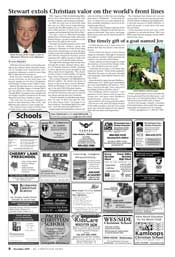
LESS than 24 hours after receiving the prestigious Ross Munro Media Award in Ottawa, one of Canada’s most respected war correspondents addressed a crowd of more than 800 in Abbotsford November 21.
Brian Stewart, sharing his experience of seeing Christians on the front lines, was keynote speaker for the Day of Inspiration and Banquet of Praise at the Tradex Centre.
Held for the first time in B.C., the event was put on by The Bible League of Canada (TBLC) and the Bibles For Missions Foundation Canada (BFM). Its purpose was to inspire and encourage Canadian volunteers by showing them the front lines of faith in action.
“The only way you can get volunteers to work is to give meaning to their work,” said BFM executive director Casey Langbroek.
“We wanted to have a day to tell the story of what we do, a time to inspire people.”
TBLC began in 1948, first distributing Bibles door to door. More than 60 years later, they provide scriptures and training worldwide.
In 1989, two men were so moved by what they saw on a TBLC tour to India that they opened the first BFM thrift store in Chilliwack. BFM operates 37 thrift stores across Canada, and has raised $30,566,000 for TBLC.
The day’s event in Abbotsford brought speakers from North Korea, India, Africa and Eastern Europe – people in ministries on the front lines throughout the world.
Through moving first-hand accounts, they spoke of African children dying and orphaned; Christians in North Korea being persecuted, and having an average life span of three years; cities in Macedonia and Poland still without evangelical churches; and an estimated 400 million people in India who have never even heard the name of Jesus.
Through all the messages, that of hope came through the loudest. Michael Alemu, director of Christian Horizons Global, speaking of those affected by severe drought in East Africa, said it most eloquently: “The church of Jesus Christ is in the middle of it giving hope, where there is no hope physically.”
The evening’s banquet was highlighted by Stewart’s address. He told his own stories of being on the front lines, from El Salvador, Beirut and Rwanda to his acclaimed coverage of the mid-1980s Ethiopian famine.
He emphasized that it didn’t seem to matter how fast he arrived at a war zone or crisis; he was always arriving after the Christians.

| Previous article The timely gift of a goat named Joy | Next article Missions Fest pivotal to Rosens |
 |  |
| Page 8 | Page 9 |
“It used to frustrate me that they were always first,” he said. “It drove me nuts! We were never there before them.” He began to see these people as “the primary light in the darkness – and often the only light there is.”
Seeing organized Christianity in action over and over led him to follow his own winding path back to Christianity – “connecting the dots” of what he’d seen and experienced, and eventually returning to his roots in the Presbyterian Church.
“The church and Christians stand up in the face of danger, telling the world they are not going to stand aside. They stick it out longer than anyone; they are the bravest people in the world.”
The Christians that Stewart saw over and over are able to be in the front lines because of those that are working in the background – to provide resources to build churches, to teach the people, to reach those who need the most help.
Using discarded goods and some 3,000 volunteers to sort and sell them, TBLC and BFM ensure that the message of Jesus Christ will not stay silent.
December 2009