

LAST month, hundreds of University of Victoria (UVic) students witnessed a debate and saw images the pro-abortion group on campus didn’t want them see.
Members of the pro-abortion Students for Choice refused to participate in the debate, forcing philosophy professor Eike Henner Kluge to reluctantly take up the task.
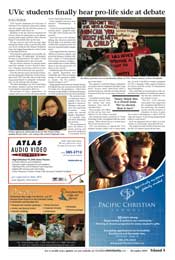
The pro-choicers also held up large signs during the debate itself, to prevent the audience from seeing pro-life debater Stephanie Gray, the Calgary-based director of the Centre for Bioethical Reform.
Their refusal to participate was roundly criticized by Kluge. “It’s deplorable,” he declared, because it undermined “the spirit of free inquiry” fundamental to the university.
The pro-choice element on campus dominates the student society’s board of directors. Whether this faction believes in free inquiry at all has been put into question.
Over the last two years, the board of directors has repeatedly denied the Youth Protecting Youth (YPY) pro-life club its club funding as punishment for allegedly “intimidating” co-eds with pro-life messages.
The latest defunding vote, two weeks before the debate, sparked a protest from the B.C. Civil Liberties Association (BCCLA).
The prospect of Gray’s appearance on campus was even cited in the latest student society defunding decision.
Gray’s graphic pictures were deemed “intimidating” in advance.
“It can’t be me personally that’s scaring them,” quipped Gray. “I’m only 5 feet 6 inches and 110 pounds.”
Gray lived up to her advance billing. She showed a short but bloody film of an abortion that ended with a poignant shot of a tiny but unquestionably human hand.
Gray argued that the objective differences between unborn and post-born humans, whether children, adults or handicapped, were merely matters of degree – and insufficient to justify killing those in the first group but not those in the second.
Disabled people and newborns are equally dependent and vulnerable, but “they are human beings. So the question tonight is, clearly: ‘Are the unborn human beings or not?’”
Kluge agreed that fetuses are human beings, but argued they are not persons until at least 20 weeks into the pregnancy – when they develop enough ability to think and feel pain, at which point abortion becomes unethical.
The professor also condemned Gray’s graphic video as an appeal to emotion. Members of the audience also expressed revulsion; some called the bloody images “disgusting.”

| Previous article Trendy justice feels good, for a bit | Next article UVic students finally hear pro-life side at debate |
 |  |
| Island Page 4 | Island Page 5 |
In rebuttal, Gray led off by defending her pictures.
“We use pictures to show the effects of drunk driving and genocide. Images are a reasonable tool to get at the truth.”
She argued as well that Kluge’s definition of a person was too subjective and hard to pin down. Science knew objectively what a human being was, and this was what should be protected by law at any stage of development.
An audience survey taken afterwards showed that few minds had been changed, Gray told BC Christian News.
Most people who filled out the survey were true believers in one camp or another.
But Anastasia Pearse, president of Youth Protecting Youth, was pleased with the result, saying: “Many think this is a closed issue. We’ve shown that it isn’t.”
YPY was planning to appeal the UVic Student Society’s latest vote to deny funding. As well, it has filed a formal complaint to UVic’s Equality Office against Students for Choice and the society, for harassment and intimidation.
This could take several months to rule on, and raises the question of whether the university has any authority over the student society.
The B.C. Civil Liberties Association has supported the complaint with letters to the university, the student society and the minister of education. In these, it states the society is attempting to censor YPY for only one reason: “your strong disagreement with its convictions.”
Such an argument has no place in a free society or a university, states the BCCLA.
The student society’s board of directors says the BCCLA doesn’t know all the facts.
December 2009