


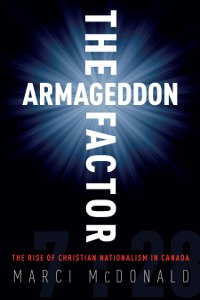
According to the publisher, Random House, Marci McDonald’s The Armageddon Factor: The Rise of Christian Nationalism “shows that the Canadian Christian right [is] determined to outlaw homosexuality and abortion, and to restore Canada to what they see as its divinely determined destiny to be a nation ruled by Christian laws and precepts.”
However, speaking to BCCN, McDonald maintained she had no intention of “demonizing” conservative Christians. Further, she said she was “raised from a young age to have an abhorrence of intolerance. I am a Christian who lost my faith for some years, and came back to it.”
As might be expected, the book has been sharply criticized by some Christians.
Aileen Van Ginkel serves with the Evangelical Fellowship of Canada (EFC), as vice president of ministry services. EFC, she writes, “rejects the charge that Canadian Evangelicals are working to establish a theocratic government where ‘non-believers – atheists, non-Christians and even Christian secularists – have no place, and those in violation of biblical law, notably homosexuals and adulterers, would merit severe punishment and the sort of shunning that once characterized a society where suspected witches were burned’ . . .
Shun the theo-cons
 |
According to John Stackhouse, a professor at Regent College in Vancouver, McDonald “has just released a very bad book on what she posits is an increasingly menacing Religious Right in Canada . . . Some bloggers have already noticed that Ms. McDonald is getting basic facts wrong . . . or misinterpreting what facts she has . . .
“The book’s title, introduction, and penultimate chapter would lead us to think that dispensational ‘end-of-the-world’ theology is key to the Religious Right in Canada. But to say so is just laughable for Roman Catholics, most Protestants, and even large numbers of evangelicals.”
McDonald, he adds, “blurs important distinctions among various religious groups, movements and categories.” Further, “because the main thrust of the book is conspiracy theory . . . McDonald trades in the requisite rhetoric. But her sinister language often becomes comical.”
However, Stackhouse, like some other Christian observers, concedes there are good things in The Armageddon Factor.
McDonald’s book, he writes, “has so many evident problems that it is hard to trust what she says . . . And that’s too bad, because I don’t think she’s wrong about one crucial matter . . . There is a Religious Right in Canada, and it has influence worth noticing.
“The mere fact . . . that theologically conservative Christians increasingly have involved themselves in Canadian public life is not news . . . No one needs to be alarmed about Catholic bishops or the Evangelical Fellowship of Canada . . . What does disturb me . . . is the fact that extreme forms of Canadian evangelicalism – the creation-science, hysterical-prophetic, health-and-wealth, visionary-charismatic, culturally-imperialistic, all-or-nothing forms – seem indeed to have purchase on significant figures in Canadian political life.”
Ron Dart, a professor at the University of the Fraser Valley in Abbotsford, B.C., writes very positively about the book.
‘Must-read tome’
The Armageddon Factor, he states, is “a poignant, probing and searching . . . must-read tome for those interested in how a type of Christian nationalism has come to define Canadian nationalism in a distinctively republican manner . . .
“McDonald, to her credit, does make distinctions between a more moderate and centrist approach on the right, and a more aggressive and confrontational style. Distinctions do need to be made if the religious right is to be properly understood. There is, in short, a plurality of colours on Joseph’s coat . . . even though it is the same political and ideological coat.”
Further, Dart notes: “The republican right has now, brick by brick, put in place think tanks, organizations, educational institutions, media mansions, creationist museums and a new generation of lawyers and publishing companies that will last long after [Stephen] Harper descends from the throne.”
Some commentators in the secular press have praised the book.
Douglas Todd, spirituality and ethics columnist for the Vancouver Sun, contends that McDonald “never actually says in her book that evangelicals and other religious conservatives aren’t free to pursue their political goals in a democratic country. McDonald’s main aim is to simply let readers know about the extent and sophistication of what might be called the Religious Right in Canada . . .
“The claim by McDonald in the book that she was trying to be balanced, however, has certainly not stopped many evangelical activists from feeling persecuted . . . This, clearly, is a book that stirs strong and often angry emotions, while raising big issues for religious people and the country.”
Other commentators in the secular press have contended the book relies on sloppy research; utilizes unjustified leaps of logic; and is unfair in its treatment of evangelicals.
Those crazy Christians
In a Maclean’s magazine article entitled ‘Those crazy Christians are taking over Ottawa!’ Paul Wells writes: “McDonald is a former Washington and Paris bureau chief for this magazine. In 2006, she wrote a long article for The Walrus. In it, she took an obvious and interesting fact – the Harper government pays a lot of attention to the concerns of evangelical Christians – and turned it into a risible fantasy: the Harper government is a plaything of wild-eyed end-timers who would transform Canada into a soul-saving factory in anticipation of the Rapture.”
The Armageddon Factor, he claims, “is the book-length version of that article . . . It’s a blend of screaming hysteria linked to something that probably actually happened over an exquisitely equivocal footbridge of maybe-words . . .
“McDonald admits her so-called Christian nationalists are only ‘one faction,’ before declaring it has ‘gained influence out of all proportion to its numerical heft.’ From there it’s only a short step along the maybe-word footbridge to warning that the end-timers are about to take over . . .
“People who believe in God and vote their beliefs often work hard. That makes them a potent ingredient in any political coalition anywhere. They win some and lose some. Always have, always will. These days, they win more than they used to. They still lose a lot.”
Masked zombies
In a Globe and Mail piece entitled ‘Onward, Christian nationalists,’ Molly Worthen notes that McDonald “has spent hundreds of hours interviewing evangelicals, but still seems to view them as Christian zombies masked as ordinary citizens, who ‘burble’ and ‘enthuse’ rather than merely speak . . .
“Her account relies heavily on a handful of books by American journalists who over-simplified evangelical thought, in an effort to galvanize liberals during the George W. Bush era. Some of her subjects may indeed dream of ruling Canada by divine mandate, but she paints all with the same theocratic brush.”
In the National Post, Charles Lewis maintains that McDonald “believes there is a dangerous rise in the religious right in this country, and most good Canadians are sleepwalking into a political nightmare – much like she witnessed in the United States under Ronald Reagan . . .
“Want to know something about social conservatives? The Catholic Church and many evangelical Christians are opposed to abortion and gay marriage – but spend a lot of time feeding the hungry and housing the homeless and lobbying for social justice.”
‘Shrill nonsense’
The Armageddon Factor is “shrill nonsense,” according to Naomi Lakritz of the Calgary Herald, who is especially offended by the book’s portrait of Harper’s support for Israel. Based on McDonald’s perspective, she writes, “you’d never suspect the reason Harper is pro-Israel is that he recognizes it is the only Western-style democracy in the Middle East, or that he’s aware that the Palestinian people’s problems are caused by their corrupt leaders.”
Gerry Nicholls, in the National Post, says “Canada’s trendy, urban, secular left . . . earnestly believe Harper has a ‘hidden agenda’ that includes, among other things, imposing a Christian-style theocracy . . .
“I worked with Harper for five years (1997-2002) at the National Citizens Coalition. During all the time I knew him, he never displayed an ounce of zealotry . . . Indeed, many social conservatives I have talked to have expressed frustration at Harper’s failure to promote their agenda.”
Secular media panic
“Canada’s secular liberal media,” writes Lorrie Goldstein in the Toronto Sun, “are panicking about evangelical Christianity . . . The Armageddon Factor by one of their own, Marci McDonald, has them clucking about how Stephen Harper and his theo-Conservatives are plotting a church takeover of the state . . .
“Today, proclaim our media, devout Christians have no place in the public square . . . This would come as a shock to NDP founder Tommy Douglas, a Baptist minister . . . I don’t ever recall the secular liberal media getting this hysterical about left-wing and mainstream religious leaders organizing and lobbying in the public square . . .
“As a member of the secular media who is pro-choice and Jewish . . . I wish they would visit some of Toronto’s most troubled communities, like Jane-Finch. There they will find courageous, black, Christian, socially conservative, evangelical pastors, trying to undo decades of damage caused by secular, liberal social engineers – who, decades ago, thought just like they do today.”
Ultimately, the core issue underlying the furor over McDonald’s book is the role of religion in public life – and whether conservative Christians should have the right to express their views.
June 2010