
The Missing
Film review
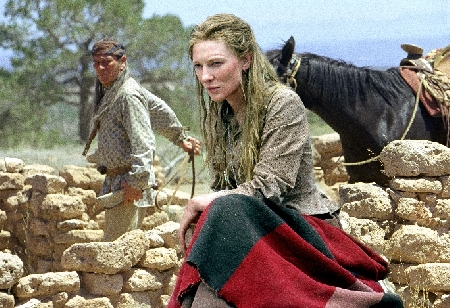
THE MISSING -- a classic kidnap-and-rescue thriller set in 1880s New Mexico, and the first film from Ron Howard since he won his Oscar for directing A Beautiful Mind -- is a fascinating attempt to interweave Christian and Native American faiths, while blurring, if not outright erasing, the line between religion and magic.
Cate Blanchett stars as Maggie Gilkeson, a 'healer' -- actually a sort of amateur doctor -- with two daughters whose Christian faith is often brought to the fore, from the psalms she instructs her children to read to soothe her patients, to the prayers she says and the cross she wears and her lover's (Aaron Eckhart) ardent defence of her good Christian virtues. (The fact that she sleeps with him, despite turning down his marriage proposals, is apparently no mark against her Christian character.)
One day Maggie receives a visit from her estranged father, Samuel Jones (Tommy Lee Jones), who she had given up for dead when he abandoned his white family and decided to live with the Indians. He, too, is frequently defined by his religious practices, but Maggie has no love for him, and his pagan ways give her just that much more reason to send him away.
But then Maggie's elder daughter, Lily (Thirteen's Evan Rachel Wood), is kidnapped by a gang of Indians led by a wicked shaman, who plans to sell Lily and several other girls into sexual slavery in Mexico; so Maggie sets her bitterness aside, as much as she can, and sets out with Samuel and her other daughter, Dot (Jenna Boyd), to find and rescue her.
The Missing is a well-crafted film, one of Howard's better efforts, and it wisely allows its characters to retain a degree of mystery; it hints at, but never quite spells out, the traumatic circumstances under which Maggie had her first child, and why their relationship is as strained as it is. The film's explicit treatment of religious themes also makes it a good conversation piece for viewers who want to explore the distinctions between medicine, miracle and magic, even if the film ultimately gives the upper hand to magic.
There is currently a fair bit of debate among anthropologists and religious scholars over where, how, and even whether such lines should be drawn. Some scholars say miracle and magic are both forms of supernatural power, and the only difference between them is that "miracle" and religion are what we do, whereas "magic" is what they do. Others say "miracle" involves humble submission to God, and a request for his intervention, whereas "magic" is like a more bizarre form of science, impersonal and essentially mechanical.
But the lines are not always as clear cut as such definitions imply. For one thing, in the film, the rituals Jones participates in take place within a context of prayerful submission to the Native American spirits. On the other hand, the Bible talks of Elisha cutting a stick and throwing it into the Jordan River to levitate an axhead that had fallen into it, without any indication that Elisha had called on God to do this; even after he died, Elisha's bones had the power to raise a man to life, more or less by accident (II Kings 6:1-7, 13:21).
Similarly, the New Testament talks about people being healed by touching the garments of Jesus (Mark 5:24-34) and by touching pieces of cloth that had merely been touched by Paul (Acts 19:11-12), without any indication that Jesus or Paul consciously assented to the specific acts of healing before they took place.
To the nominally objective, secular observer, the idea that supernatural power can reside within body parts and articles of clothing may seem indistinguishable from magic, and there are many Christians who would share this point of view if such claims appeared anywhere outside the Bible; indeed, the belief in relics is one of the things which separates Catholic and Orthodox believers from most Protestants. But we cannot deny that the concept is there at the earliest stages of Christian belief -- indeed, it is even earlier than Christianity, since it is there among the ancient Jewish prophets.
This may be one of those areas where historical Christianity is closer to pagan thought than it is to the modern, secular worldview that influences many Christians without their realizing it. The trick for us as believers, then, is to balance our honest skepticism -- especially given that many claims regarding miraculous events have turned out to be false -- with our belief that God continues to act in ways that boggle the unbelieving mind.
The central issue for Christians, of course, is Christ himself, and his lordship over this world. And it is here that The Missing falters. In its syncretistic vision, Christian and pagan spirituality must learn to work together, just as Maggie and her father must set aside their differences; and by the end of the film, there has been an exchange of symbolic jewelry -- Maggie wears her father's Apache necklace to ward off a curse, while he wears her cross.
The link between paganism and Christianity is made most explicit in one scene in which a healing ceremony is performed on Maggie while Dot stands off to the side, reciting the "begats" at the beginning of Matthew's gospel. It is not clear whether the recitation is merely meant to soothe Maggie emotionally, the way Maggie earlier told Dot to recite the Psalms while one of her patients waited for her, or whether it is meant to have supernatural power in and of itself; what is clear is that it is the Native healing ceremony that dominates the scene and sets the context within which the Bible verses are read.
In the end, The Missing portrays Christianity as something that, at best, supports the efforts of doctors and shamans as they go about their work, but it never takes centre stage. The Apache necklace actually wards off curses, but the Christian cross is just a family heirloom, albeit one that means a lot to the family in question. Early on in the film, one character refers to how Maggie gives people the "doctorin'" they need. For a moment I thought he said "doctrine", but no, there's very little of that here.
Internet Movie Database | Movie Review Query Engine
USA: R | BC: PG | ON: 14A